COVID-19 poses much greater hazards than influenza: Singapore Health Minister
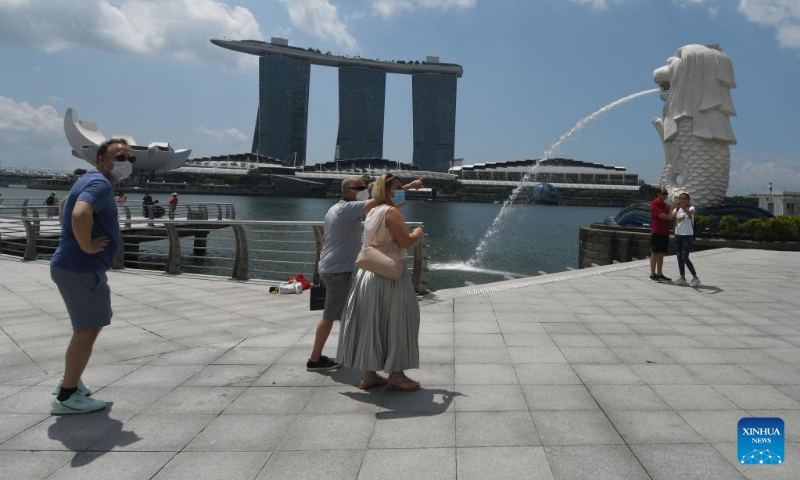
Tourists wearing face masks visit the Merlion Park in Singapore on March 24, 2022. Photo: Xinhua
COVID-19 actually poses much greater hazards than influenza, Singapore's Health Minister Ong Ye Kung stressed during discussions on what the government took into consideration when working out strategies and making policies to combat the epidemic.
Ong made the remarks during the ongoing Boao Forum For Asia annual conference held from April 20 to 22 at Boao, South China's Hainan Province. He noted that the most important condition for convincing Singaporean residents to co-exist with the virus is the high vaccination rate.
According to Ong, Singapore's decisions on policies in combating the epidemic are based on science, but they also go beyond science, to consider not only public health but also economic and social conditions.
It is very difficult for any government to make decisions, and many countries have to balance the demands between saving lives and securing livelihoods, Ong said.
"In Singapore, the majority of the residents have been vaccinated, so we have some confidence that we can divert away from 'zero-COVID policy'," Ong said.
Singapore has gradually loosened its epidemic prevention measures since March 29, but maintains the mask mandate for indoors and other measures such as not allowing unvaccinated people to dine at restaurants.
According to The Straits Times, 93 percent of Singaporeans have been inoculated with at least one dose of a vaccine and 96 percent of its population who are eligible to be vaccinated have completed their vaccination program. In addition, 73 percent have taken the third booster jab, Ong said, stressing that an important condition for Singapore to start co-existing with the virus is a high vaccination rate.
Over the past four weeks, 128,000 people have been infected with the virus, of whom 99.7 percent are asymptomatic carriers. The case fatality rate is around 0.03 percent.
"It is fortunate that Singapore's fatality rate is still relatively low compared to the rest of the world," Wang said.
When society gradually opens, there will also be a shift in the government's focus, ensuring that the medical system has sufficient capacity to treat the most severe cases that may appear.
At present, Singapore is working hard to protect its medical and healthcare system, and is paying close attention to the development of the epidemic, while being ready to make policy adjustments at any time.
RELATED ARTICLES

