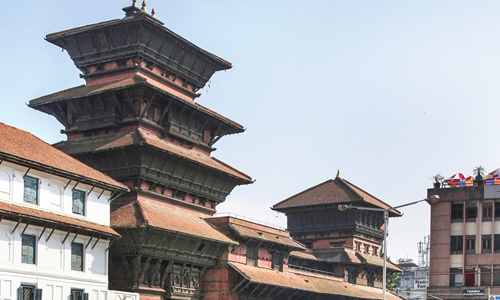
A view of the Kathmandu Durbar Square Photo: IC
Despite the COVID-19 pandemic, the restoration of the quake-hit nine-story Basantapur Palace complex in Nepal has been completed with Chinese aid after nearly five years of hard work.
The Chinese government and the experts have been able to "erect this monument with its original authenticity, integrity as well as its outstanding universal value," Damodar Gautam, director general of Nepal's Department of Archaeology, said on Friday.
The complex, which lies at the heart of the Kathmandu Durbar Square, a world cultural heritage site in the Nepali capital, was badly damaged in the massive 2015 earthquakes.
The top three stories of the Basantapur Palace, situated in the southwest corner of the complex, totally collapsed, while part of the Bhaktapur Tower in the northeast corner collapsed as well, and some 80 percent of the complex walls suffered varying degrees of deformation and cracking, with over 10,000 wooden components damaged and scattered.
In the aftermath of the tremors, both the Chinese government and the Nepali government agreed to launch a project aimed at restoring the nine-story Basantapur Palace complex. The project officially kicked off in August 2017.
According to the Chinese Academy of Cultural Heritage, which has been undertaking the restoration project, post-quake recovery for the complex was pressing, challenging, risky and hard for the team, as the damaged parts of the complex would suffer less loss if the project could move ahead as quickly as possible.
In addition, the fact the complex remained open to visitors challenged the team as they had to ensure the safety of both tourists and the project. Some 200 people were involved in the reconstruction during the project's peak.
Gautam noted that the Chinese experts always consulted with the Nepali side about how to preserve the complex's traditional value, design and originality so that "the outstanding universal values of the world heritage site could be maintained."
"They were very cautious about maintaining the authenticity, integrity and value of the world heritage site," he added.
For chief engineer Zhou Jianguo and the team, they had insufficient historical references to work on at the very beginning, especially for the collapsed parts. They had to visit veteran craftsmen and collect old photos in their efforts to restore the historical traces of the complex.
The team moved to reinforce the structures by means of a so-called reversible soft connection, which enabled them to achieve a minimal disturbance but preserve the complex's originality to the most possible extent.
The Chinese team has successfully applied for a patent for the innovative technology in China.
In addition, as the complex had numerous fine and exquisite wooden structures and sculptures, the team used as many original components as possible and all the damaged carvings in the elaborate windows were restored.
About 85 percent of the old wooden components were repaired during the project, while around 3,700 pieces of wooden components were newly built as supplementary parts for the restoration project, accounting for 15 percent of the total wooden components used.
Nepali sculptor Manhari Maharjan said he felt "fortunate" to work with the Chinese team.
"We could learn a lot from the Chinese team as they identified the carvings of designs that we had not seen earlier," he said.
"If a window needed to be repaired, the Chinese team examined the window very well and invited us to discuss with them about whether something was missing."
"They asked us to compare the available window with pictures of the original window so they could make the same window," he added.
"We sketched the missing parts based on pictures of the original window and helped to create a window like the original one."
The restored palace complex looks "very beautiful" and "historical," said one Nepali tourist who had arrived well before opening time.
Xinhua
RELATED ARTICLES