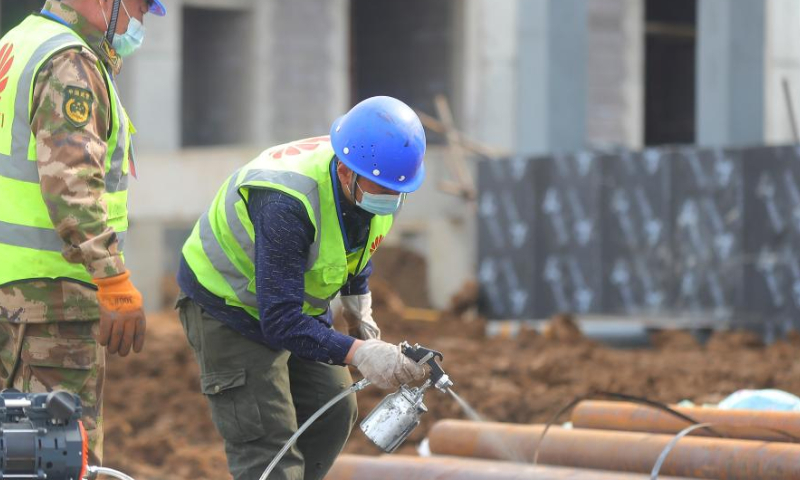
People work on the construction site of an artificial intelligence center in Shenyang, northeast China's Liaoning Province, April 29, 2022. Despite the challenges from COVID-19 pandemic, Liaoning has been strengthening infrastructure construction and speeding up the construction of major projects this year. (Xinhua/Yang Qing)
China's Finance Ministry on Tuesday vowed to meticulously implement a proactive fiscal policy, beef up fiscal capacity for major strategic tasks and resolutely ensure and improve people's livelihoods in the second half, as part of efforts to stabilize employment and prices to keep economic operations within a reasonable range.
Major infrastructure projects planned for the 14th Five-Year Plan (2021-25) could be the focus of increased fiscal spending to shore up economic growth, a veteran macroeconomist said, and a larger fiscal deficit could be on the cards.
In its first-half fiscal policy implementation report on Tuesday, the Ministry of Finance (MOF) pledged to continue implementing preferential tax and fee policies and oversee the local rollout of ramped-up policy support in the second half of the year.
The MOF envisioned an enhanced link-up between fiscal and monetary policies, and it endorsed the availability of policy-based and development financial instruments to boost effective investment and employment as well as spur consumption.
Such financial instruments would help ease the pressure on local governments to honor expansionary fiscal promises amid the fallout on growth from sporadic Omicron outbreaks and a declining property sector, among other issues, Tian Yun, former vice director of the Beijing Economic Operation Association, told the Global Times on Tuesday.
Instead of being categorized as fiscal deficit items, these instruments were tallied in the central bank's balance sheet as policy banks trade their obligatory rights in project development for the extension of liquidity from the central bank, Tian explained.
As part of 19 policies unveiled last week, touted as policy package 2.0 in addition to the 33-measure list of pro-stabilization policies in late May, the central government announced an additional 300 billion yuan ($43.48 billion) in policy-based and development financial instruments.
That's in addition to the previously planned 300 billion yuan allocated to specific projects.
Major infrastructure projects set for the current five-year plan, including underground utility tunnels, railroads and highways, as well as water conservation and power capacity, could be the focus of increased fiscal spending, Tian said.
Among the second-half policy priorities is increased fiscal support for major strategic undertakings such as key "chokehold" technologies, food and energy security.
Furthermore, the finance ministry called for an active response to the epidemic, disasters and heat waves, among other issues weighing on people's livelihoods.
The policy objectives come amid multiple challenges.
The MOF's Tuesday report enumerated numbers that spoke to the country's robust fiscal muscle.
New tax refunds and cuts and fee reductions totaled 507.4 billion yuan in the first half, and 1.85 trillion yuan of taxes had been refunded, lifting market confidence and pushing the economy's stable and healthy development, read the report.
Special-purpose bonds issued in the first half supported 23,800 projects, including about 10,800 already being built and 13,000 new ones.
It's likely that the 2023 special-purpose bond quota could be brought forward to the end of October or early November, economists at the Zhixin Investment Research Institute said in a research report sent to the Global Times on Tuesday.
This year's special-purpose bond quota has almost been used up. The National People's Congress approved 3.65 trillion yuan in special-purpose local bonds for 2022. But just in the first six months, the issuance of new special-purpose bonds amounted to 3.41 trillion yuan, the MOF said.
Fiscal funds directly channeled by the central government hit around 4 trillion yuan, up about 1.2 trillion yuan from the year before, according to the ministry.
The central government transferred 3.99 trillion yuan, or 97.9 percent of the 4 trillion yuan, in the first half.
Local governments allocated 3.63 trillion, or 90.8 percent of the central government's transferred amount, to the financed entities.
Still, Tian said, a larger fiscal deficit might be considered to give a shot in the arm for the economy for the remainder of the year.
The country set its deficit-to-GDP ratio at over 3.6 percent in the pandemic-hit 2020. The ratio trended downward to 3.1 percent in 2021 before declining further to around 2.8 percent this year.
Local government debt issues reached 1.93 trillion yuan in June, official data showed, the highest monthly reading on record.
If this pace continues, the actual deficit-to-GDP ratio will likely top 3 percent this year, Tian estimated.
RELATED ARTICLES