SOURCE / PRESS RELEASE
Four-time CIIE exhibitor Tapestry promotes digital transformation as a new path to Chinese market
The 5th China International Import Expo (CIIE) was held in Shanghai from November 5 to 10, 2022. Tapestry has participated in the expo for four consecutive years. The company has three luxury brands, COACH, Kate Spade and Stuart Weitzman, all household names in China.
The reason for Tapestry's continuous participation in CIIE is not hard to identify. In 2020, the personal luxury goods market fell by 23 percent due to the COVID-19 pandemic. However, China's domestic luxury sales rose by 48 percent in 2020 and 36 percent in 2021. According to China Luxury Market Report 2021 released by the global management consulting firm Bain & Company, China is expected to become the world's largest luxury market by 2025.
The rapid growth of luxury consumption can't be explained simply by China's economic development. Changes in policies, customer base and marketing have profoundly affected the strategies of luxury brands in recent years. For example, in 2018, China's State Council approved the establishment of the China (Hainan) Pilot Free Trade Zone. The sales of duty-free shops in Hainan soared by 120 percent in 2020 and increased by 85 percent in 2021, of which personal luxury goods accounted for 95 percent
On April 19, 2022, Tapestry officially signed a strategic cooperation agreement with Hainan Provincial Bureau of International Economic Development and Haikou Integrated Free Trade Zone Management Committee to place the headquarters for its China travel retail business in Hainan Free Trade Port. Soon, many other brands followed Tapestry's footsteps.
Another reason for luxury brands' entry in China is innovation. Chinese luxury market is embarking on a path of digital marketing, ahead of the global average. In 2021, nearly 26 percent of the total retail sales in China were made online, while the global average digital buyer penetration rate is about 22 percent.
Customer-centric digital transformation
China's Generation Z has gradually become the most influential consumers of luxury goods. They have grown up in a digital world and are more comfortable with digital life. For brands to achieve sustainable growth, they must embrace digitalization and new consumer groups. Just as Ms. Joanne Crevoiserat, CEO of Tapestry, said, "We insist on being customer-centric, putting digital development first, and constantly enhancing our long-term connection with consumers."
Digital transformation of luxury brands focuses on creating customer experience with various digital platforms to enhance interactions, and forming a close integration of brand, image and consumer experience through the application of new technologies and methods. This requires brands to establish close partnerships with a large number of leading e-commerce and social media platforms.
In July 2022, Tapestry announced a strategic partnership with Tencent Smart Retail, to explore the WeClient customer service system, WeChat mini program, and omni-channel marketing. The company has also partnered JD.com and Tmall to develop digital collections, virtual fashion and digital stores. Ms. Crevoiserat noted that Tapestry also created connections with consumers on social media platforms such as Douyin, Red and Bilibili, adding that "our staff members are deeply involved, becoming our 'brand ambassadors' on social media platforms."
Future: holistic integrated retail
Although consumers have become more digitally focused globally, they still value the in-store experience inspired by the decoration, culture and characteristics when visiting to a luxury brick-and-mortar. Ms. Crevoiserat shared her view that "we see digital channels and in-store experience as a coexistence, not a binary choice. They complement each other, and the in-store experience is still important."
Tapestry has opened more than 350 stores in China, forming a complete marketing network in cities across the country. These days, Tapestry still holds frequent offline marketing activities, but with innovation. In July this year, COACH digital art fashion flagship store opened in Sanlitun, Beijing, with an interactive holographic screen in the background, where customers can engage in the virtual art and digital fashion.
Tapestry's attempt represents a new understanding of the digital operation mode in the luxury industry, that is, to build an all-scenario integrated retail mode, which goes beyond the previous form of marketing with display and exhibition, and adds digital interaction to realize the operation of customers. While trying to expand its business in China through an all-scenario mode, Tapestry also tries to promote digital experience from China to other markets, thus forming a positive feedback in the business cycle.
"We've learned a lot from the ongoing innovation practices in China and are promoting these experiences globally," Crevoiserat concluded.
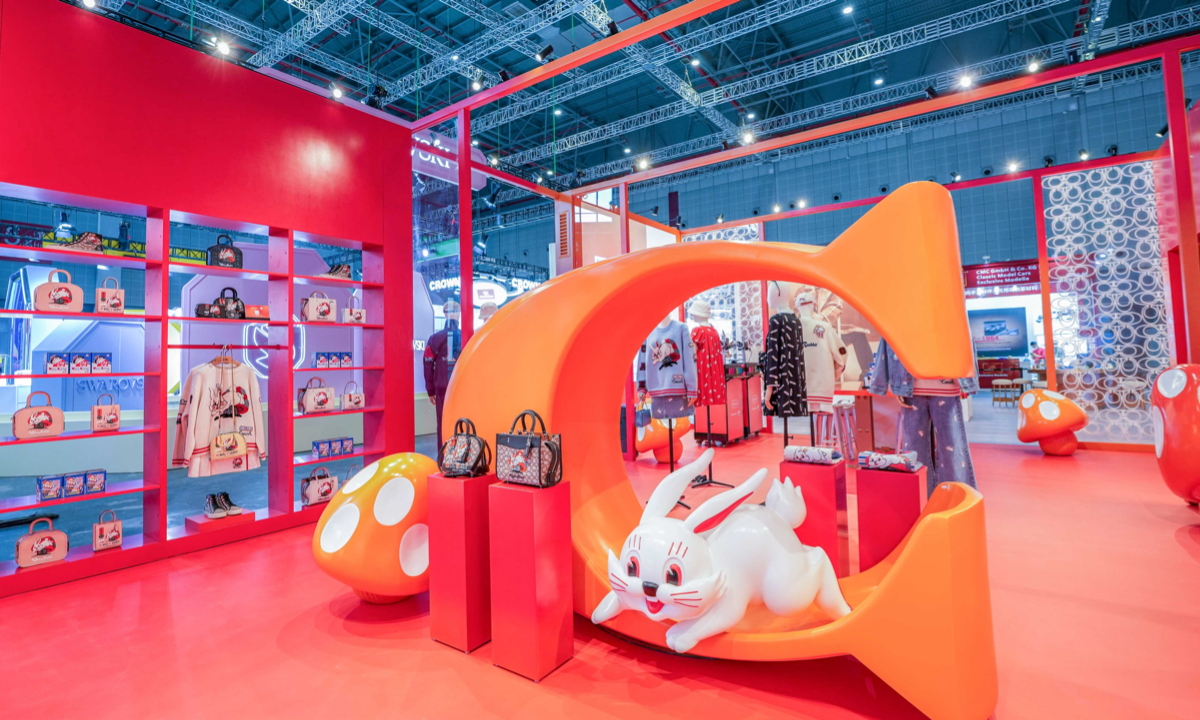
The Tapestry company's brand COACH was exhibited at the 5th China International Import Expo. Photo: Courtesy of Tapestry
International luxury brands started to actively participate in the CIIE in 2019. In 2021, world's top three luxury giants and six global luxury groups, including Tapestry, gathered in Shanghai, making CIIE a "family bucket" of global luxury brands.The reason for Tapestry's continuous participation in CIIE is not hard to identify. In 2020, the personal luxury goods market fell by 23 percent due to the COVID-19 pandemic. However, China's domestic luxury sales rose by 48 percent in 2020 and 36 percent in 2021. According to China Luxury Market Report 2021 released by the global management consulting firm Bain & Company, China is expected to become the world's largest luxury market by 2025.
The rapid growth of luxury consumption can't be explained simply by China's economic development. Changes in policies, customer base and marketing have profoundly affected the strategies of luxury brands in recent years. For example, in 2018, China's State Council approved the establishment of the China (Hainan) Pilot Free Trade Zone. The sales of duty-free shops in Hainan soared by 120 percent in 2020 and increased by 85 percent in 2021, of which personal luxury goods accounted for 95 percent
On April 19, 2022, Tapestry officially signed a strategic cooperation agreement with Hainan Provincial Bureau of International Economic Development and Haikou Integrated Free Trade Zone Management Committee to place the headquarters for its China travel retail business in Hainan Free Trade Port. Soon, many other brands followed Tapestry's footsteps.
Another reason for luxury brands' entry in China is innovation. Chinese luxury market is embarking on a path of digital marketing, ahead of the global average. In 2021, nearly 26 percent of the total retail sales in China were made online, while the global average digital buyer penetration rate is about 22 percent.
Customer-centric digital transformation
China's Generation Z has gradually become the most influential consumers of luxury goods. They have grown up in a digital world and are more comfortable with digital life. For brands to achieve sustainable growth, they must embrace digitalization and new consumer groups. Just as Ms. Joanne Crevoiserat, CEO of Tapestry, said, "We insist on being customer-centric, putting digital development first, and constantly enhancing our long-term connection with consumers."
Digital transformation of luxury brands focuses on creating customer experience with various digital platforms to enhance interactions, and forming a close integration of brand, image and consumer experience through the application of new technologies and methods. This requires brands to establish close partnerships with a large number of leading e-commerce and social media platforms.
In July 2022, Tapestry announced a strategic partnership with Tencent Smart Retail, to explore the WeClient customer service system, WeChat mini program, and omni-channel marketing. The company has also partnered JD.com and Tmall to develop digital collections, virtual fashion and digital stores. Ms. Crevoiserat noted that Tapestry also created connections with consumers on social media platforms such as Douyin, Red and Bilibili, adding that "our staff members are deeply involved, becoming our 'brand ambassadors' on social media platforms."
Future: holistic integrated retail
Although consumers have become more digitally focused globally, they still value the in-store experience inspired by the decoration, culture and characteristics when visiting to a luxury brick-and-mortar. Ms. Crevoiserat shared her view that "we see digital channels and in-store experience as a coexistence, not a binary choice. They complement each other, and the in-store experience is still important."
Tapestry has opened more than 350 stores in China, forming a complete marketing network in cities across the country. These days, Tapestry still holds frequent offline marketing activities, but with innovation. In July this year, COACH digital art fashion flagship store opened in Sanlitun, Beijing, with an interactive holographic screen in the background, where customers can engage in the virtual art and digital fashion.
Tapestry's attempt represents a new understanding of the digital operation mode in the luxury industry, that is, to build an all-scenario integrated retail mode, which goes beyond the previous form of marketing with display and exhibition, and adds digital interaction to realize the operation of customers. While trying to expand its business in China through an all-scenario mode, Tapestry also tries to promote digital experience from China to other markets, thus forming a positive feedback in the business cycle.
"We've learned a lot from the ongoing innovation practices in China and are promoting these experiences globally," Crevoiserat concluded.
RELATED ARTICLES