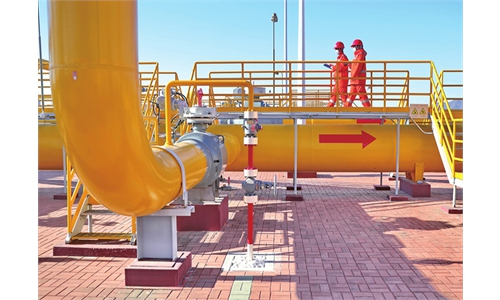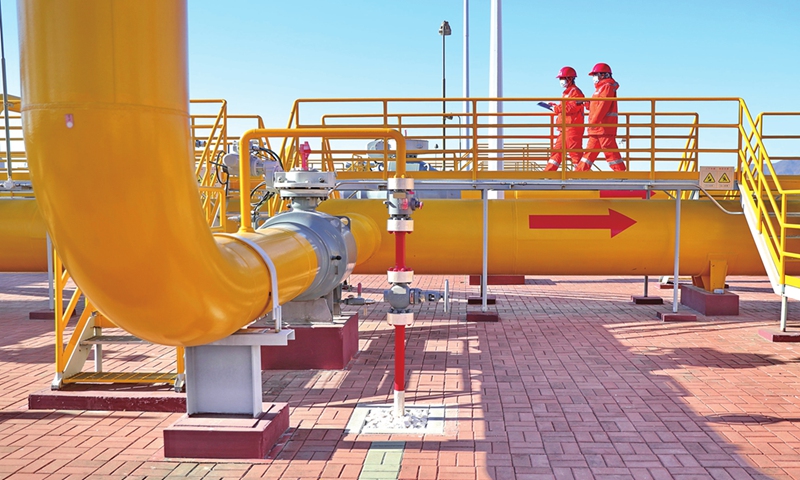
Staff members from PipeChina conduct a daily inspection of the China-Russia east-route natural gas pipeline in Qinhuangdao, North China's Hebei Province on November 1, 2022, aiming to strengthen inspections of the route and ensure the daily consumption of gas for households in the Beijing-Hebei-Tianjin region of North China. Photo: VCG
The newest phase of the China-Russia east-route natural gas pipeline between Tai'an city, Shandong Province, and Taixing city, Jiangsu Province, entered operation on Wednesday, channeling natural gas from Siberia to the Yangtze River Delta, one of China's most populous regions, CCTV reported.
Wang Chunlin, manager of the Tai'an-Taixing construction sector, said the daily volume of the phase will rise to 50 million cubic meters after it's connected to the China-Russia natural gas pipeline, from 30 million cubic meters currently sourced from offshore gas fields.
The pipeline of the section crosses populous regions with rivers, highways and aquaculture facilities, and the construction team used shield tunneling and other techniques to reduce the damage to the surrounding environment, said the report.
With a total length of 5,111 kilometers, the China-Russia east-route natural gas pipeline starts in Heihe city in Northeast China's Heilongjiang Province, crossing nine provinces and autonomous regions before connecting to Shanghai. Of the stretch, 3,371 kilometers of the pipeline have been newly built, with enough steel to build 280 Eiffel Towers.
The China-Russia east-route natural gas pipeline has China's largest caliber of 1,422 millimeters, and maximum pressure of 12 mega-Pascal, so that 1 meter of pipeline can transmit 250 cubic meters, meeting one year of consumption for a meet the one year demands for a three-member-family.
The designed annual natural gas transmission volume of the pipeline is 38 billion cubic meters. By 2025, the volume of channeled natural gas will meet the demand of 130 million households in Heilongjiang, Jilin and Liaoning provinces, as well as Beijing, Tianjin and North China's Hebei Province and the Yangtze River Delta, according to the report.
The natural gas to be sent by the pipeline will mean 164 million tons less carbon dioxide emissions, further accelerating China's green push.
RELATED ARTICLES