GT Yearender: China stands firm against relentless US crackdown in 2022
Curbs inspire industry's determination to move forward, seek breakthroughs
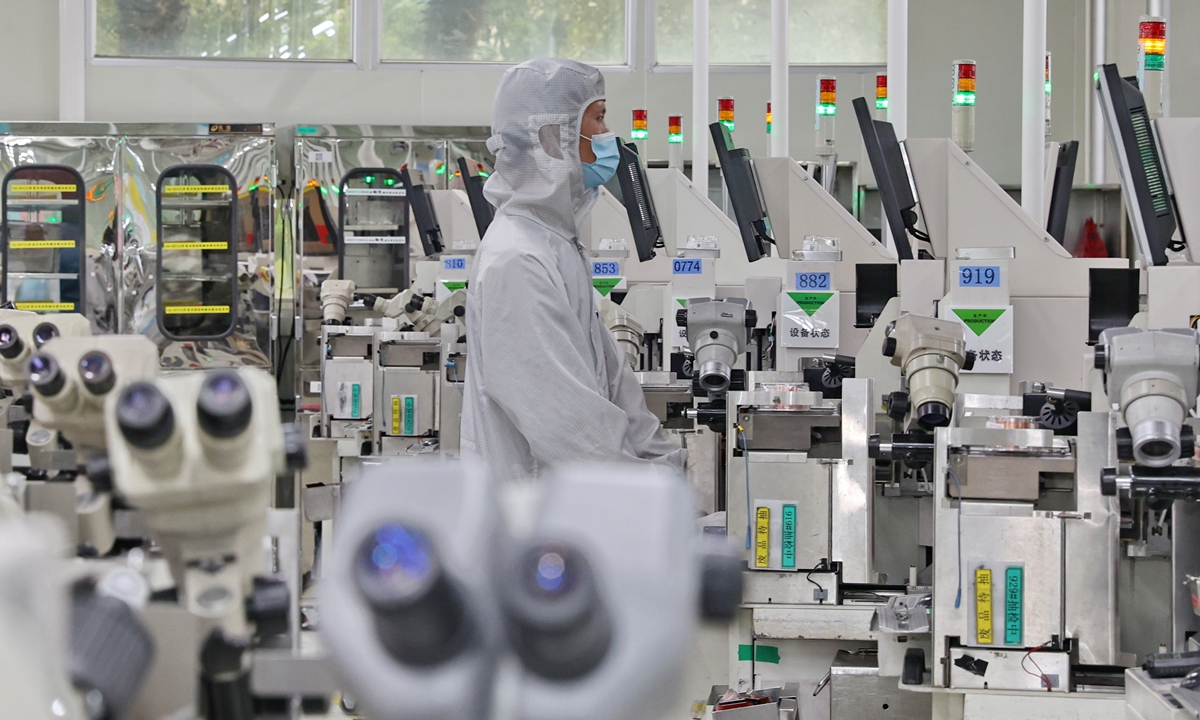
A worker checks integrated circuit prodcut at a manufacturing facotry in Nantong, East China's Jiangsu Province on September 16, 2022. Photo: VCG
As if the world isn't facing enough crises from food to energy to economy, 2022 was also marked another year of relentless US unilateralism and protectionism, with a dizzying number of crackdown measures that seriously disrupted global supply chains from energy products to chips.
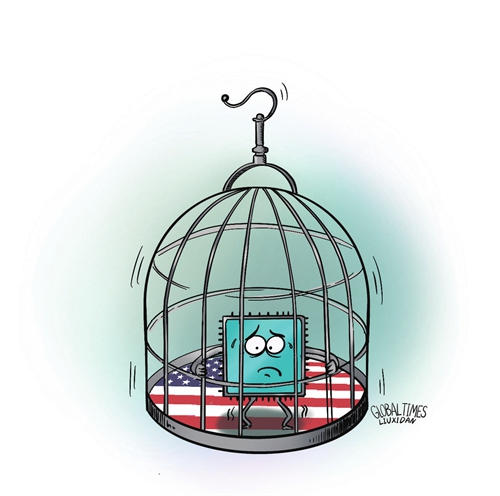
Among Washington's malign economic and trade behavior, the harshest crackdowns were aimed at containing China's rise. In October, Washington fired a final shot to impede China's efforts to develop high-end semiconductors, announced some of the broadest and harshest export controls yet - requiring licenses for firms exporting chips to China using US-originated tools or software, no matter where they're made in the world, no matter which country they come from.
However, China took a series of direct and indirect measures to beat back Washington's economic and trade aggressions, including filing and winning suits against the US at the WTO and bolstering its domestic industries to counter the US measures head on. All in all, over the past year, though the US measures impact a series of industries, China stands firm and continues to emerge stronger in a wide range of areas.
Beating back trade aggression
In terms of chips, following the US bans and associated sanctions, China has laid out a series of moves, formulating an omnidirectional counterattack using its strong ecosystem of domestic industry players, and is walking more firmly on a path to achieve breakthroughs in the sector.
Globally, China launched a trade dispute at the World Trade Organization against the US over its chip export control measures - a move seeking to address Chinese concerns through legal means, and a necessary way to defend China's legitimate interests, China's Ministry of Commerce said in a statement on December 12.
Domestically, China is reportedly working on a more than one trillion yuan ($143 billion) support package for its semiconductor industry, Reuters reported on December 14, citing three sources.
The package, allocated over five years and will mainly serve to bolster semiconductor production and research activities at home, will be one of China's "biggest fiscal incentive packages."
Those moves send a very clear signal - uncertainties are mounting, but one thing is for sure - nothing will hold back China's fight on advancing in chip technology and tech development. Though the fight will be arduous and last long, Ma Jihua, a veteran industry analyst and a close follower of China's chip industry, told the Global Times on Tuesday.
The determination of developing science and technology was also particularity stressed at the 20th National Congress of the Communist Party of China (CPC), a key meeting that outlined China's development vision for the next decade.
Among the 15 sections of the 20th CPC National Congress report, five of them incorporate technology, including sections on the Party's new missions, economic development, science and technology and education strategy, domestic security, and military and defense.
Chips, which are used to power supercomputers and artificial intelligence, are the vital for the whole tech industry and internet of things era, who also serve as a critical battlefield for the US to maintain supremacy in the global tech frontier.
As China's chip industry is developing rapidly and has now reached a critical point in which breakthroughs in core technologies are likely to be achieved soon, US bans have dealt a heavy blow and slowed down existing projects, a Beijing-based researcher who worked at a semiconductor firm, told the Global Times on Tuesday.
"We can feel the impact already along the whole industrial chain; some fabricators are unable to buy equipment, and the designs of some advanced process nodes of some chip design companies are also affected by the restrictions," said the researcher, who asked not to be named.
Data released by Chinese customs on December 21 showed that China imported $2.3 billion worth of chip manufacturing equipment in November, a year-on-year decrease of more than 40 percent, the highest since May 2020.
After the US intensified its ban, any progress in the advanced process - 14 nanometer or above - would be hard to make breakthrough in the short term if US maintains its curbs, Han Xiaomin, general manager of Jiwei Insights in Beijing, told the Global Times on Tuesday, warning about "relatively" long period before catching up.
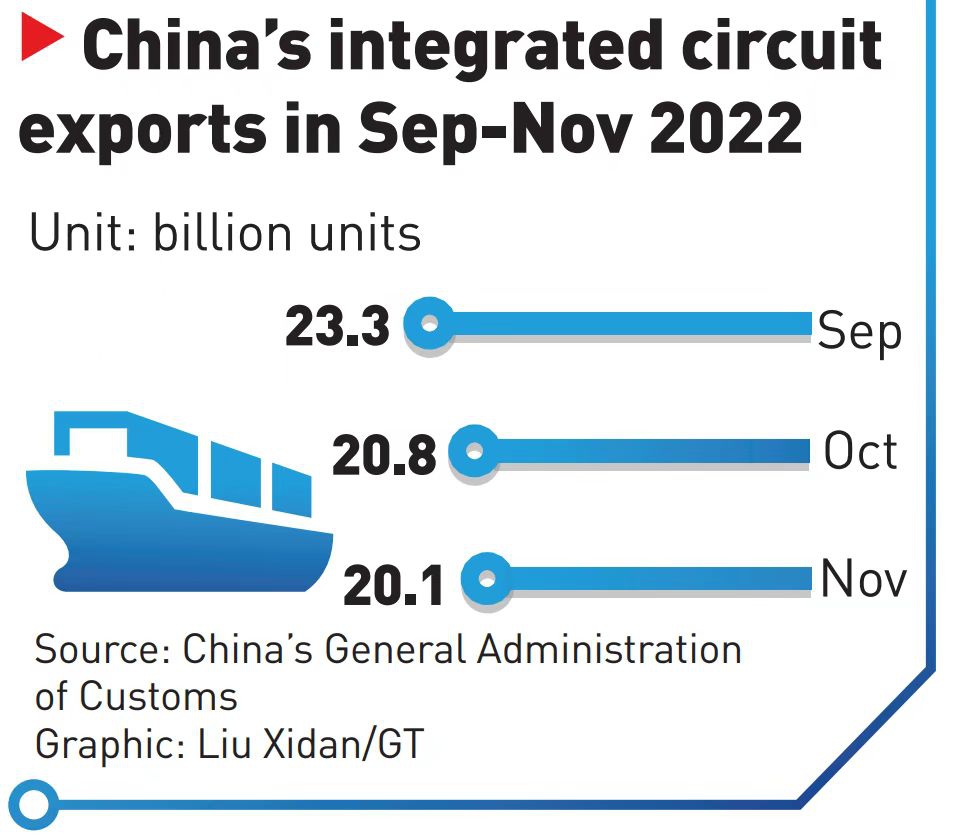
Graphic: Liu Xidan
Focus on self-reliance
But on the positive side, "the whole industry has achieved a highly consistent and precious consensus in developing a localized, self-reliant ecosystem, which in turn is facilitating wider use of domestic processors and inspiring innovation," another Shanghai-based industry player, who is engaged in chip design work, told the Global Times.
This also created a sense of crisis among downstream users of chips, making them look for secure supply chains less reliant on US chip technologies and products, thus opening up more opportunities for Chinese chip designers, the industry player said.
In his eyes, the consensus will offer a "golden period" for some small industry players, who may have good products, but lack advantages when competing with global giants of the industry.
Data from the China Semiconductor Industry Association (CSIA) showed on Monday that the Chinese chip design sector's sales revenue this year is expected to reach 534.57 billion yuan, up 16.5 percent year-on-year,
Defying the impact of US chips ban, Wei Shaojun, president of the integrated circuit design branch of the CSIA, said at an industry forum on Monday that China's chip design sector is likely to account for a bigger proportion of the global semiconductor sales.
Moreover, progress of localization in advanced chips has not been impeded under US restrictions.
Chinese researchers have developed the country's first Data Processing Unit (DPU) chip, known as the "third main chip" after Central Processing Unit (CPU) and Graphics Processing Unit (GPU), a report from the Xinhua News Agency stated on December 23.
Heterogeneous computing based on the combination of DPU, CPU and GPU has become the mainstream technology of the next-generation intelligent computing centers.
The DPU chip was developed by Beijing-based YUSUR Technology Co, using a 28 nanometer (nm) process. It has the advantages of low cost, excellent performance and low power consumption, and can achieve ultra-low latency of 1.2 microseconds and support up to 200G network bandwidth.
Limited support
Apparently realizing that its unilateral bans cannot contain China's progress, the US is now desperately bringing other key players in the semiconductor sector, including Japan and South Korea on board, in curbing China - and that intention is even more obvious in the October ban.
The October update means that "in addition to Chinese-funded enterprises, the extent of these restrictions stipulate foreign-owned production centers located in China will also need to apply for approval on a case-by-case basis in order to continue to obtain manufacturing-related equipment," TrendForce, a world-leading market intelligence provider, said in a statement it sent to the Global Times.
But Washington is now suffering pushback from global chip firms - who are already fretting over the US chip ban, warning about falling sales, shrinking investment plans and concerns for future operations - refusing to leave China under the US ban.
SK Hynix, a South Korean chip giant, told the Global Times in a statement that along with the South Korean government, it will continue its consultations with the US Department of Commerce and make the "utmost efforts" to operate its plants in China in a stable manner.
"The US cannot form so-called small groups to kick China out from the industrial chain at the moment, and it will never be able to do that in the future, since a curb on China means a loss for all except for the US," Ma said.
Moreover, South Korea and Japan, have both been at a similar position of China in the past and once been a victim of US' hegemony during their technological rise, Ma said.
What's more clear is that the technological war between China and the US in the semiconductor field is more than just a simple tech war, but an inevitable event reflecting deeper national competition, Han said.
"We may have to look beyond chips to solve the problems," Han said.
Ma agreed, predicting that a chip fight between China and the US will run through 2023 and even years to come. WTO lawsuit will be just the prelude, diplomacy and other economic means may already be brewing to tackle the problem.
"But the US' protectionism practice has already left trauma to the world - a halt of rapid development period of the tech industry, a slowdown in new investment, and a disrupted industrial chain," Ma said.
RELATED ARTICLES