Producers, pharmacies beef up supplies after cold-related drug sells out amid H1N1 outbreak
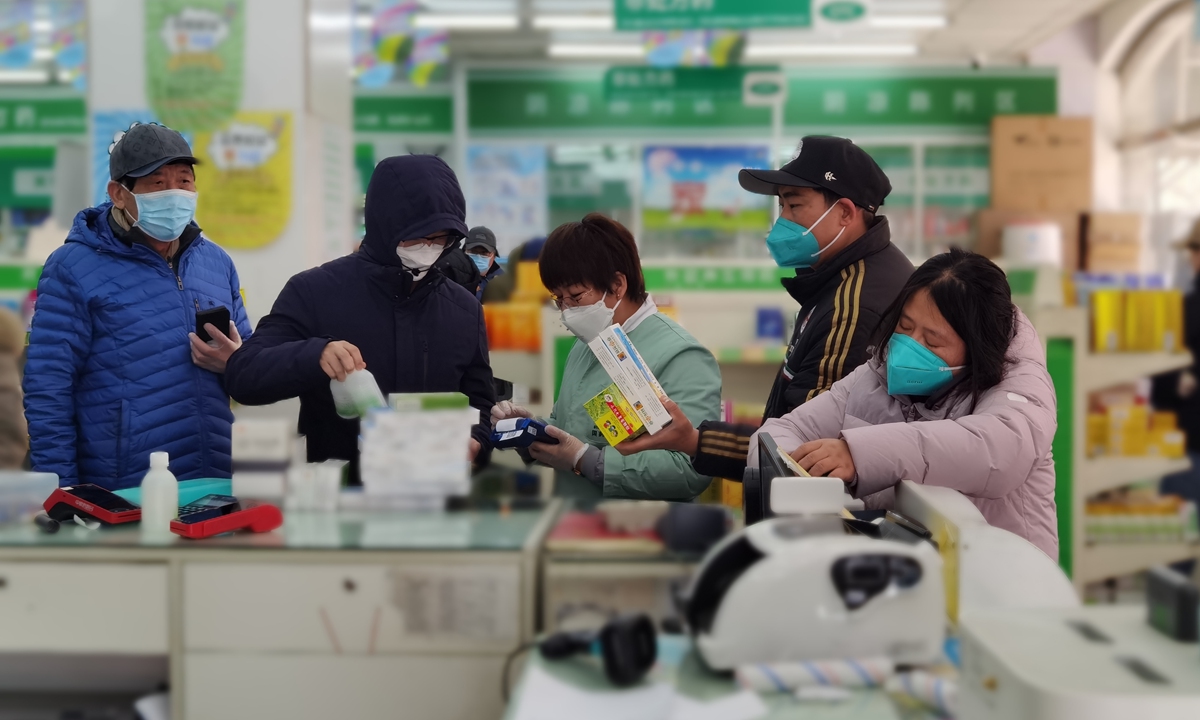
Customers purchase medical products in a pharmacy of Guoda Drugstore in Beijing. Photo: Courtesy of Sinopharm
Chinese producers and pharmacies are beefing up supplies after cold-related drugs such as oseltamivir were sold quickly in many parts of the country in the wake of the outbreak of H1N1, a seasonal flu that often comes in late winter and the beginning of spring.
Some schools suspended classes and hospitals were thronged with patients in several cities and provinces due to H1N1, a month after COVID-19 reached the infection peak in most parts of the country.
Several pharmacies in Beijing the Global Times reached on Monday said that oseltamivir was sold out and there is no timeframe when it may be back on shelves, given the rising demand.
An employee with a branch store of the Jinxiang Pharmacy in Chaoyang district, Beijing, said the drug for H1N1 sold out very quickly and it's not available at the moment.
Another staffer with a local pharmacy said on Monday that they are reaching out to dealers to put the drug back on the shelf as soon as possible.
The demand for the corresponding drug has also tightened the supplies at some local hospitals. A Beijing resident told the Global Times that his 3-year-old daughter was having a high fever and was later found to be infected with H1N1.
While oseltamivir was still available at hospitals, they have set a purchase limit per person for three days of consumption at a maximum, he said. Some hospitals are also thronged with patients facing the illness, the Global Times learned from local residents and insiders.
SL Pharm, a Beijing-based drug producer and one of the makers of oseltamivir, said that the company closely monitors the market demand and is flexible in adjusting production capacity in response to actual orders.
In responding to the hot demand for the drug, Feng Zijian, executive vice chairman of the Chinese Preventive Medicine Association and the former deputy director-general of the Chinese Center for Disease Control and Prevention, told the Global Times on Monday that oseltamivir supplies would not be high in stores' reserves, because it is rarely used in normal times, mainly to deal with H1N1.
"The dispatch can be accelerated according to the market's need," he said.
Influenza has overtaken COVID and become the most prevalent virus in Beijing as the positive rate of influenza across the country continued to rise in recent weeks.
The H1N1 type took up 71 percent of the total samples of influenza, ranking the highest by percentage, the China CDC Weekly report on influenza on February 23 showed.
The high infection rate has made H1N1-related topics reach the top search list on China's Twitter-like platform Sina Weibo, with 1 billion viewers and over 600,000 comments as of press time.
Many primary and secondary school students in Beijing, Shanghai, Zhejiang and Tianjin developed fever symptoms, and some schools were closed as the positive rate of influenza continued to rise, according to media reports.
In the past three years, the influenza infection rate was fairly low because of the strict epidemic responses and less travel and gathering among people, experts said.
Because the infection rate of influenza was low in the past three years, some people have not developed the corresponding immunity strong enough to cope with it, Feng said. Children are the most vulnerable group given their weak immunity.
"Although the H1N1 infection rate is rebounding, it is not as serious as some thought when it comes to the infection rate," which is still within an expected level, Feng said, adding that as a seasonal flu, it would disappear within weeks.
Speaking at a press conference of the Joint Prevention and Control Mechanism of the State Council on Monday, Guo Yanhong, director of the medical emergency department of the National Health Commission, said that recently, there have been clusters of seasonal infectious diseases such as influenza in many provinces, which has drawn public attention.
Guo said medical institutions at all levels across the country are urged to further strengthen pre-examination and triage, such as fever clinics and intestinal clinics. A certain amount of therapeutic drugs will also be provided.
RELATED ARTICLES