China hopes to work with EU to remove obstacles hindering Comprehensive Agreement on Investment: envoy
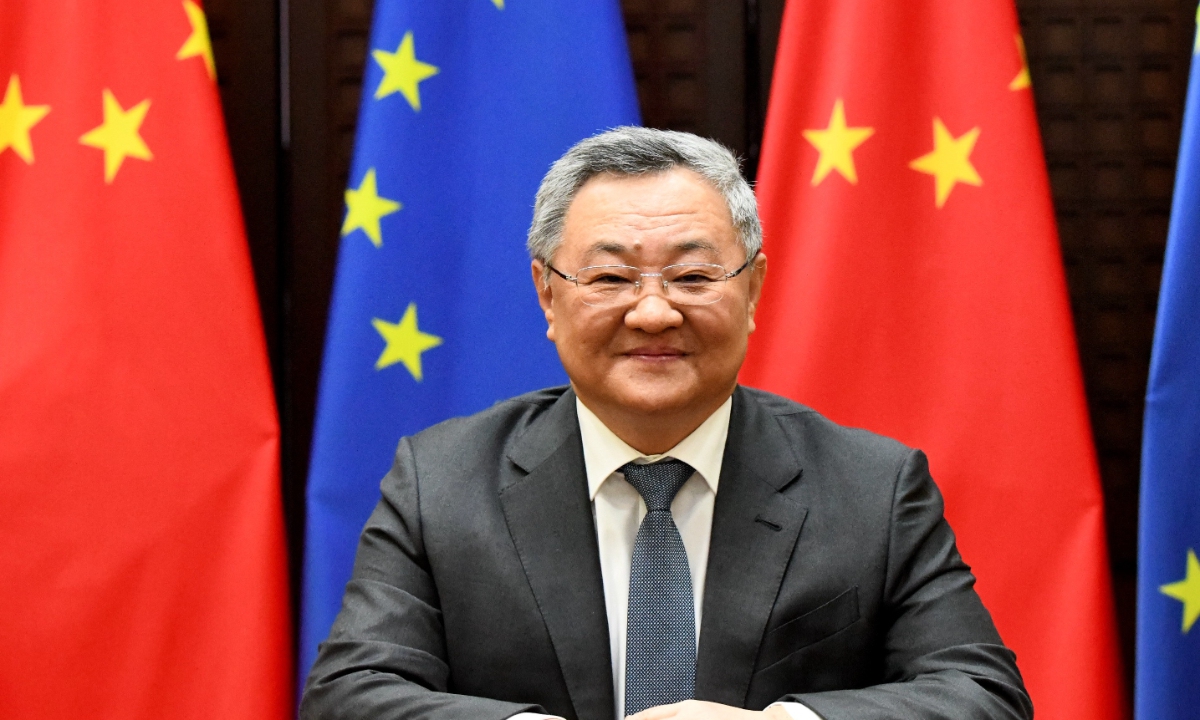
Ambassador Fu Cong, head of the Chinese Mission to the EU. Photo: Courtesy of Chinese Mission to the EU
China sincerely hopes to work with the EU to remove the obstacles restricting implementation of China-EU Comprehensive Agreement on Investment (CAI), a sweeping deal that has come to a standstill, a Chinese envoy to the EU said.
"We should look forward. I have proposed to my EU interlocutors to simultaneously lift the sanctions," Fu Cong, head of the Chinese mission to the EU, said during a recent interview with the Diplomatic World, which was posted on the official website of Mission of China to the EU.
"China is also open to other proposals from the EU. As long as the solution is based on equality and mutual benefit, China will consider it," Fu said.
The CAI, a balanced, high-level, and mutually beneficial agreement, was reached in late 2020 after 35 rounds of negotiations over seven years. Both sides have shown great flexibility in the negotiations and it will provide high-level market access to one another when it comes into effect.
For the first time, China has made market access commitments on all industries, offering the most comprehensive level of market access to date. It covers not only the manufacturing sector but also new energy, cloud computing, financial services, medical care, and other sectors.
The CAI would address many of the concerns that European business people may have about China, according to Fu. "I would say that it will greatly benefit both business communities and take our economic relations to a higher level," he noted.
Discussion on the deal were halted by the European Parliament in May 2021 after China countered the EU's sanctions placed on Chinese officials over Xinjiang.
"I can't guarantee that the CAI could be unfrozen during 2023. But from China's perspective, we sincerely hope to iron out the problems as soon as possible," Fu told the Global Times in an exclusive interview in early March.
The massive deal is still facing some political headwinds within the EU, despite its vast potential for generating economic benefits for both sides, experts said.
Cui Hongjian, director of the Department of European Studies at the China Institute of International Studies, told the Global Times that it is hard for the agreement to make breakthroughs within a short period to come, given the mounting pressures that the EU is imposing on Chinese firms and Chinese investment under the guise of "national security" concerns.
The EU has developed a toolkit of protectionist policies since 2022, which made it more difficult for foreign companies to invest in EU and participate in public procurement. The EU even interfered with supply chain cooperation between foreign companies and EU companies. As a result, investment opportunities for foreign-invested enterprises in the EU market have been reduced and uncertainties of localized operations have increased, according to a report issued by the academy of China's trade promotion agency on Wednesday.
RELATED ARTICLES