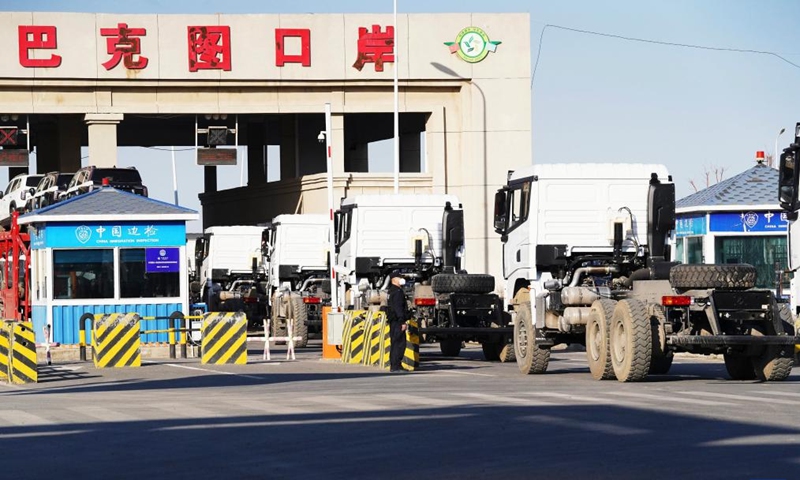
Outbound vehicles are seen at the Bakti port in Tacheng, northwest China's Xinjiang Uygur Autonomous Region, March 29, 2023. Located on the border of China and Kazakhstan, the exit and entry frontier inspection station of Bakti port has optimized clearance measures to improve the transportation efficiency since this year.(Photo: Xinhua)
Northwest China's Xinjiang Uygur Autonomous Region vowed in a recent key meeting to expand opening-up and deepen communication and cooperation with neighboring economies, especially with the five Central Asian countries, in order to develop the region into an Asia-Europe golden passage and a bridgehead for westward opening-up.
The just-concluded 8th plenary session of the 10th Party Committee of Xinjiang passed an action plan for promoting the high-quality development of Xinjiang from 2023-25 and a raft of measures to boost the growth of southern Xinjiang.
It proposed the establishment of an economic development belt surrounding Tarim basin to boost the development of southern Xinjiang, local media Xinjiang Daily reported.
Experts said that the more balanced development of Xinjiang will benefit itself and other economies in the region.
"Located at the heart of Eurasia, Xinjiang has unique geographic advantages of connecting Central and South Asian countries and other Chinese provinces, making it a key transportation, trade and logistics center in the Silk Road Economic Belt," Qian Feng, director of the research department at the National Strategy Institute at Tsinghua University, told the Global Times on Wednesday.
Xinjiang is expected to obtain more policy support from the central government, making it more accessible to regional resources and markets, Qian said, noting Xinjiang could expand cooperation with neighboring economies in infrastructure connection, agriculture, solar panel production and cross-border trade.
The meeting highlighted tasks related to southern Xinjiang development as a top priority for local government work.
The meeting also put forward a proposal to set up an economic development belt surrounding Tarim to accelerate economic development of southern Xinjiang, Zhang Hong, an associate research fellow at the Institute of Russian, Eastern European and Central Asian Studies of the Chinese Academy of Social Sciences, told the Global Times on Wednesday.
"This move shows that the local government of Xinjiang hopes to ride the tide of China-Central Asia cooperation to boost the development of southern Xinjiang through smooth infrastructure connections," Zhang said, noting that the China-Kyrgyzstan-Uzbekistan railroad link is expected to change the transportation pattern of Xinjiang and the whole of western China.
Since the optimization of China's COVID-19 epidemic response in December, local Xinjiang economy has staged a rapid recovery. Xinjiang's GDP grew by 4.9 percent year-on-year in the first quarter of the year.
In early May, Xinjiang rolled out measures to stimulate regional demand and achieve its annual target of 12 percent growth in retail sales, through tax and fee cuts and other incentives to boost car consumption and the deployment of charging stations.
RELATED ARTICLES