Illustration: Chen Xia/Global Times
The US Supreme Court issued a landmark ruling on Thursday in banning discrimination by race in college admissions at Harvard University and the University of North Carolina. The high-stakes legal ruling, which directly impacts the future of employment, incomes and socioeconomic status of the nation's young people, was welcomed by many as a measure to bolster racial equality, which is the bedrock of social norms in many countries.But the ruling has drawn fierce criticism from US President Joe Biden. In a statement, Biden assailed the court decision, saying that he continued to believe in the need for "diversity" in American colleges, with his undertone reading that black and Hispanic students deserve "special favorable treatment" to be enrolled in the country's elite institutions of higher learning.
Introduced in the 1960s, the so-called "affirmative action" policies were designed to boost the number of black and Hispanic students on American college campuses to increase racial and ethnic diversity in the domain of higher education. But in practice, in the past decade, many students of Asian origin have been put at a severe disadvantage, despite their consistent high performance on globally standardized metrics like exam scores, grades and coursework.
These affirmative action programs are designed to help black and Hispanic students gain easier access to higher education, but the policies are biased against Asian students, particularly those of Chinese origin.
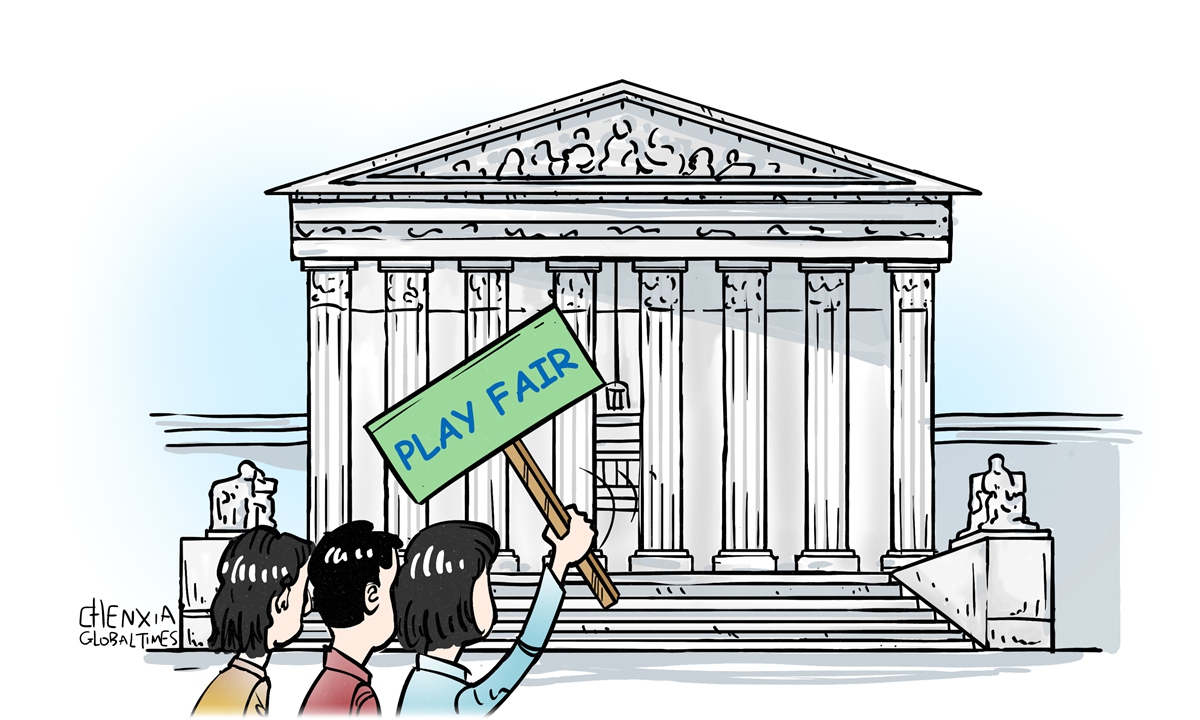
Therefore, a largely anonymous group of Asian diaspora who highly value children's education, acting as part of Students for Fair Admissions in the US, brought the complaint to the high court. The group has a membership of about 20,000 students and parents, who claim the affirmative action has actually encouraged and aggravated racial discrimination, according to media reports.
The US Supreme Court ruled that Harvard and the University of North Carolina's race-conscious admissions policy is "unconstitutional," noting university programs "must comply with strict scrutiny, may never use race as a stereotype or negative," which must come to an end. From now on, all American universities will be required to abide by this new ruling, and should no longer consider an applicant's race as a factor during the admissions process.
It is not difficult to assume the affirmative action policies are socially contentious and divisive, often leading to racial and ethnic disputes and confrontation. Many in the US render the policy as unhealthy and harmful. However, Biden was scathing, saying it came from "not a normal court" - a well-worn accusation from the executive branch against the court.
The truth behind Biden's disapproval is that he, facing the 2024 presidential reelection, aspires to curry favor with a big proportion of American constituency, the rapidly growing African and Latino American voters. Therefore it is all politics.
The anti-Asian bias in higher education is an open secret at many elite "Ivory Tower" institutions in the US. Not long ago, a report by Harvard's own researchers concluded that being Asian Americans were disadvantage in the US college admissions process. So it is high time to frankly and honestly discuss the pervasive anti-Asian prejudice in American higher education, as people's future careers and earnings are at stake.
And, the dispute on college admissions fully illustrates the troubled race relations in the US, this time placing the interests of the whites and Asians against the blacks and Latinos. Their dueling is drawing attention to the systemic problem of an increasingly polarized society.
In China, a student's score from the annual college entrance examinations is the only universal metric to determine whether a student can go to the best universities regardless of the student's family background. Many other countries have also observed the same set of principle in college admissions.
But, some in the US claim that reducing college admissions to a simple score of SAT or other tests overlooks the nuances and complexities of how race and inequality intersect in the US. They are stubbornly beholden to affirmative action and race-conscious college admissions, which they believe are necessary in addressing a history of racism and inequality.
A large majority of Asian Americans say that when prestigious colleges consider race and ethnicity in admissions decisions, it negatively affects fairness and student quality in enrollment. Amid the pandemic and the rising US-China tensions in recent years, Asians, especially Chinese, have been facing escalating anti-Asian racism in the US.
Increasingly, many students are forced to hide their Asian identity in the US college admissions. For an instance, a popular test-prep guide published by the Princeton Review, advises students of Asian descent to "conceal their racial identity," according to media reports. And, some consultants advocate the students to shift away from "classically Asian activities" like playing chess or learning the piano or other instruments in order to improve their chance of getting into elite universities.
Isn't it ridiculous and absurd that students of Asian origin are being prompted to appear "less Asian" or "less Chinese" on their college applications, along with the perception that Asian students must meet a higher bar than other racial groups in order to get into the same universities?
Following the latest supreme court ruling, a number of US media pundits predicted that American college admissions could become even more "subjective" and "opaque", as institutions would place less emphasis on test scores, and more emphasis on personal qualities, the application essay and the recommendations, the opposite of what many opponents of affirmative action had hoped for. In that case, the stereotypes placed on Asians will persist, and the bias and discrimination against them will only be amplified, ruining their hopes or dreams of achieving upward social mobility in the US.
The author is an editor with the Global Times. bizopinion@globaltimes.com.cn
RELATED ARTICLES