IN-DEPTH / IN-DEPTH
A simple, moderate, and green lifestyle, universal involvement keys to tackling climate change
Unfolding crisis

Eco Forum Global Guiyang 2023 concludes in Guiyang, Southwest China's Guizhou Province, on July 9, 2023. Photo: Courtesy of Eco Forum Global Guiyang
As the scorching heat of the summer continues to grip the world's northern hemisphere, relentless heatwaves have become an unwelcome norm, signaling a harsh wakeup call - the effects of climate change are no longer a distant future, but a blistering reality.
With record-breaking temperatures not seen in 100,000 years in conjunction with extreme weather events, and their far-reaching effects, the world finds itself at a critical juncture, where urgent action is imperative to confront the unfolding climate crisis.
At the just-concluded Eco Forum Global Guiyang 2023 hosted in Guiyang, Southwest China's Guizhou Province, chief scientist at the National Climate Center Sun Ying pointed out that research conducted has confirmed that extreme weather events in the future will become more frequent and last longer. In the future, high temperatures will become the new norm.
"Currently, there is a consensus among the international and the scientific communities that human activities are the primary driving force behind global warming," she said.
To tackle climate change, China has actively shouldered its responsibility in seeking green and low-carbon development and the preservation of ecology. It has also cooperated with other countries in promoting green development including highly prioritizing investment in green energy.
"The Law on Foreign Relations of the People's Republic of China" was recently passed, Article 25 of which states that China "plays an active part in global environmental and climate governance and endeavors to strengthen international cooperation in green and low-carbon development; it is committed to jointly enhancing global ecological conservation and building a global system of environmental and climate governance that is fair, equitable, cooperative, and beneficial to all."
"China has become a model for the world in climate change governance," noted Colombian Ambassador to China Sergio Cabrera Cárdenas.
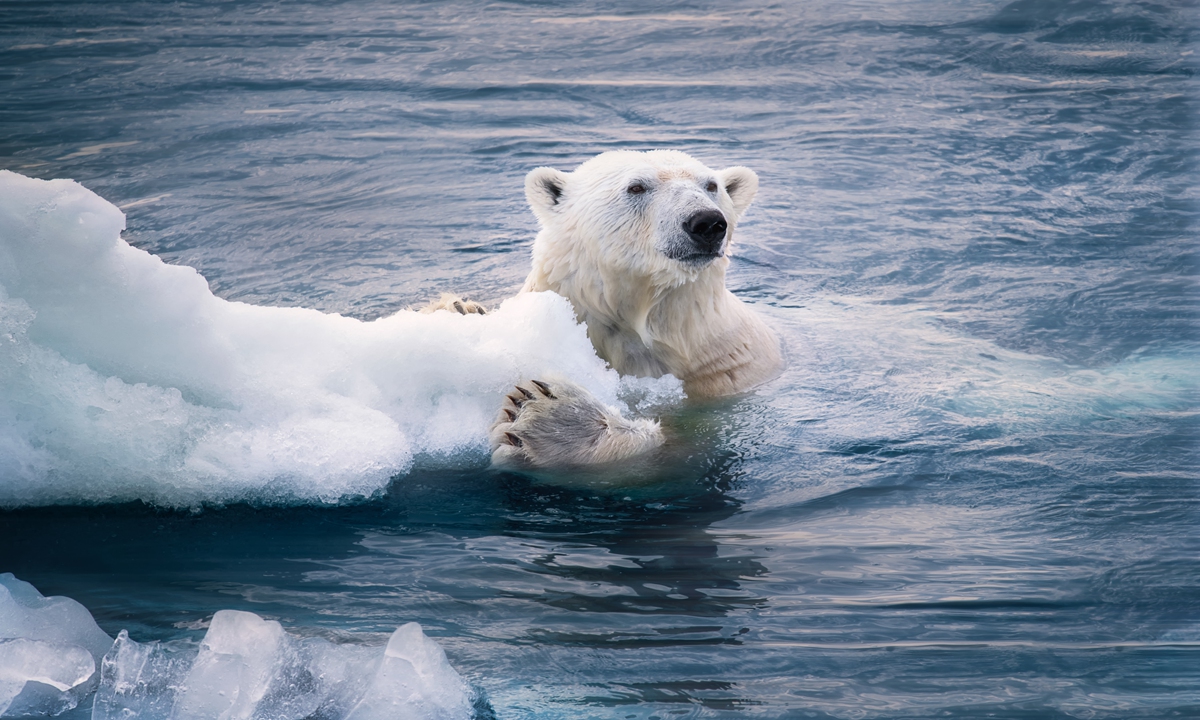
A lonely polar bear swims among melting glaciers. Photo: VCG
Harsh reality
China's warming rate is higher than the global average, and the frequency of extreme heat events is significantly increasing, the Blue Book on Climate Change in China (2023) noted, which was issued on Saturday during the Eco Forum Global Guiyang 2023.
A total of 3,501 extreme heat events were recorded in 2022, the most frequent since 1961. Among them, 366 events in Southwest China's Chongqing Municipality, Central China's Hubei Province, and other regions saw temperatures surpassing historical records.
Other parts of the world are also grappling with unusual high temperatures. The US National Weather Service said that at one point, more than 120 million Americans - meaning more than one in three of its total population - were under some kind of heat advisory, read a BBC report.
In the UK, the temperature was 0.9 C higher than the previous high record in June set back in 1940, read the report. Other regions including the Middle East and North Africa also experienced unprecedented heatwaves.
"We can understand the general trend. In the future, it is certain that high temperatures will become the new normal. However, the specific extent and locations to which this normalization will occur are matters that need to be explored in the future," Sun said, noting that it is hard to accurately predict the length and the exact locations of such extreme weather phenomena at present.
According to Sun, in China, high temperatures are mainly recorded in eastern China. In the western regions like the Qinghai-Xizang (Tibet) Plateau and Yunnan-Guizhou Plateau, where the terrain is relatively elevated, temperatures are indeed warming but not to the same extent as in the east.
"Both the 2022 and this year's high temperatures are considered highly abnormal. Based on our analysis of extensive data, high temperatures in 2022, particularly in the Yangtze River basin, broke record levels. Similarly, this year's temperatures have also surpassed previous records in North China," she said.
The impacts of these extreme temperatures go beyond mere heat. High temperatures in 2022 triggered numerous events, such as severe drought in the Yangtze River basin, which was aggravated by the lack of rainfall following the heatwave. There is a feedback mechanism in meteorology where high temperatures and drought exacerbate each other, leading to a compounding effect on the intensity of the heat, the expert noted.
Sun explains that natural factors such as solar radiation, volcanic eruptions, and internal variations within the climate system, as well as human factors like greenhouse gas emissions and deforestation, are the two primary causes of climate warming.
However, human activities are now the most significant cause of global warming, with their impact estimated to be approximately ten times that of natural factors, she noted.
The latest assessment report from the Intergovernmental Panel on Climate Change (IPCC) revealed that human factors have been the dominant contributor to climate warming over the last century. From pre-industrial times to the present day, a quantitative conclusion is that the global average temperature has increased by approximately 1.1 degrees. Human factors have contributed around 1.07 C, while natural factors may account for approximately 0.1 C.
"This indicates that human factors are the primary influencing factor based on the magnitude of their contribution," Sun said.
Meanwhile, El Nino, a climate pattern characterized by warmer than average ocean temperatures in the equatorial Pacific which can lead to significant weather disruptions worldwide, is developing in the tropical Pacific.
Experts said that if the seas become warmer than usually, air temperatures will undoubtedly become higher.
Unite together
Experts point out that the extreme weather, ecosystem degradation, glacier retreat, and other phenomena caused by global warming will have a serious impact on human survival and development in the future. The international community should unite to address climate change.
In China, efforts are being made both on the national and personal levels to address climate change. The country has set clear "dual carbon" goals at the national level and is currently vigorously implementing its emission reduction commitments.
China has pledged to have CO2 emissions peak before 2030 and achieve carbon neutrality before 2060, demonstrating China's active participation in global governance in response to climate change, experts said.
China is now the world's biggest investor in renewable energy, accounting for about 30 percent of total global investment in the area each year since 2015, Xinhua reported.
Sun noted that China has made great contributions to the international community in climate change, including actively joining in and promoting the negotiations of international treaties on climate change as well as pushing forward bilateral cooperation in climate and ecology.
In 2022, Wuhan in Central China's Hubei Province, hosted the 14th Meeting of the Conference of the Contracting Parties (COP14) to the Ramsar Convention on Wetlands, together with the city of Geneva in Switzerland, which facilitated the adoption of the Global Strategic Framework for Wetland Conservation 2025-2030 that aims to curb wetland degradation.
Additionally, China held the presidency of COP15, known as the 15th meeting of the Conference of the Parties to the Convention on Biological Diversity. It led the parties involved to adopt a landmark deal, the Kunming-Montreal Global Biodiversity Framework, for reversing biodiversity loss.
At the eco forum in Guiyang which concluded on Sunday, the "Guiyang Declaration" was unveiled and is set to focus on cherishing the beauty of nature, promoting green development, and advancing the construction of a high quality nature reserve system.
Meanwhile, Guizhou Province and the Colombian province of Narino signed an agreement to promote pragmatic cooperation in various fields, particularly in key areas such as green development and the digital economy at the forum.
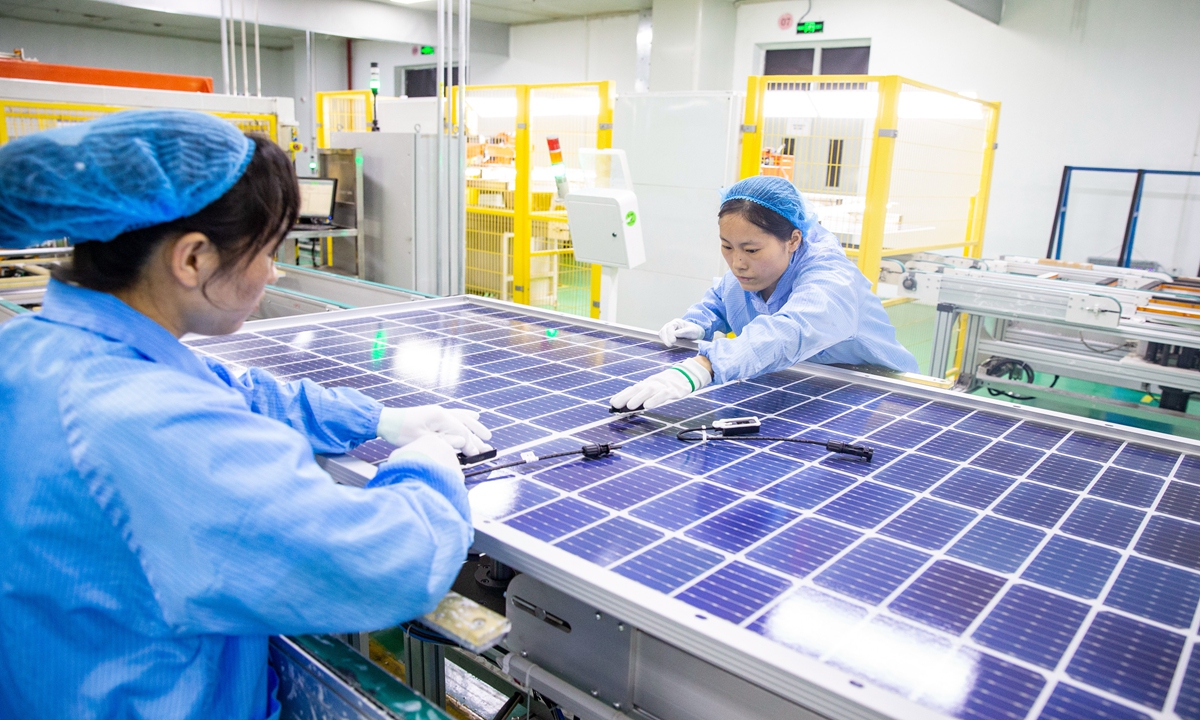
Workers rush to produce solar photovoltaic modules for domestic and foreign market at a solar energy company in Haian High-tech Zone, East China's Jiangsu province on June 17, 2023. Photo: IC
Get everyone involved
Michia Molemoeng Mocho, national committee member of the Young Communist League of South Africa, said at a sub-forum in Guiyang that Western media outlets always talk about China but what she saw in-country was totally different.
"I saw people taking care of the environment and the environment is taking care of them. What I like is the commitment and dedication of the people to see the dream of an eco-friendly society coming to [reality]," she said.
Former UNEP Executive Director Erik Solheim stressed that China has made great achievements in green development and through the Belt and Road Initiative (BRI), China shares its valuable experiences with other countries to promote green development.
China aims to enhance cooperation in multiple areas with the countries along the Belt and Road by 2025 and form a green development pattern for the initiative by 2030, according to a guideline issued by the National Development and Reform Commission along with three relevant departments.
Cooperation on clean energy will be deepened as China encourages solar and wind power companies to "go global," and promotes technological cooperation in areas including renewable energy, advanced nuclear power, smart grids, and hydrogen energy, said the guideline. Meanwhile, new-energy vehicles and smart transportation plans will be promoted to the countries along the route of Belt and Road.
China's export of three tech-intensive green products, namely solar batteries, lithium-ion batteries, and electric vehicles, registered a 66.9 percent increase in the first quarter of 2023, official data showed. Together, they contributed 2 percentage points to overall export growth, up from 1.7 percentage points in 2022, Xinhua reported.
At Monday's media briefing, China's Foreign Ministry spokesperson Mao Ning said that China sees lucid waters and lush mountains as humanity's invaluable assets. "Ecological conservation is an important priority and we are committed to green and low-carbon development," she said.
This week is the 33rd National Energy Conservation Week and July 12 marks this year's national low-carbon day in China.
"To advocate a simple, moderate, green, and low-carbon lifestyle and get everyone involved in actions to conserve energy and reduce carbon emissions is the key to achieving green and low-carbon development and enhancing ecological conservation, and also part of China's vigorous effort to respond to climate change and promote harmony between humanity and nature," Mao noted.
RELATED ARTICLES