Industrial upgrades fuel robust growth of Chinese provinces, injecting confidence into growth despite headwinds
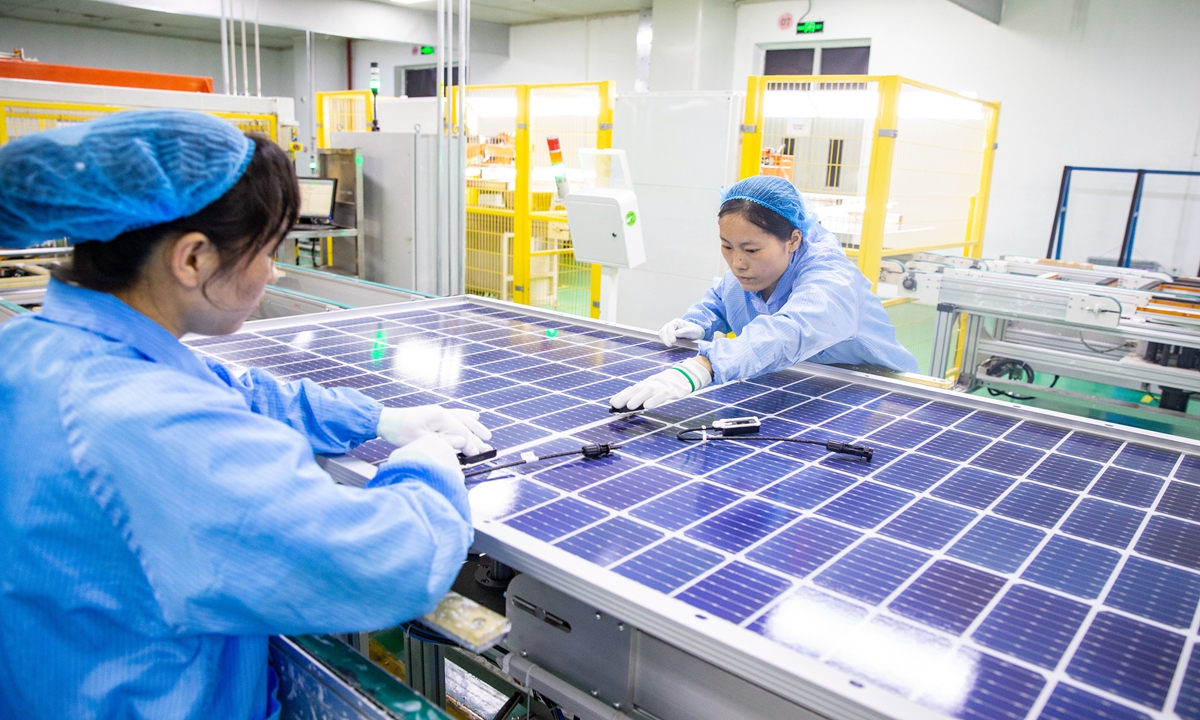
Workers make solar photovoltaic modules at a factory in Hai'an, East China's Jiangsu Province on June 19, 2023. Hai'an has been ramping up efforts to upgrade the local industrial chain, aiming to further elevate the competitiveness of the PV industry. China's total export of PV products exceeded $51.2 billion in 2022, up 80.3 percent year-on-year, industry data showed. Photo: cnsphoto
All 31 provincial-level regions in the Chinese mainland have unveiled their first-half "economic report cards" as of Sunday, with eastern economic powerhouses leading the pack, driven by successful industrial upgrades and the rapid growth of new driving forces.
East China's Anhui Province reported a year-on-year GDP growth rate of 6.1 percent on Sunday, the last of the 31 to release the figures. Of the total, growth rates in 17 regions surpassed or matched the national growth rate of 5.5 percent.
The total output of the six economic powerhouses - South China's Guangdong, East China's Jiangsu, Shandong and Zhejiang, Central China's Henan and Southwest China's Sichuan - accounted for about 45 percent of the country's total, playing a key role in stabilizing the economy.
Chinese economists emphasized the sustained recovery momentum seen in local economies, with particular highlights being successful industrial upgrades in certain provinces, which they believe will promote the nation's high-quality development and lay a solid foundation for the accomplishment of the annual economic development goals.
Guangdong, which has been leading China's growth in term of GDP for decades, reported a rise of 5 percent to more than 6.29 trillion yuan ($886 billion). As the largest provincial economy, the output accounted for 10.6 percent of the nation's total.
Jiangsu followed closely with a total GDP of 6.05 trillion yuan, up 6.6 percent. Shandong ranked third with an economic output of 4.41 trillion yuan, up 6.2 percent, and Shanghai's GDP surged 9.7 percent to 2.14 trillion yuan, ranking 11 on the list.
"Normally, the western regions would see faster growth than eastern coastal provinces and cities due to their development progress and relatively smaller sizes. However, the latest data showed a reversal, which is closely related to the country's industrial upgrading," Tian Yun, a veteran economist based in Beijing, told the Global Times on Sunday.
Compared with some western and central regions, which have higher dependence on raw material supply and other relatively "not advanced" industries, the eastern provinces, which have seen great achievements in industrial upgrading, have clearly shown strong resilience and faster growth, Tian said.
According to China Media Group (CMG), Guangdong has facilitated the digital transformation of 27,500 large industrial enterprises. Emerging industries such as digital programmable switches, industrial control computers and systems, and industrial robots have grown rapidly in the province.
The added value of Sichuan's green and low-carbon industries increased by 11.6 percent in the first half. In Beijing, the information services and financial industries contributed more 70 percent of economic growth, CMG reported.
Tian said that this has injected strong confidence into the overall growth of the national economy. "It shows that the nation's pursuit of high-quality development has not been affected by the COVID-19 pandemic or the ill-intentioned crackdown by the US," he said.
Turning to innovation-driven development has become a common move by all of society and high-quality development is the only way to hedge the downward pressure on the economy, Cong Yi, dean of the School of Marxism at the Tianjin University of Finance and Economics, told the Global Times on Sunday.
By promoting industrial upgrading, more potential for high-quality growth will be released, Cong said.
Still, economists warned that there were still weak spots and the growth trends of different regions had diverged.
Compared with the first quarter, GDP growth in 10 regions fell in the first half of the year. For instance, the GDP growth rate of South China's Guangxi Zhuang Autonomous Region slowed to 2.8 percent in the first half from 4.9 percent in the first quarter, according to the Economic Observer.
It is within expectations that some regions may grow slower during the economic structural overhaul, Cong said, stressing that it is key to stay on track and speed up the industrial upgrading so as to achieve synergy to promote national economic recovery.
RELATED ARTICLES