COMMENTS / EXPERT ASSESSMENT
China's maritime achievements demonstrate US' containment policy is doomed
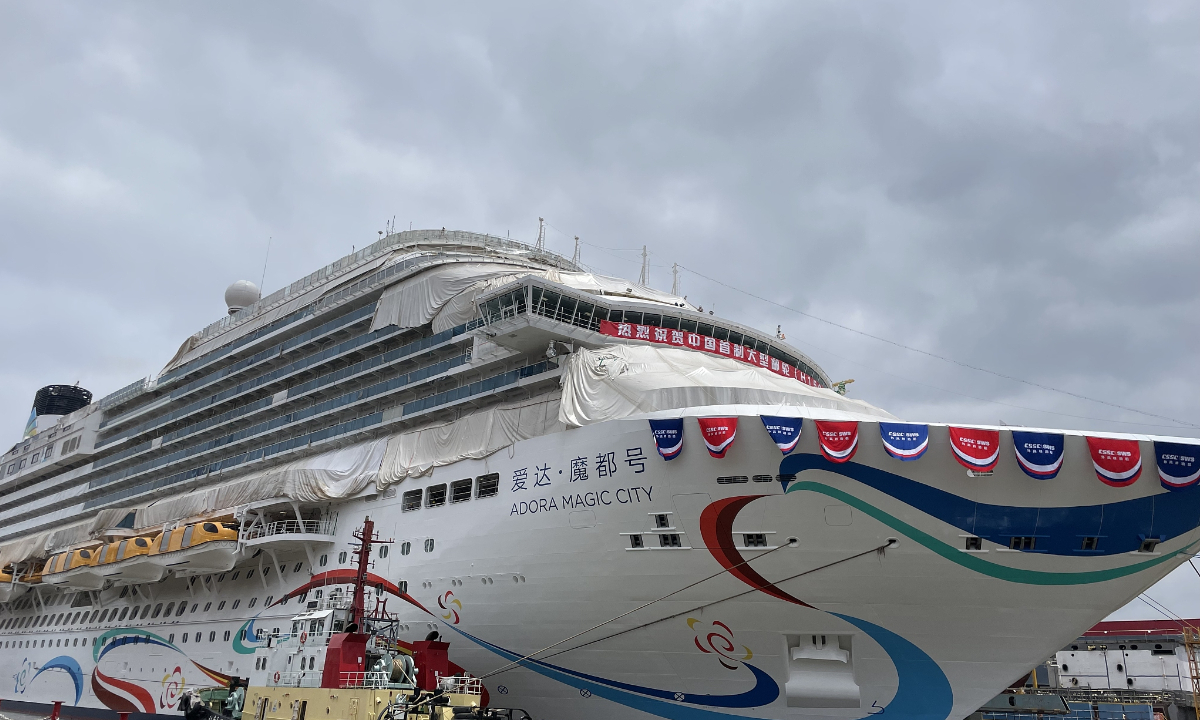
Cruise ship Adora Magic City Photo: VCG
Amid Washington's economic "decoupling" or "de-risking" calls, China is continuously developing its ocean shipping capacity.
China has surpassed Greece to become the world's largest owner in terms of gross tonnage (GT), the China Shipowners' Association said in a report on its WeChat account Saturday, citing data from UK-based Clarksons Research.
Stephen Gordon, an analyst from Clarksons Research, was quoted by media reports as saying that China's growth in ship fleet size should not come as a surprise, given its formidable cargo scale, well-developed ship-building industry and increasingly active financial sector.
According to data from Clarksons Research, China's ship-owning fleet currently has reached a total tonnage of 249.2 million GT, accounting for a global market share of 15.9 percent that is still growing.
About 95 percent of China's foreign trade goods are transported via marine shipping. In 2022, China's port cargo throughput reached 15.7 billion tons, and the total volume of container shipping neared 300 million TEUs. Freight volumes soared by 33 percent and 56 percent, respectively, compared with the levels10 years ago, according to Xinhua News Agency.
Marine shipping is an important barometer of China's foreign trade. The fact that China replacing Greece as world's largest owner in terms of GT is a natural result of China's foreign trade development.
As early as 2019, Asian ship-owners had reportedly surpassed their European competitors to control the largest share of the global fleet. This reflects the changes that are taking place in the global trade. Asia is a relative bright spot in the more somber context of the global economy's rocky recovery.
The narrative of so-called "decoupling" from China is based on the misperception that over reliance on the Chinese economy is a source of security concern; therefore, in pursuit of economic security and self-reliance, other economies should reduce their economic dependence on China, which is against open market rule and free market competition.
Most of the people in Asia clearly understand that economic "decoupling" is a false proposition, because any behavior that disrupts the Asian industrial chain will cause severe damage to regional economies. Washington's "decoupling from China" theory violates conventional economic laws and is detached from reality.
Over the past few years, the global shortage of shipping containers, partly caused by the COVID-19 pandemic, has led to a spike in shipping and container prices. Against this backdrop, Chinese companies have invested heavily to expand their own shipping capacity. This is a natural process driven by market choice. Such efforts will help maintain and enhance Asian supply chain resilience.
The US' anti-globalization endeavor led to seriously disrupted global industrial supply chains, and higher barriers holding back free investment and trade. China will have to confront the challenges from the disrupted global supply chains. However, China's rapid shipping development proves that it can cope with the "decoupling" headwind.
The author is a reporter with the Global Times. bizopinion@globaltimes.com.cn
RELATED ARTICLES