Home prices in China's tier-1 megacities remain stable in July, though property developers face liquidity woes
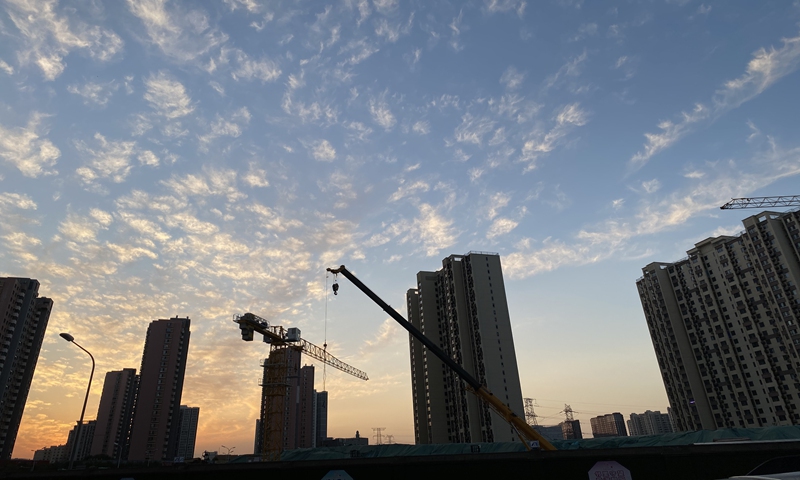
Cranes are seen at a construction site of a housing complex in Beijing. Photo: VCG
Chinese home prices remained basically stable across major cities in July, despite growing challenges faced by developers such as Country Garden, a major developer. An official from the National Bureau of Statistics said on Tuesday that the problems facing Chinese housing market are "temporary".
China's new home prices remained flat or slightly down in July from the previous month, second-hand home prices saw a moderate dip but remained largely stable nationwide, according to data released by China's National Bureau of Statistics (NBS).
In July, prices for newly-built homes remained flat d in so-called tire-1 cities like Shanghai and Beijing, while home prices in tire-2 cities saw a 0.2 percent decrease, and in tire-3 cities the prices slid 0.3 percent. Second-hand housing market was weak, with the sales prices in tire-1 cities dropped 0.8 percent, while the price decline reached 0.5 percent and 0.4 percent in tire-2 and tire-3 cities.
The property market is expecting more growth-reinforcing measures from the government to help boost market morale, amid concerns over a potential liquidity crisis faced by Country Garden, a major privately-owned developer.
Although Chinese property market is facing uncertainties, stock prices of developers in the A-share market largely rose Wednesday, as four stocks including Tianfang Development, Beijing Jingtou Sunlight Real Estate Development, Yukaifa and Zhongdi Investment hit daily upper limit of 10 percent.
Fu Linghui, a NBS spokesperson, said on Tuesday that problems facing the housing market are temporary, and the sector's risks are expected to recede or be resolved with the implementation of the government's pro-growth policies.
The real estate market in China has encountered some difficulties this year. With Evergrande's lingering debt woes and Chinese residents' decreasing consumption willingness, the market has been largely sluggish. NBS data shows that, from January to July, property sector investment fell 8.5 percent year-on-year to 6.77 trillion yuan ($929.5 billion).
Global Times
RELATED ARTICLES