Illustration: Chen Xia/GT
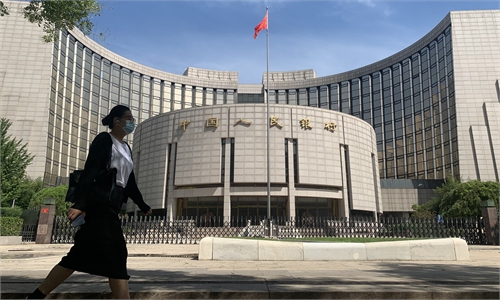
China's central bank on Tuesday moved to reduce the one-year medium-term lending facility (MLF) loan rates for the second time in three months, paving the way for a reduction to the key policy interest rate this month, or loan prime rate (LPR). The aim is to stimulate overall credit growth and boost economic activity. The five-year-term LPR is expected to be cut by 15 basis points to support the country's real estate sector recovery and reduce long-term borrowing cost for businesses.The policy rate reduction is timely and well-warranted as the economy faces some headwinds including a cool-down across domestic consumption and investment, and the US-led unrelenting assaults in trade and technology. To counter these challenges, a moderate-scale fiscal stimulus plan through a spike in government bond issuance is also needed, many economists say.
It's never easy to manage financial policy in the context of propelling employment and economic growth, while at the same time keeping consumer prices at an appropriate level of around 2-percent rise each year. Economists always claim that managing a rapidly evolving giant economy like China is a great art.
Chinese policymakers have done quite well since 2000 in maintaining a relatively high rate of economic growth while keeping inflation under control. However, they now face an increasingly volatile world and growing structural competition among nations. It is hoped that Chinese policymakers will develop the most suitable "policy portfolio" to accelerate an economic revival in the aftermath of the highly disruptive COVID pandemic of the last three years.
It is of great importance to reduce the borrowing cost borne by companies and households through cutting LPRs to spur a broader improvement in household and business sentiment, as well as the overall market morale, which has been significantly impacted by the pandemic and the ongoing US tech war. For example, data from the People's Bank of China revealed that Chinese banks issued only 345.9 billion yuan ($47.5 billion) in loans in July.
Under basic economic theory, moderate levels of credit growth are always needed to support household consumption, infrastructure construction, business expansion, imports and exports, and ultimately a country's economic growth. Given declining credit demand in July, it is very necessary to cut the benchmark interest rates and retail mortgage rates to stimulate home sales and boost overall social investment.
Facing economic distress like the 2008 global financial crisis or a severe health crisis like the COVID pandemic, businesses and households are often the first to feel the impact, tending to snap shut their pockets at times of high uncertainty, meaning governments must step in with a comprehensive financial stimulus plan to jumpstart economic momentum through deficit-spending programs.
In 2008, witnessing the US and other major economies collapsing in the US subprime loans-caused turmoil, China's State Council implemented the groundbreaking "4-trillion-yuan" financial rescue plan, which significantly modernized the country's transportation systems, shored up the nation's manufacturing strength and led to double-digit economic growths for several years. Additionally, a moderate fiscal spending plan in 2021 to fight the pandemic also led to impressive 8.1 percent GDP growth that year.
Of course, monetary policy aimed at fine-tuning short-term objectives, such as curbing elevated inflation or a housing market bubble, runs the serious risk of inducing too much policy forbearance for too long. Exiting an extraordinarily accommodative mode too late can sow the seeds of future imbalances in the market.
To tackle an overheated property market and reduce the debt levels of major housing developers, China's financial authorities launched the so-called deleveraging campaign in 2016, an interventionist financial policy aimed to mitigate bubbling risks in the property sector as housing prices in major Chinese cities skyrocketed, causing waves of grievances from ordinary urbanities. The policy shift was necessary and highly justified to tamp down on an overheating property market at that time.
The deleveraging bid was an important test case of the adaptability and flexibility of the country in responding to economic challenges such as the growth of the informal or "shadow banking" that fueled the property frenzy. However, no specific time frame has been set for exiting the interventionist financial policy, which was prolonged and helped upend the country's unprecedented credit expansion cycle since the 2008 global financial crisis. As a result, many local governments' financing vehicles were shut down, and the central bank decided to phase in the macro-prudential adjustment mechanism to manage annual credit issuance.
Economists believe that the credit "austerity" measure and the crackdown on shadow financing channels have made China's financial system significantly more secure. Nevertheless, the measure also cut down the society's total credit growth, which is a major source and also an effective means of supporting the Chinese economy's growth for many years.
It's high time to introduce a set of growth-reinforcing fiscal policy and persistent monetary stimulus - such as cutting the central bank's LPR policy rates - in order to provide consistent credit streams to propel and reinvigorate the economy.
In financial management, forecasting, tracking and managing financial information are central to assessing whether an economy is on track to achieve the pre-set targets. Timely reviewing all the key performance drivers and keeping abreast of leading and lagging indicators - such as monthly data covering retail sales, home sales, exports and imports, consumer prices and bank loans - will help policymakers decide how urgently a policy adjustment is needed. Failure to do so effectively can result in unwanted financial surprises and impact high-quality economic development.
The author is an editor with the Global Times. bizopinion@globaltimes.com.cn
RELATED ARTICLES