Illustration: Xia Qing/Global Times
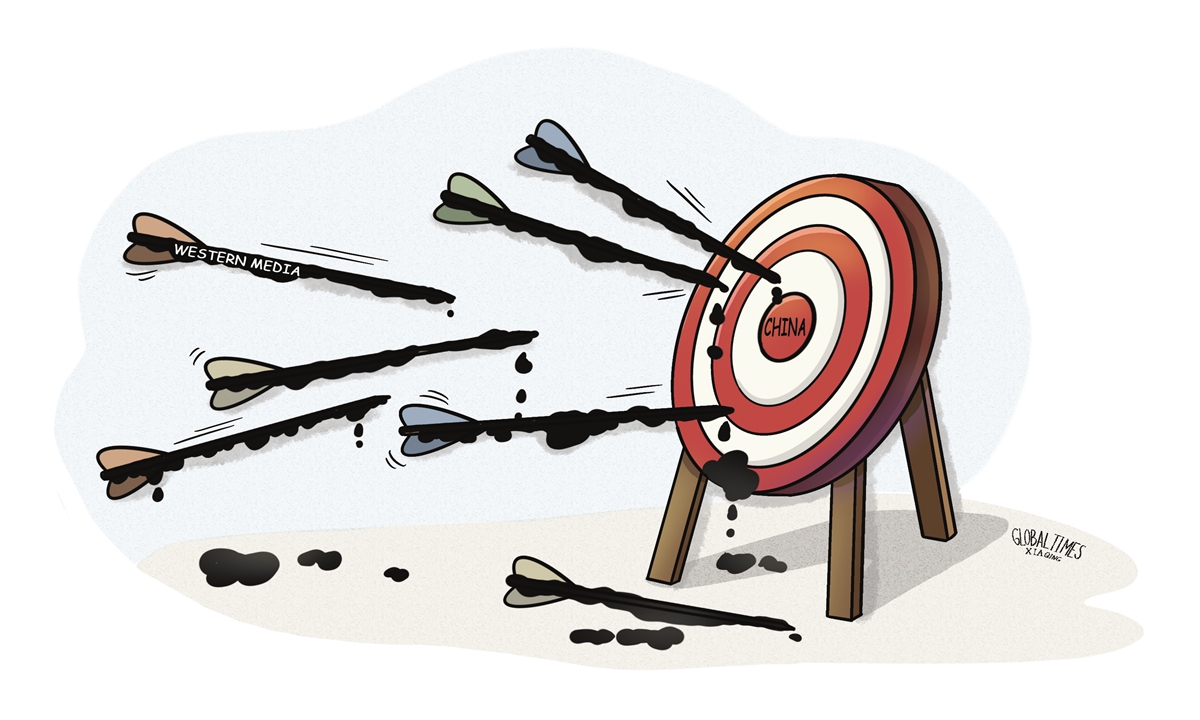
Have foreign executives been cautious about business travel to China due to concerns about being restricted from leaving? Just look at how many well-known Western CEOs have visit China this year despite the US' and some Western countries' "de-risking" rhetoric, people can realize how absurd it is. However, this nonsense that can be easily distinguished has been astonishingly over-hyped by some mainstream Western media, such as the Wall Street Journal (WSJ).The so-called departure restriction hype by some Western media is a new campaign to smear China's business environment. The intention is clear, as they try to deprive China of development opportunities by spreading false information to mislead public opinion. Beyond ill-intentioned trade war and chip war, the information war, intense as it may seem, is a common tactic used by the US in an attempt to isolate China and suppress the Chinese economy.
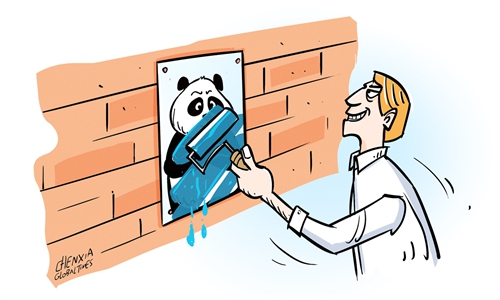
It is regrettable to see that not only the WSJ, but also other US and Western media outlets have been caught up in a smear campaign targeting the Chinese economy. Washington's policy of treating China as a strategic opponent and its "de-risking" rhetoric has led to a large-scale campaign against the Chinese economy at various levels of Western propaganda machines. They create false information, attempting to scare off Western investment, and naively believe this can disrupt China's development and maintain US hegemony.
These Western media outlets hyping up so-called China's departure restrictions should take a look at who is the one that takes advantage of "departure restrictions" to suppress foreign companies. For instance, Huawei's Meng Wanzhou was arbitrarily detained by Canada on a US extradition request on December 1, 2018 at Vancouver International Airport. The US and Canada abused their bilateral extradition treaty and arbitrarily took compulsory measures against a Chinese executive, which severely violates the legitimate rights and interests of the Chinese citizen. The recent US hype about so-called departure restrictions is just a new version of the old trick of "a thief crying 'stop thief!'"
People can count how many well-known Western CEOs have come to China this year. Even the Wall Street Journal report, which entitled "China is becoming a no-go zone for executives," admitted that executives of a slew of US companies, including Apple's Tim Cook, JPMorgan Chase's Jamie Dimon and Tesla's Elon Musk have made high-profile business travels to China this year. And more foreign executives have visited China to attend important business conferences including the Summer Davos.
The fact is that since the beginning of the year, visiting China has become the foremost priority itinerary for CEOs of numerous renowned multinational companies. The CEOs of major foreign companies in various industries including technology, banking, fashion, and manufacturing are lining up to visit China, and the Chinese market warmly welcomes law-abiding foreign enterprises with open arms.
Apparently, the world's second-largest economy has a strong appeal to major Western companies. What these foreign executives have received during their visits to China was not so-called restrictions on leaving the country or other unpleasant experiences, instead, they have found opportunities for business growth that they could not find in other countries around the world.
Western media outlets' hype surrounding China's "departure restrictions" has a simple purpose: reducing the attractiveness of the Chinese market to Western enterprises. The move is in line with Washington's "de-risking" push. However, it has been repeatedly argued that de-globalization, economic "decoupling," or forming economic "small circles" that exclude China will disrupt the global supply chain, making everyone in the industry chain a victim.
China is a country under the rule of law, and Chinese law has always supported and encouraged law-abiding operators. As long as they comply with Chinese laws, any Westerners can ensure personal safety and share China's economic opportunities.
Of course, China has the right to crack down on illegal business operations, which is also a part of continuously improving China's business environment. Such move will be based on legal foundations. To be clear, international investment is still coming into China at a steady clip. Foreign investments are welcome in China, and the door to China will only open up further.
The author is a reporter with the Global Times. bizopinion@globaltimes.com.cn
RELATED ARTICLES