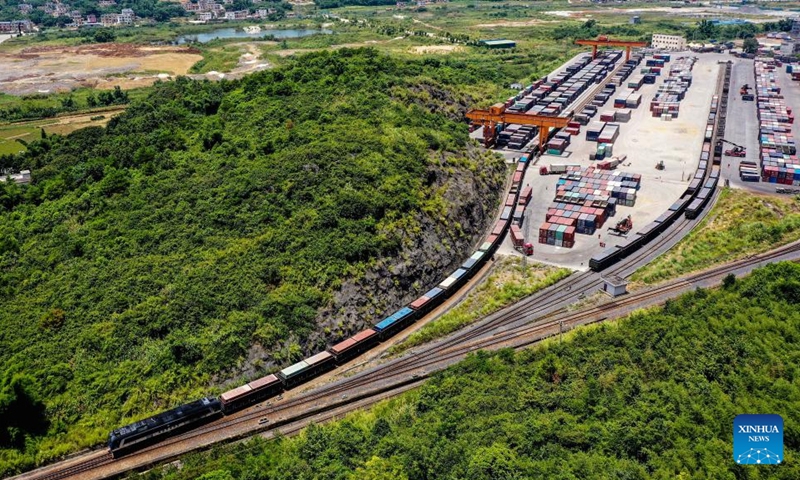
Aerial photo taken on July 29, 2022 shows an outbound freight train at a railway freight center in Wuzhou, South China's Guangxi Zhuang Autonomous Region. Photo: Xinhua
The new western land-sea corridor has become a vivid example of China's efforts to expand high-level opening-up to the outside world, Foreign Ministry spokesperson Wang Wenbin said on Friday, while commenting on the milestone of over 300,000 twenty-foot equivalent units (TEUs) of containers being transported via the passage this year.
From a single train route to a whole network, the multimodal transport of the new western land-sea corridor now covers 72 cities in 18 provinces, regions and municipalities in China and carries cargo to 514 ports of 123 countries and regions worldwide, Wang told a regular press briefing on Friday.
In 2023, the sea-rail combined transport carried 860,000 TEUs of goods, up by 14 percent year-on-year. High-quality agricultural products from Vietnam, Cambodia, Thailand, Malaysia, Indonesia and other countries have been brought into the Chinese market and reached the tables of Chinese consumers. China's new energy products, new material products and electromechanical products have been transported overseas, giving a strong boost to the economic growth of ASEAN countries, Wang noted.
Industry insiders said the corridor slashed the time required for goods from ASEAN to reach China's western provinces by about 10 days to around 20 days.
Wang further pointed out the significance of the corridor's construction in facilitating an opening-up paradigm that connects China and the world as well as the eastern and western regions of the nation.
Meanwhile, many provinces along the corridor are rolling out policy measures to make the new western land-sea corridor an open corridor for development of strategic importance with better connectivity both at home and beyond, according to Wang.
The new western land-sea corridor is located in China's western hinterland, connecting the silk road economic belt and the 21st century maritime silk road and supporting the high-standard opening up and the building of a new development paradigm in western China. In 2019, the Chinese government rolled out the master plan for the new western land-sea corridor.
"We are confident that the new western land-sea corridor will continue to reach further, support bigger trade and bolster deeper industrial cooperation and become an international economic corridor with robust impetus," Wang said.
RELATED ARTICLES