Revitalizing rural Gansu Province in Northwest China: an e-commerce-powered path to prosperity
Live-streaming empowers farmers in remote northwestern China to escape poverty

Ren Jingtao and his partner advertise matsutake mushroom during a livestream, in Chengxian, Longnan in Northwest China's Gansu Province, on December 10, 2024. Photo: Chen Tao/GT
"Today, Xiao Tao will introduce you to one of the world's most renowned mushrooms, the Qinling matsutake, which has particularly demanding conditions for cultivation," said Ren Jingtao, as he picked the coveted mushrooms in the high-altitude forests in his hometown while giving his online audience a firsthand look at the product's natural environment.
In the lush highlands of Chengxian, a small county in Longnan, Northwest China's Gansu Province, e-commerce has created new opportunities for agricultural produce, attracting young talent back home to start businesses, and forging a new path for rural revitalization.
Ren, a 1999-born young entrepreneur and live-streaming influencer from Chengxian, has turned local agricultural produce into Internet commodities and attracted an increasing number of consumers around the country. He has sold over 320,000 orders of agricultural produce through live-streaming, achieving total sales of 10.33 million yuan ($1.42 million).
Planning key tasks for 2025, China's annual Central Economic Work Conference emphasized coordinated progress in urbanization and all-around rural revitalization by promoting urban-rural integration. It called for developing rural industries, enriching rural residents in an integrated manner, and doing everything possible to raise farmers' incomes.
In early February, China unveiled its "No. 1 central document" for 2024, outlining the priorities for comprehensively promoting rural revitalization. The document proposes to implement high-quality development projects for rural e-commerce, promote the construction of county-level e-commerce live-streaming facilities, to ramp up online sales of rural specialties.
The story of Ren and his team highlights the booming e-commerce industry across China. In recent years, the government has advanced the development of e-commerce in rural areas, supporting 1,489 counties in building up to 3,000 county-level e-commerce public service centers and logistics distribution centers, as well as over 158,000 village-level e-commerce service sites.
'Anything can be livestreamed'
"In Longnan, anything can be livestreamed, and anyone can be a live-streamer," Ren told the Global Times.
Ren started his live-streaming business three years ago. "At first, I had few followers, and my daily sales volumes during a live-streaming session were low, so villagers were reluctant to let me sell their products," Ren said.
In order to raise the earnings of his parents and fellow villagers, he decided to start a live-streaming business.
After quitting his job at a local e-commerce company in 2021, Ren enrolled in vocational training courses at Longnan Teachers College, where he acquired skills in livestreaming, video shooting and editing, and copywriting too.
"Working 14 hours per day, I focus on account management, live-streaming services, and e-commerce operations," Ren said. Within two years, Ren's live-streaming team has achieved daily transactions of 100,000 yuan, with a net profit as high as 50,000 yuan. "Our goal is to reach a sales value of 3 to 4 million yuan every month," he said.
Live-streaming hosts are helping sell rural produce and injecting vitality into the development of China's rural e-commerce industry. Thanks to their efforts, specialty agricultural produce — such as Hainan mangoes, Zhejiang white tea, and Zigui navel oranges — are reaching the wider market, boosting farmers' income.
Data from the Ministry of Commerce showed that the country has witnessed rapid development in e-commerce sales and the rural e-commerce market experienced consistent growth throughout 2023.
Online retail sales of agricultural products in China reached about 2.5 trillion yuan in 2023, an increase of nearly 13 times compared to 2014, while the country's online retail sales of farm produce reached 587.03 billion yuan, up 12.5 percent year on year. From 2021 to 2023, the total value of agricultural product logistics exceeded 5 trillion yuan for three consecutive years.
Rural training courses
The story of Ren is not an isolated one. To cultivate more young entrepreneurs, Longnan has organized training programs about e-commerce strategies and business management skills.
In 2015, the school of e-commerce at Longnan Teachers College was established to foster entrepreneurship in the new form of doing business, He Wei, Party secretary of the E-commerce School at Longnan Teachers College, told the Global Times.
Currently, over 25,000 people have been trained through e-commerce courses launched in collaboration with the country's largest e-commerce platforms including Alibaba, Tencent, JD, and Pinduoduo.
Rural e-commerce has encouraged young migrant workers, college graduates, and ex-servicemen to return to their hometowns and start their own business ventures.
However, rural e-commerce development has faced some constraints, as experts call for more effort to narrow the knowledge gap between urban and rural areas on the evolving e-commerce. "How to train rural e-commerce talent is the key," said Chan Zhongfeng, president of the local e-commerce association.
In March 2024, China's Ministry of Commerce, along with eight other government agencies, issued a document outlining a five-year plan to nurture roughly 10,000 rural e-commerce leaders.
Since early 2014, China has been implementing a set of policies to advance the high-quality development of e-commerce in rural areas. Among them, the Ministry of Commerce issued detailed guidelines, which proposed building a multi-level rural e-commerce service system, accelerating the construction of a modern logistical system, and fostering diversified new e-commerce entities in rural areas, Xinhua News Agency reported.
In the lush highlands of Chengxian, a small county in Longnan, Northwest China's Gansu Province, e-commerce has created new opportunities for agricultural produce, attracting young talent back home to start businesses, and forging a new path for rural revitalization.
Ren, a 1999-born young entrepreneur and live-streaming influencer from Chengxian, has turned local agricultural produce into Internet commodities and attracted an increasing number of consumers around the country. He has sold over 320,000 orders of agricultural produce through live-streaming, achieving total sales of 10.33 million yuan ($1.42 million).
Planning key tasks for 2025, China's annual Central Economic Work Conference emphasized coordinated progress in urbanization and all-around rural revitalization by promoting urban-rural integration. It called for developing rural industries, enriching rural residents in an integrated manner, and doing everything possible to raise farmers' incomes.
In early February, China unveiled its "No. 1 central document" for 2024, outlining the priorities for comprehensively promoting rural revitalization. The document proposes to implement high-quality development projects for rural e-commerce, promote the construction of county-level e-commerce live-streaming facilities, to ramp up online sales of rural specialties.
The story of Ren and his team highlights the booming e-commerce industry across China. In recent years, the government has advanced the development of e-commerce in rural areas, supporting 1,489 counties in building up to 3,000 county-level e-commerce public service centers and logistics distribution centers, as well as over 158,000 village-level e-commerce service sites.
'Anything can be livestreamed'
"In Longnan, anything can be livestreamed, and anyone can be a live-streamer," Ren told the Global Times.
Ren started his live-streaming business three years ago. "At first, I had few followers, and my daily sales volumes during a live-streaming session were low, so villagers were reluctant to let me sell their products," Ren said.
In order to raise the earnings of his parents and fellow villagers, he decided to start a live-streaming business.
After quitting his job at a local e-commerce company in 2021, Ren enrolled in vocational training courses at Longnan Teachers College, where he acquired skills in livestreaming, video shooting and editing, and copywriting too.
"Working 14 hours per day, I focus on account management, live-streaming services, and e-commerce operations," Ren said. Within two years, Ren's live-streaming team has achieved daily transactions of 100,000 yuan, with a net profit as high as 50,000 yuan. "Our goal is to reach a sales value of 3 to 4 million yuan every month," he said.
Live-streaming hosts are helping sell rural produce and injecting vitality into the development of China's rural e-commerce industry. Thanks to their efforts, specialty agricultural produce — such as Hainan mangoes, Zhejiang white tea, and Zigui navel oranges — are reaching the wider market, boosting farmers' income.
Data from the Ministry of Commerce showed that the country has witnessed rapid development in e-commerce sales and the rural e-commerce market experienced consistent growth throughout 2023.
Online retail sales of agricultural products in China reached about 2.5 trillion yuan in 2023, an increase of nearly 13 times compared to 2014, while the country's online retail sales of farm produce reached 587.03 billion yuan, up 12.5 percent year on year. From 2021 to 2023, the total value of agricultural product logistics exceeded 5 trillion yuan for three consecutive years.
Rural training courses
The story of Ren is not an isolated one. To cultivate more young entrepreneurs, Longnan has organized training programs about e-commerce strategies and business management skills.
In 2015, the school of e-commerce at Longnan Teachers College was established to foster entrepreneurship in the new form of doing business, He Wei, Party secretary of the E-commerce School at Longnan Teachers College, told the Global Times.
Currently, over 25,000 people have been trained through e-commerce courses launched in collaboration with the country's largest e-commerce platforms including Alibaba, Tencent, JD, and Pinduoduo.
Rural e-commerce has encouraged young migrant workers, college graduates, and ex-servicemen to return to their hometowns and start their own business ventures.
However, rural e-commerce development has faced some constraints, as experts call for more effort to narrow the knowledge gap between urban and rural areas on the evolving e-commerce. "How to train rural e-commerce talent is the key," said Chan Zhongfeng, president of the local e-commerce association.
In March 2024, China's Ministry of Commerce, along with eight other government agencies, issued a document outlining a five-year plan to nurture roughly 10,000 rural e-commerce leaders.
Since early 2014, China has been implementing a set of policies to advance the high-quality development of e-commerce in rural areas. Among them, the Ministry of Commerce issued detailed guidelines, which proposed building a multi-level rural e-commerce service system, accelerating the construction of a modern logistical system, and fostering diversified new e-commerce entities in rural areas, Xinhua News Agency reported.
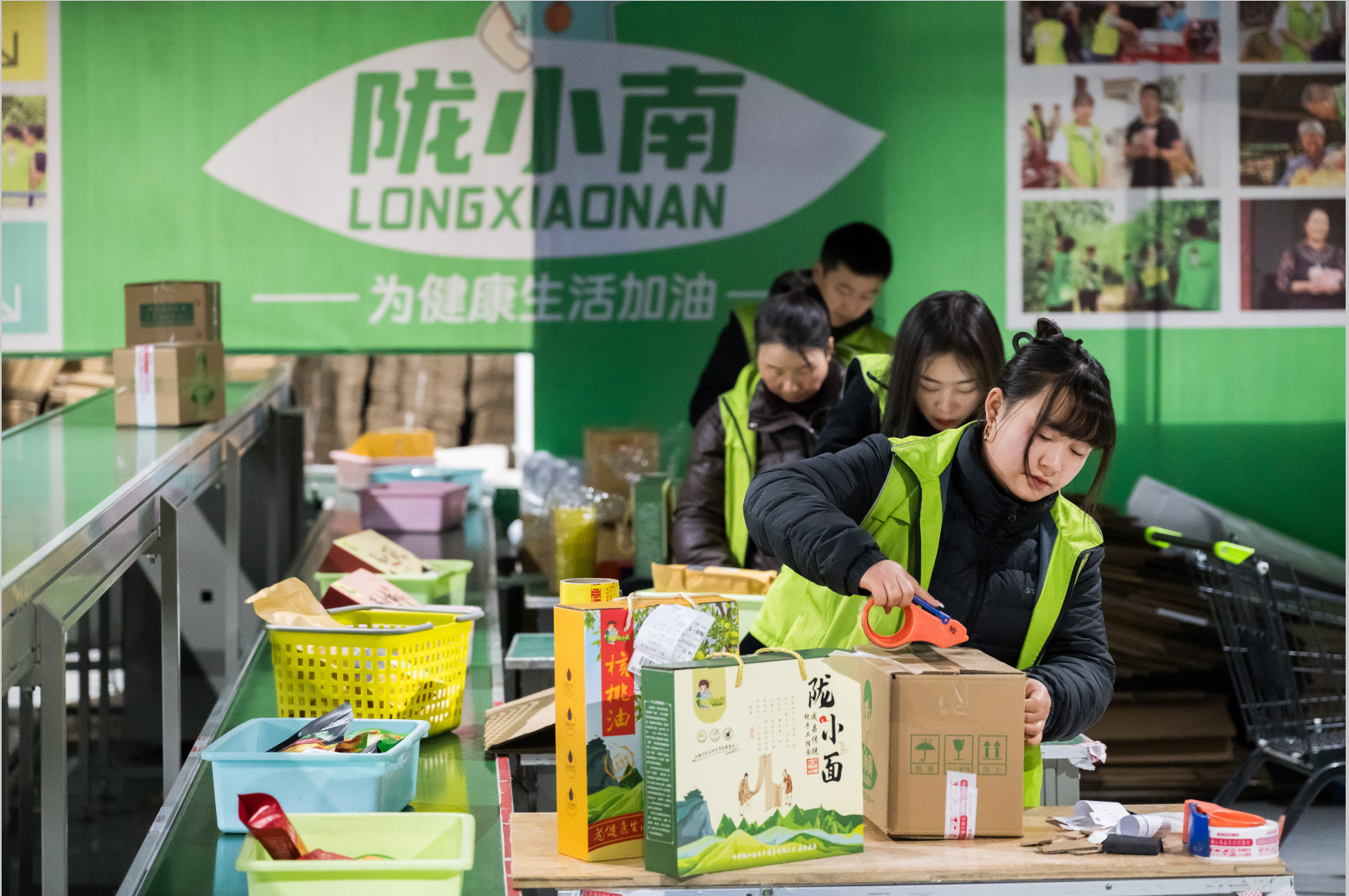
In the packaging workshop of Longxiaonan E-commerce Company's distribution center in Chengxian, agricultural specialties are being packaged and are prepared for distribution, on December 10, 2024. Photo: Chen Tao/GT
At Longxiaonan E-commerce Company's distribution center at Chengxian, Global Times reporters were impressed by many products being displayed, such as dried fruit, nuts, honey, rice noodles, mushrooms, sesame, tea, rice wine, as well as traditional Chinese medicine.
Following the rapid development of e-commerce, Chengxian's famous walnuts and other agricultural produce are now sold nationwide, significantly boosting local agricultural sector, said Du Longhui, an official from the Chengxian e-commerce bureau.
However, as recently as 2011, more than 1.3 million people, or 53 percent of Longnan's population, were living in poverty. "There was no expressway, railway station or airport here and two-thirds of its administrative villages had no access to the internet then," Du said.
To address these issues, the city government moved to bolster e-commerce support services, investing heavily in infrastructure and launching a series of initiatives to nurture the growth of the rural e-commerce sector.
To date, Chengxian has set up 2,734 online stores and micro-stores, launched 52 e-commerce business enterprises, and established nine postal and express delivery service providers. The e-commerce industry chain has generated employment opportunities for more than 20,000 individuals, and achieved a total sales volume of 6.437 billion yuan, Du said.
"The practices of Longnan demonstrate that rural e-commerce construction is an ecosystem," Du said. It consists of three parts: frontline services, including e-commerce trading platforms and online retailers; middlemen of the e-business service system — service providers, payment services, express logistics, and e-business bases; and three main pillars, including leading enterprises, family farms, and professional cooperatives.
As the e-commerce business becomes well accepted now, Longnan-based companies are stepping up efforts to market local products to international buyers too.
Zhang Yuya, of Gansu Qianli Silk Road International Trade Co, told the Global Times that her company, founded in 2023, has prioritized Belt and Road partner countries as a key market and it has processing plants in both Longnan and Kashgar, Northwest China's Xinjiang Uygur Autonomous Region, with an annual capacity of over 5,000 tons for walnuts and dried fruits.
"Relying on cross-border e-commerce platforms, we have successfully extended our business into Central Asian and even European markets," Zhang said.
RELATED ARTICLES