China’s real estate market risks ease off, starting to seek a new equilibrium: central bank governor
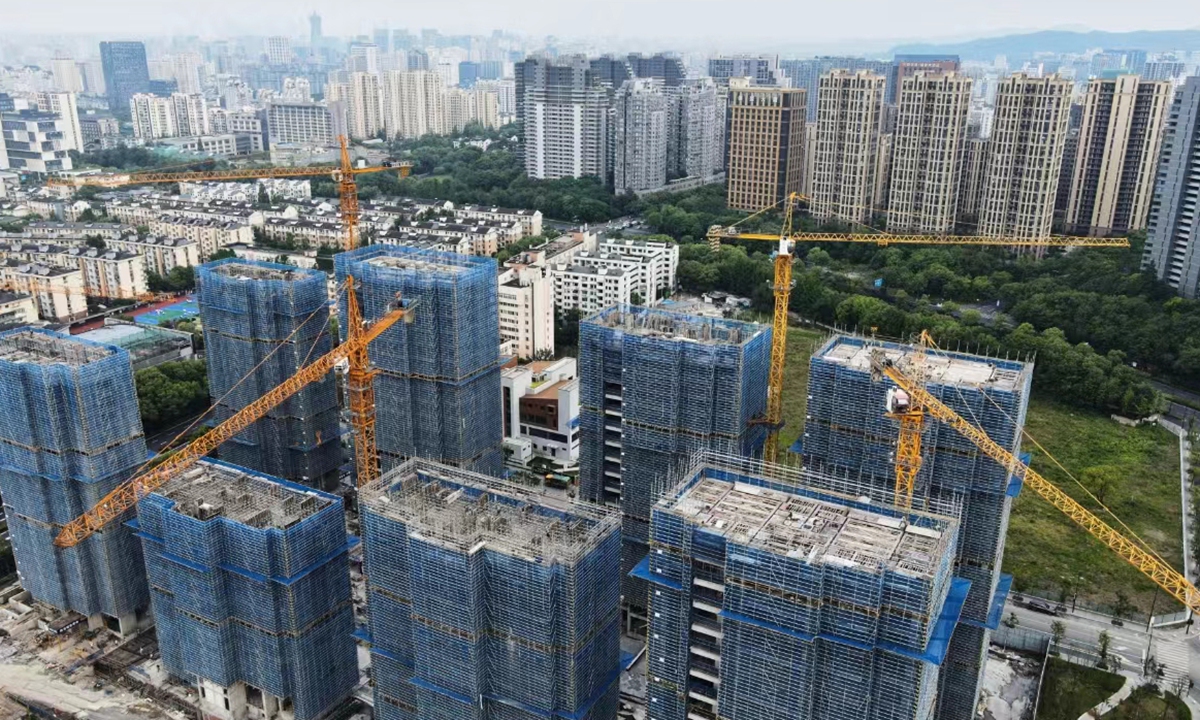
A view of a residential property project under construction in Hangzhou, East China’s Zhejiang Province on May 9, 2024. The city announced the same day that it will lift all home purchase restrictions, making it among the first Chinese cities to completely abolish purchase restrictions amid a nationwide effort to shore up the real estate market. Photo: VCG
The risks exposed by China’s real estate market have significantly eased off, and the market is seeking a new equilibrium, Pan Gongsheng, governor of the People's Bank of China, the country’s central bank, said on Monday.
China’s real estate market has witnessed almost three decades of robust growth, and undergone a substantial transformation, and is currently seeking a new equilibrium, Pan said at the 18th Asian Financial Forum (AFF) held in Hong Kong Special Administrative Region.
“We have implemented an integrated policy addressing both the supply and demand, refining our financial policies related to real estate and revising relevant tax frameworks. Meanwhile, the market players have initiated self-recovery through strategic realignments and debt restructuring efforts. As a result, the risk level in the property market has significantly dropped, as overall transaction levels have improved,” Pan said.
Since October 2024, sales of commercial housings in 30 major cities across China has achieved three consecutive months of month-on-month growth and two consecutive months of year-on-year growth, Pan said.
Recently, the central government has announced that proceeds from selling local government special bonds could be utilized to recoup the idle land, acquire additional land reserve, and purchase unsold properties. The move is expected to facilitate inventory reduction and shore up stabilization of the real estate market, Pan said.
According to data from the National Bureau of Statistics, a growing number of major Chinese cities reported month-on-month rise in residential housing prices in November. Among them, the first-tier cities saw an overall rise in property prices, and the price slump in the second- and third-tier cities has moderated.
The number of cities reporting month-on-month price increases in newly built homes increased from seven in October to 17 in November. The recovery has been particularly notable in the first-tier cities, spurred by the prolonged effects of relaxed purchase restrictions the government introduced in September.
Global Times
RELATED ARTICLES