Apple’s market cap drops, reflecting serious supply chain disruptions for firms caused by US tariffs: analyst
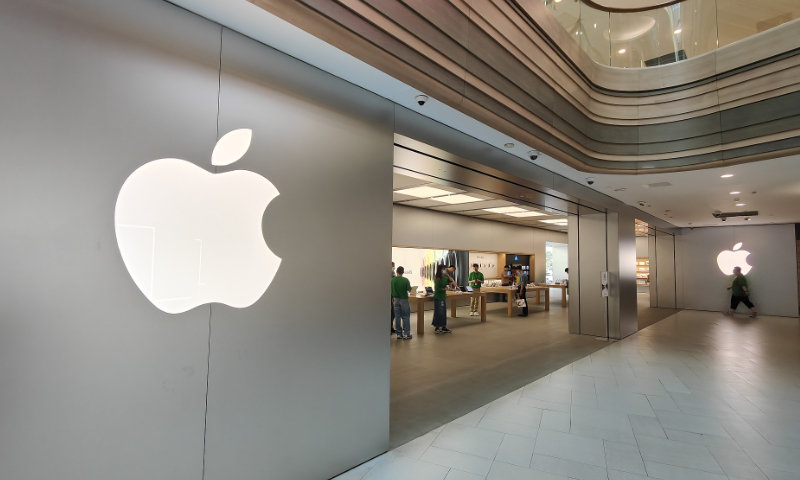
An Apple store in Shanghai Photo: VCG
Affected by Washington's imposition of "reciprocal" tariffs, the shares of Apple fell for the fourth straight day on Tuesday, wiping out its status as the world's most valuable company by market capitalization on Tuesday, US local time. The plunge indicates that Apple, among American mega tech companies, is being battered by the US tariff policy, which is severely disrupting the global supply chain and will drive up US inflation, a Chinese expert said.
Apple shares plunged 23 percent over the past four trading sessions as of Tuesday, enabling Microsoft to become the world's most valuable public company.
As of Tuesday's market close, Microsoft was worth $2.64 trillion, while Apple's market cap stood at merely $2.59 trillion, according to CNBC.
Apple shares edged up around 3 percent to $172.9 in early trading in the US on Wednesday, local time, recouping some of the previous session's nearly 5 percent plunge.
Apple's share plunge came as the US imposed so-called "reciprocal" tariffs on products imported from scores of countries and regions around the world.
To mitigate the impact, Apple transported five planes full of iPhones and other products from India to the US in three days in late March, a senior Indian official confirmed to The Times of India.
The company rushed to move inventory from manufacturing centers in India and China to the US, even though this period is typically a slow shipping season, according to the Times of India (TOI).
"Factories in India and China and other key locations have been shipping products to the US in anticipation of the higher tariffs," one source said, according to the TOI report.
"Apple's reported shipments are a desperate attempt induced by the so-called reciprocal tariffs, which represent a blatant assault on the global trade order," Liu Dingding, a veteran tech industry observer, told the Global Times on Wednesday.
Liu noted that the iPhone is, in many ways, a symbol of the electronics sector, which has a highly globalized supply chain. The electronics sector, with its complex cross-border supply chains and significant presence in international trade, is being hit hard by the US tariffs.
"The US tariffs are bound to substantially ramp up selling prices on the market. Instead of strengthening the US economy, they will not only add financial stress to US consumers but also drive up US inflation," Liu said.
Apple has a vast global supply chain, with a particularly high dependence on Asian countries like China. In the short term, it will be difficult to find countries or regions that can fully replace the current manufacturing system, Wang Peng, an associate research fellow at the Beijing Academy of Social Sciences, told the Global Times on Wednesday.
Tariffs are likely to cause a sharp increase in the costs of importing components and finished products. To shift these costs, the company may raise product prices, further intensifying inflationary pressures, Wang said.
Apple's supply chain is spread across Asian countries, including China, India and Vietnam, according to a CNBC report.
China accounts for about 80 percent of Apple's production capacity, according to estimates from Evercore ISI, and about 90 percent of iPhones are assembled in China. Evercore ISI estimates that about 10-15 percent of iPhones are currently assembled in India.
About 20 percent of iPad production and 90 percent of Apple's wearable product assembly, including the Apple Watch, takes place in Vietnam, according to Evercore ISI.
The US has imposed some of the steepest tariffs on goods from China, India and Vietnam. The US put a 46 percent tariff on goods coming from Vietnam and a 26 percent tariff on imports from India, the Washington Post reported.
Washington's "reciprocal" tariffs could lead Apple to raise the price of the iPhone 16 Pro Max by as much as $350 in the US market, UBS analysts said on Monday, CNBC reported.
JPMorgan Chase analysts predicted last week that Apple could raise its prices by 6 percent to offset the US tariffs. Barclays analyst Tim Long wrote that he expects Apple to raise prices, or it could suffer as much as a 15 percent cut to earnings per share, according to CNBC.
While Apple is among the most prominent tech companies hit by the tariffs, other tech companies have also been affected, as the tech-heavy Nasdaq fell 13 percent over the four trading days ending on Tuesday.
The significant declines in the Nasdaq and other tech-sector indices reflect investors' concerns about the future of the US tech industry as the US tariff policies have exacerbated uncertainty in the global supply chain, and companies may face the risk of supply chain disruptions. In the long run, tariff policies may erode the international competitiveness of US tech companies, Wang said.
According to a Reuters report, US makers of personal computers (PCs) and AI servers will be hit hard as well. The US imported nearly $486 billion in electronics last year, the second-biggest sector for imports after machinery, according to Census Bureau data.
PC makers, including Dell and HP, could face cost increases of about 10-25 percent, adding between $200 and $500 in costs per unit, said Tony Redondo, founder of Cosmos Currency Exchange, according to Reuters.
RELATED ARTICLES