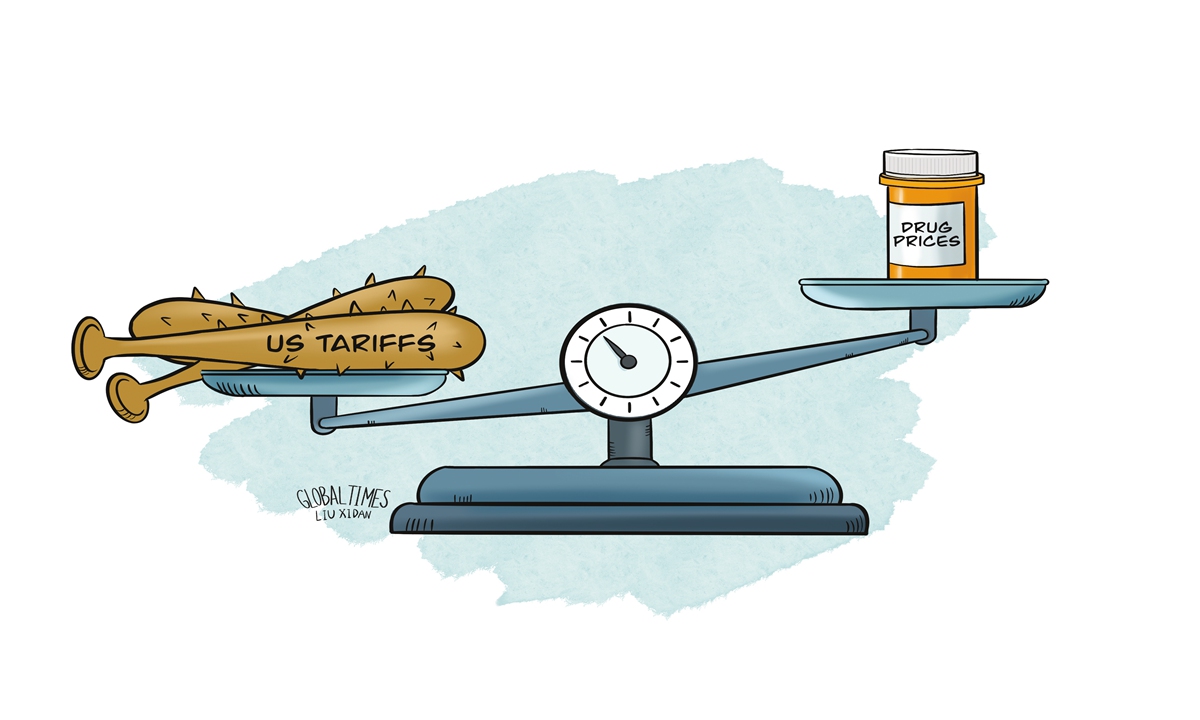
Illustration: Liu Xidan/GT
An executive order aimed at lowering prescription drug prices was signed on Tuesday in the US. The order directs the Department of Health and Human Services to take steps to significantly reduce drug prices for American patients. It's a well-documented fact that the cost of pharmaceuticals in the US is higher than in many other nations, a disparity that has long fueled calls for reform in the country. However, the path to lower drug prices is now complicated by an additional factor: tariffs.The US administration is proceeding with probes into imports of pharmaceuticals and semiconductors as part of a bid to impose tariffs on both sectors on the grounds that extensive reliance on foreign production of medicine and chips is a national security threat, Reuters reported on Monday, referencing US Federal Register filings.
The global footprint of major pharmaceutical companies spans the US, Europe and Asia, creating a complex and interdependent supply chain for medical products that has evolved over the past few decades. Imposing additional tariffs on imported drugs could drive up domestic prices in the US, exacerbating the issue that policymakers are striving to address.
Additional tariffs may not only inflate costs but also heighten the risk of drug shortages, ultimately limiting access for American patients.
Over the past few decades, globalization has led to a mass migration of manufacturing industries to countries where production costs are significantly lower. This shift makes economic sense from a corporate standpoint, so it has undeniably led to increased cost efficiencies. A notable example is the pharmaceutical industry in the US, where many drugs are manufactured abroad. According to the US Department of Health and Human Services, the Food and Drug Administration estimates that nearly 40 percent of finished drugs and approximately 80 percent of active pharmaceutical ingredients (APIs) are manufactured in registered establishments in more than 150 countries.
In the complex landscape of global trade, the discussion around imposing tariffs on pharmaceuticals represents a move that could have unforeseen repercussions. At first glance, the rationale for such a policy might appear simple: By imposing tariffs on imported medications, the US government could seemingly encourage multinational pharmaceutical companies to set up manufacturing facilities within the US, thus serving its market more directly. However, the intricate dynamics of the pharmaceutical industry's structure and economics indicate that this result is anything but certain.
Three significant obstacles hinder the relocation of production for these items, especially for APIs with low profit margins. First, labor costs in the US are higher than in countries like India and China, which are currently leading the production of APIs and generic drugs. Second, the US lacks a robust manufacturing supply chain for pharmaceuticals, rendering the establishment of new production sites a formidable task. Third, the construction of pharmaceutical plants that comply with strict regulatory standards demands substantial investment and time, often rendering it an unrealistic goal in the short term.
As a result, rather than revitalizing domestic pharmaceutical manufacturing, imposing tariffs on medications is more likely to result in higher drug prices. Such an outcome would not only fail to achieve the intended policy objective but also impose additional financial strains on US consumers and healthcare systems. In the intricate web of pharmaceutical production and supply, simplistic approaches like tariffs may turn out to be ineffective tools that do not adequately tackle the complex challenges.
In the complex landscape of healthcare economics, the US stands out for its high prescription drug prices. Highlighted by the Peter G. Peterson Foundation, the stark reality is that the US spends twice as much on prescription medications as other similarly wealthy nations, underscoring an urgent need for reform. Efforts to curb prescription drug prices are essential in the US. Among various methods, a very important one should be to prevent the imposition of additional tariffs that could disrupt the pharmaceutical manufacturing supply chain. Such measures are crucial to mitigate further increases in drug prices, ensuring that efforts to make medications more affordable are not undermined.
The author is a reporter with the Global Times. bizopinion@globaltimes.com.cn
RELATED ARTICLES