Chinese vice premier meets with Nvidia CEO, highlighting nation’s vast potential for investment

Latest news
Chinese Vice Premier He Lifeng met with Nvidia CEO Jensen Huang on Thursday, at the Great Hall of the People in Beijing, the Xinhua News Agency reported. He, also a member of the Political Bureau of the Communist Party of China Central Committee, said China holds vast potential for investment and consumption, with industrial transformation and upgrading gaining pace.
As the best application scene for the next wave of technological and industrial revolutions, China remains a fertile ground for foreign investment and trade, He said, adding that China welcomes more US companies, including Nvidia, to deepen their presence in the Chinese market, fully leverage their strengths and capabilities, and gain a competitive edge globally.
Huang expressed optimism about China's economic outlook and said Nvidia is committed to further deepening its presence in the Chinese market, with the aim of contributing positively to US-China economic and trade cooperation.
Huang also met with Ren Hongbin, chairman of the China Council for the Promotion of International Trade. During the meeting, Huang said the company will serve the Chinese market unswervingly, and highlighted China's strengths in the consumer market, booming industrial ecology, and software prowess, according to a report by CCTV News on Thursday.
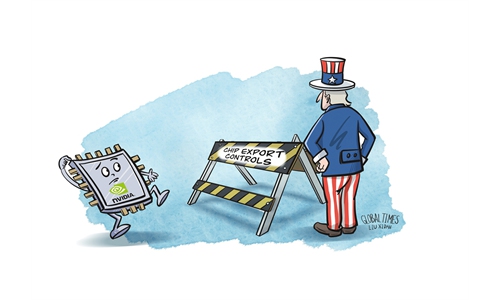
Huang made the remarks when he was received by, in response to Ren's question regarding the US' recently announced indefinite export control on Nvidia's H20 chips to China.
The US government's strengthening of chip export controls has already had a significant impact on Nvidia's business, Huang said.
As a company that has been deeply cultivating the Chinese market for 30 years, Nvidia has grown together with the Chinese market and achieved mutual success. China is not only one of the world's largest consumer markets, its booming industrial ecology and leading software strength have also become important driving forces for the company to continue innovating, Huang said.
The company's success in the Chinese market has driven the company to continuously increase investment in research and development. Moreover, in-depth cooperation with Chinese companies has enabled it to evolve into an even more competitive international enterprise. Therefore, the company will continue to spare no effort in optimizing the product system to meet regulatory requirements and serve the Chinese market unswervingly, Huang said, according to the report.
"The China market is very important to us, and it's important to our growth," Huang told reporters, according to a video posted by China News Service.
Huang's visit to China reflects Nvidia's strong commitment to the Chinese market, Ma Jihua, a veteran telecom industry observer, told the Global Times on Thursday.
Ma noted that the US export controls on chips represent the use of administrative power to dismantle the sector's stable and market-driven global semiconductor supply chain built over the decades. He noted that the US approach has disrupted research and development, innovation and product development, sharply increasing uncertainty and posing a serious risk to the future of the global tech industry.
Huang said the world is now embarking on a fierce artificial intelligence (AI) race. As the most transformative core technology of our time, AI has broad prospects for promoting the development of various industries. Countries around the world are accelerating the application of this technology, as well as research and development, innovation, and promotion, which is bound to have a far-reaching impact on the pattern of the global market, including China.
Nvidia said Tuesday in a filing that the US government informed the company that it requires a license for exporting H20 integrated circuits and any other circuits achieving the H20's memory bandwidth, interconnect bandwidth, or combination thereof to China and other countries on April 9. On Monday, the US government informed the company that the license requirement will be in effect for the indefinite future.
The filing said that the first quarter results are expected to include up to approximately $5.5 billion of charges associated with H20 products for inventory, purchase commitments, and related reserves.
The US Commerce Department said on Tuesday it was issuing new export licensing requirements for Nvidia's H20, AMD's MI308 artificial intelligence chips, as well as their equivalents, to China, Reuters reported.
The volatile US policies are sending "noisy signals," as it is difficult for companies to make effective decisions in such an environment, and downstream customers are under tremendous pressure to make purchasing and production arrangements, said Ma. "If this continues, it won't advance the AI and semiconductor sectors, but could instead set the entire industry back - and US companies will be far from the winners."
The H20 is an AI chip for China that was designed to comply with previously implemented US export restrictions. It generated an estimated $12 billion to $15 billion in revenue in 2024, per the CNBC report.
RELATED ARTICLES