China is fighting not just for its own legal interests but for the global trading system: experts at think tank forum
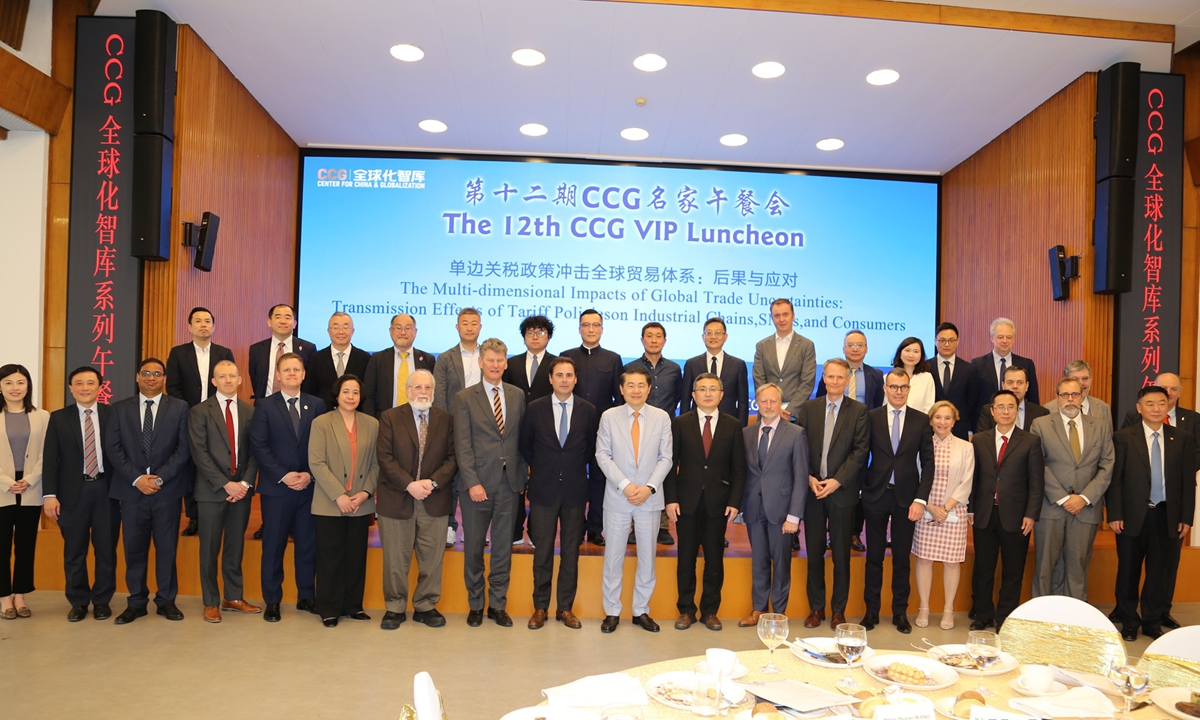
A Chinese expert speaks at the 12th CCG VIP Luncheon in Beijing on April 16, 2025. Photo: Courtesy of CCG
China firmly opposes unilateral tariff policies, not only to safeguard its own legitimate interests but also to protect the multilateral system and defend the global trading system, setting an example for other countries in countering US trade bullying, Chinese trade experts stated at a think tank forum on Wednesday.
Chinese experts also called on other countries to prioritize WTO principles in trade negotiations to uphold the authority and stability of the multilateral system, strengthen multilateral cooperation, and explore more effective ways to resolve disputes.
These remarks were made at a VIP Luncheon hosted by the Center for China and Globalization (CCG) on Wednesday in Beijing. The event focused on the impacts of unilateral tariffs on the global trade order, inviting experts from various fields to discuss how to maintain an open and inclusive international trade system.
The global trading system is currently facing unprecedented strain triggered by unilateral tariff hikes. The tariffs initiated by the US government have caused a chain reaction—supply chain restructuring, cost pass-through effects, and fluctuation in policy expectations that continue to impact economies worldwide, per a CCG statement.
Since the new US administration took office this year, it has adopted unilateral and protectionist policies that severely undermine the normal global trade system under the pretext of "America First," said Ma Jianchun, Chairman of the China Society for World Trade Organization Studies (CWTO) during the meeting.
"The US tariff policies should not be treated as just a US-China issue—it's an attack on global trade rules, which should be addressed through the WTO framework, not just one-on-one negotiations," Ma told the Global Times during a sideline interview at the meeting.
China might be able to handle these protectionist pressures, but as some US officials like to say, many other countries "don't have a hand to play," Ma said, cautioning that if this kind of unilateralism goes unchecked, global trade could spiral into a free-for-all and "law of the jungle," reversing decades of progress under the WTO's rules-based system.
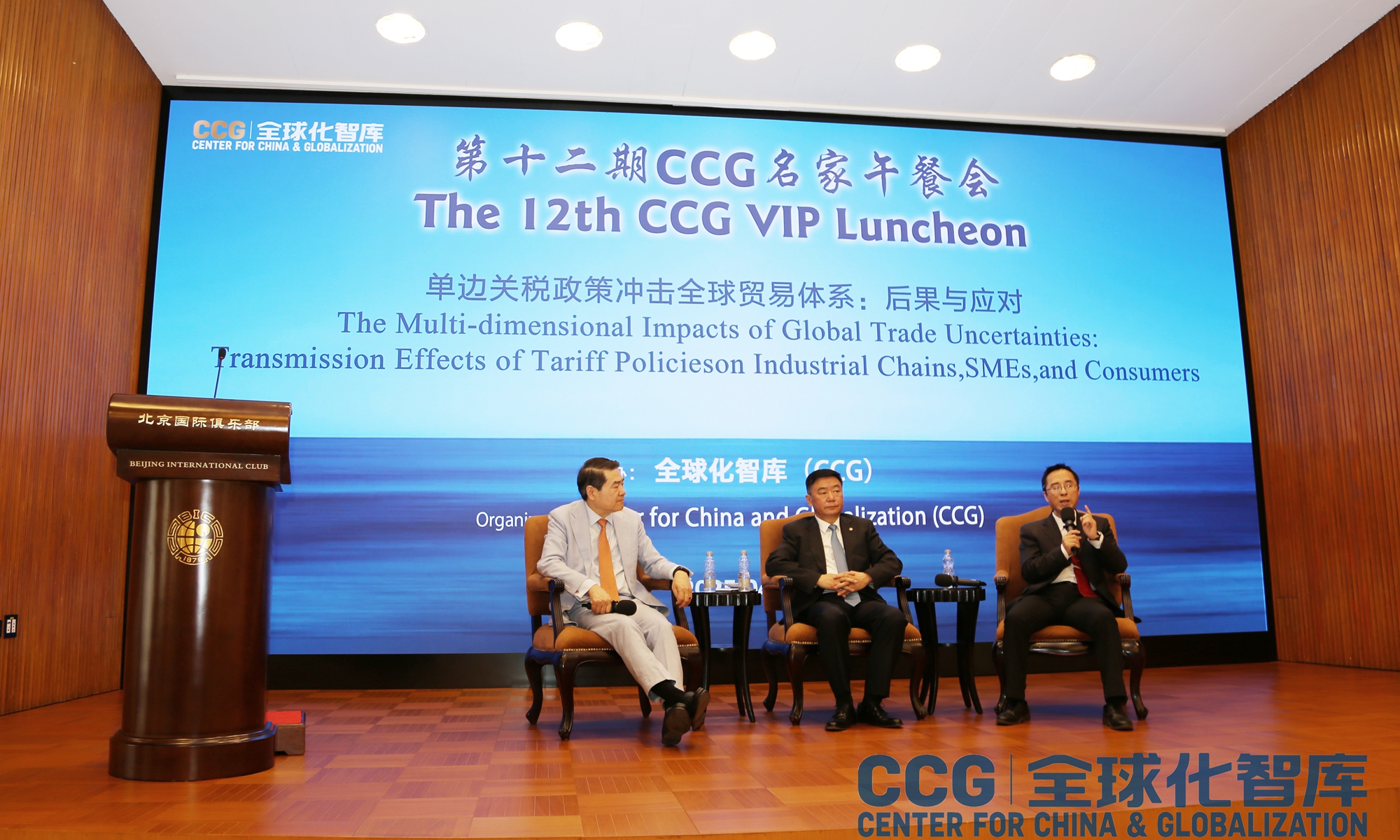
A Chinese expert speaks at the 12th CCG VIP Luncheon in Beijing on April 16, 2025. Photo: Courtesy of CCG
China's role in defending multilateral system
Citing China's reactions against the US tariffs, Ma pointed to China's large economy, strong manufacturing, and vast domestic market, which grant the country sufficient confidence and resilience to resist unfair crackdowns.
"China's firm response to US tariffs is not only about protecting its own legal interests but also about defending the multilateral trading system for all member nations, especially developing economies," Ma emphasized.
Cui Fan, a professor at the School of International Trade and Economics, University of International Business and Economics, shared similar opinions, highlighting the significance of the multilateral system's importance and noting that unpredictability in US trade policies has created deep anxiety for businesses worldwide.
China's countermeasures show its resolve to maintain the multilateral order, Cui said. "If the world's largest trading nation cannot say 'no' to unilateral actions, smaller economies would face even greater pressure in bilateral negotiations."
Cui urged all countries to prioritize WTO principles, especially the principle of non-discrimination, in tariff negotiations with the US to respond to unfair tariffs and preserve the multilateral system for the benefit of all.
China remains open to talks and is expanding market access in sectors like services and education, and the country is safe and resilient due to its production capacity and domestic market despite tariff pressures, Cui said. "Isolating China won't solve the US' trade issues," he added.
Wang Huiyao, president of CCG and former Counsellor of the State Council, criticized US policymakers' mistaken assessment of the global and its own economic situation. The US administration obviously underestimated the 80-year-old world trade system's interconnectedness, Wang told the Global Times.
The US obsesses over its trade deficit but ignores its $300 billion surplus in service trade and the benefits of being the world's largest investment destination, Wang noted. "Imposing tariffs on goods like Apple's iPhone, with China being home to roughly 90 percent of Apple's global production, will ultimately hurt US companies and consumers, as evidenced by price hikes at retailers like Walmart."
Wang further noted that the US should resume dialogue with China, and open communication can de-escalate tensions after this disruptive initial phase.
Call for win-win co-op
As for the tariffs' impacts on global businesses, Onodera Osamu, Director-General of the Beijing office of the Japan External Trade Organization (JETRO), told the Global Times, "The tariffs are significantly high and are affecting corporate profit margins."
Additionally, the uncertainty surrounding US tariffs and other countries' responses creates a challenging environment for businesses. "We hope for stabilization soon, as many companies are currently monitoring developments."
Osamu also expressed Japanese firms' confidence in investing in China. "Even with an around 5 percent GDP growth rate, China continues to add an economy equivalent to some emerging markets combined each year, making its market vast," he said, stressing that Chinese companies are increasingly competitive, advancing in technology and serving as key suppliers and customers.
Osamu said that for Japanese businesses, the Chinese market remains critical, and most Japanese firms are still committed. "Current tariffs may partly affect the dynamic, but a fundamental shift is unlikely," he added.
RELATED ARTICLES