DHL’s suspension of some US-bound parcels a rational strategy to avoid logistic risks under US tariff shadow: expert
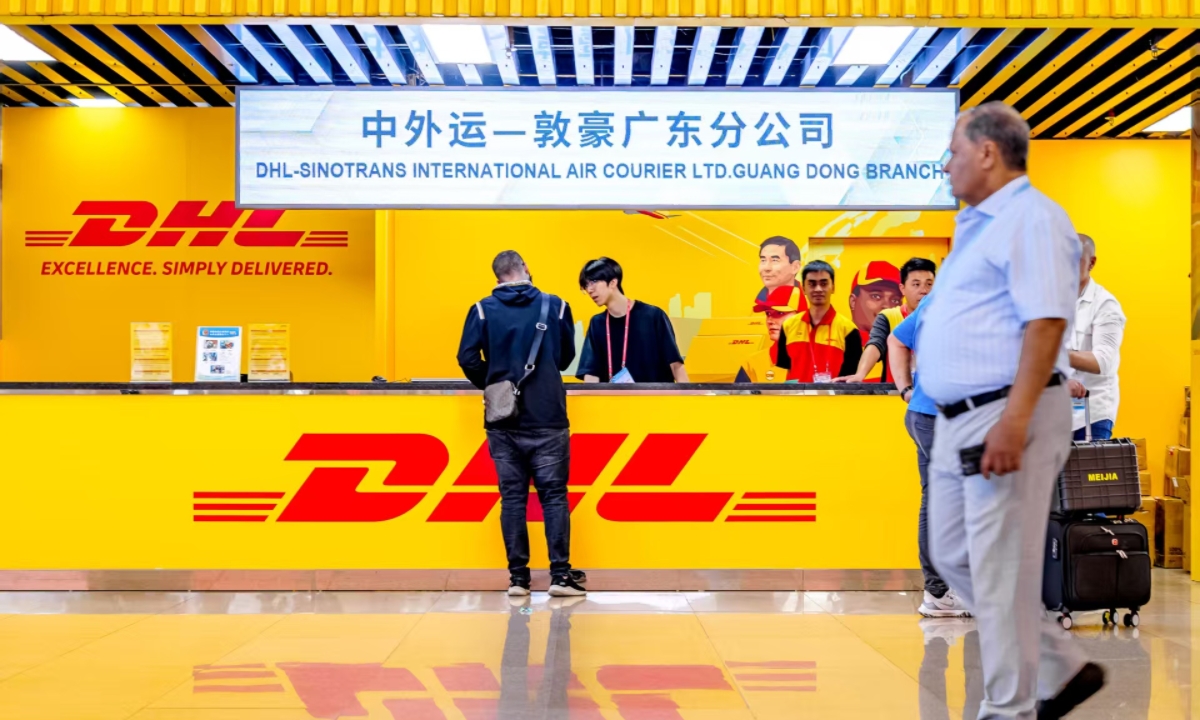
The DHL booth at the 137th Canton Fair in Guangzhou, South China's Guangdong Province, on April 19, 2025 Photo: VCG
Germany's logistics company DHL announced on Monday local time its website that starting from Monday, it has temporarily suspended B2C shipments valued over $800 to individual recipients in the US until further notice. Expert noted that halting shipments is a rational strategy for firms facing tariff-driven uncertainty and warned that mounting unpredictability in US customs policy could further disrupt global trade.
Effective April 5, 2025, all shipments to the US with a declared customs value over $800 require formal entry processing - down from the previous $2,500 threshold due to new US Customs regulations, according to the company's official website.
DHL said it is working to expand clearance capacity but warned that B2C parcels over $800 shipped to the US from any country may experience multi-day delays due to "substantial" changes. B2B shipments are expected to continue, though some delays could still occur.
Germany's DHL is the first major commercial logistics company to take action as a result of new US tariffs, according to Financial Times.
"This change has caused a surge in formal customs clearances, which we are handling around the clock," the company said, "To manage this, starting Monday, April 21, 2025, and until further notice, we will temporarily suspend business-to-consumer (B2C) shipments to private individuals in the US where the declared value exceeds $800."
The US' reckless imposition of tariff has led to a surge in customs declarations, higher paperwork and compliance costs, and mounting pressure on logistics firms — forcing some to suspend shipments to mitigate risks, Gao Lingyun, a researcher at the Chinese Academy of Social Sciences, told the Global Times on Tuesday.
"From a business standpoint, it is more practical for logistics and export firms to halt shipments and renegotiate with US buyers rather than risk delays and sudden cost hikes," Gao said.
Gao noted that the suspension of shipments is a rational risk-mitigation strategy amid growing uncertainty in US customs policy. With frequent and unpredictable regulatory changes, customs officials struggle to keep up, further slowing an already inefficient system.
At a deeper level, Gao suggested that "the root of the problem lies with the US." The mounting uncertainty, he argued, is something policymakers and importers need to seriously reflect on.
John Manners Bell, chief executive of consultancy TI Insight, said it "could be a sign that the global trading system is starting to break," according to Financial Times.
"This could become a major trend as postal offices and commercial carriers struggle to cope with the weight of tariffs and bureaucratic burdens placed on them," he said. "The changes will have real implications for the international e-commerce industry, affecting many millions of parcels that flow every day to US importers, inevitably raising costs for US consumers," according to Financial Times.
On April 16, Hongkong Post announced the suspension of parcel services containing goods to the US, citing "unreasonable, bullying and imposing tariffs abusively." It said it would not collect the so-called tariffs on behalf of the US and warned Hong Kong residents sending packages to the US to be prepared for high and unjustified charges. It has suspended acceptance of surface mail containing goods to the US as of April 16 and will suspend acceptance of airmail containing goods starting April 27.
DHL is one of the world's biggest courier companies, delivering 1.5 billion parcels a year. It employs nearly 600,000 people and operates in 220 countries. Last year, its sales exceeded €84.2 billion, according to Financial Times.
RELATED ARTICLES