Shanghai signs agreement with Toyota ahead of auto show
Industrial strength boosted by high-quality opening-up: experts

Toyota Photo: VCG
The Shanghai municipal government signed a strategic agreement with Toyota on Tuesday to establish a new-energy vehicle (NEV) company in the city's Jinshan district, the latest step in Shanghai's efforts to expand high-level opening-up.
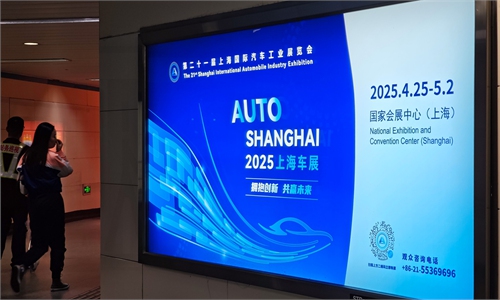
The agreement was clinched ahead of the 2025 Shanghai International Automobile Industry Exhibition, or Auto Shanghai, which will kick off on a record-breaking scale on Wednesday.
The signing of this agreement marks substantial progress in the implementation of the Toyota Lexus new-energy vehicle (NEV) project in Shanghai, the Xinhua News Agency reported, adding that it also holds significant importance for Shanghai's accelerated construction of a modern industrial system.
The investment from Toyota has reached 14.6 billion yuan ($2 billion), according to the report, adding that construction will be started in June, and the first vehicle will be manufactured in 2027. After the project is completed, it will be another globally influential NEV initiative in Shanghai following the Tesla Gigafactory in the city.
China is home to a globally leading NEV market, backed up with cutting-edge battery technology and a full-blown supply chain, which will significantly benefit the Lexus NEV project, Zhang Xiang, director of the Digital Automotive International Cooperation Research Center of the World Digital Economy Forum, told the Global Times on Tuesday.
On February 5, the Japanese automaker announced plans to establish a wholly owned research and production company for Lexus electric vehicles (EVs) and batteries in Shanghai. The project is scheduled to begin operations in 2027, according to Toyota's official website.
Toyota noted that the Chinese market has strong demand for NEVs, particularly EVs, and China leads globally in related technology innovations. Toyota will engage in the application of advanced technologies in areas such as logistics, intelligent autonomous driving, and battery recycling and reuse, while cooperating with enterprises throughout the supply chain.
Shanghai is in a leading position in the nation's overall opening-up, as it boasts active capital markets and mature manufacturing systems in surrounding regions, as well as having the most important business climate for international investors. These factors are igniting a new development opportunity for the local automobile industry, Hu Qimu, a deputy secretary-general of the Digital-Real Economies Integration Forum 50, told the Global Times on Tuesday.
Prior to the Lexus EV project announcement, Tesla launched production at its new factory in Shanghai for its energy storage system, the first of its kind built by Tesla outside the US, on February 11. The first batch of Megapack units departed Shanghai for Australia on March 21, according to a statement Tesla provided to the Global Times.
Additionally, on April 15, a total of 3,499 Tesla EVs, including 3,015 new Model Ys made at the Shanghai Gigafactory, were loaded onto a roll-on/roll-off ship in Shanghai. This marked the factory's first overseas delivery of the new Model Y, thepaper.cn reported.
Tesla's Shanghai Gigafactory has become a benchmark for the global NEV industry, represented by stable output, manageable costs and the backing of the world's largest auto consumption market, said Hu. "What's more, Shanghai's firm stance on supporting opening-up conveys to international businesses that if an industry leader can succeed, others can share in the common growth opportunities."
The local development of the automobile industry is reflected in the annual auto show. The 2025 Auto Shanghai will be held at the National Exhibition and Convention Center Shanghai through May 2, according to the organizers. Nearly 1,000 leading Chinese and foreign enterprises from 26 countries and regions will attend the show, which spans over a record of 360,000 square meters.
For foreign auto giants, the 2025 Shanghai auto show is seen as a significant demonstration of their continued commitment to the Chinese market, said analysts.
Li Yong, a senior research fellow at the China Association of International Trade, told the Global Times on Tuesday that China's rise in the automotive sector, particularly in NEVs, makes it an essential market for global players.
Amid rising tariff barriers and protectionism disrupting the global vehicle landscape, China stands out for its steadfast commitment to opening-up. "The government's continuous introduction of opening-up policies has created a thriving business environment and the strong turnout at the Shanghai auto show clearly reflects that," Li said.
RELATED ARTICLES