Illustration: Xia Qing/GT
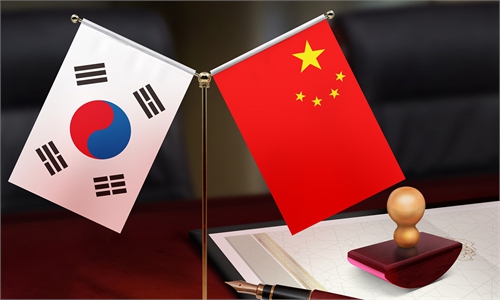
As South Korea gears up to host welcoming events for international tourists, starting this week, it presents a lens through which to observe the complex and multifaceted cooperation between South Korea and its economic partners, including China.The Yonhap News Agency reported on Tuesday that South Korea is preparing to host the "2025 Korea Welcome Week" from April 25 to May 16. This event is scheduled to coincide with holiday seasons, including China's May Day holidays, and the senior officials' meeting of the Asia-Pacific Economic Cooperation (APEC) Summit, which will take place on the resort island of Jeju in South Korea. Traditionally, this period experiences a significant increase in international visitors.
The tourism sector plays an important role in South Korea's economy. According to a study by the World Travel & Tourism Council released in June 2024, the tourism industry was projected to account for 4.3 percent of the nation's economy. The Korea Herald reported that foreign visitors spent more money than ever, pouring 9.26 trillion won ($6.39 billion) into the local economy in 2024 - a 33.8 percent increase from the previous year.
Chinese tourists have long played an important role in the tourism sector of South Korea. According to the Korea Herald, South Korea greeted 16.37 million international visitors last year, among which Chinese tourists represented the largest contingent, numbering 4.6 million. The allure of duty-free shopping and the filming locations of popular K-dramas were major attractions.
With a population of 1.4 billion, China stands as the world's largest source of outbound tourists. The growing Chinese middle class, with its increasing disposable income, is becoming a significant source of global tourism revenue. This trend presents significant opportunities for the tourism industries and economic growth of many countries, including South Korea. According to the Chinese Economic Times, an influx of 1 million Chinese group tourists could boost South Korea's GDP growth by 0.08 percentage points.
Amid a challenging and complex global landscape, China's economy has demonstrated notable resilience and stability, consistently offering new opportunities for the global economy. This trend extends beyond the realm of goods trade, which includes sectors like semiconductors and automotive components, and is increasingly evident in the services sector, covering areas such as tourism, healthcare and finance.
In recent years, China has consistently expanded the openness of its services sector, thereby offering significant opportunities for development within these areas. This expansion has contributed to injecting greater certainty and stability into the global economic landscape. On Monday, Ling Ji, vice minister of commerce and deputy China international trade representative, said that China is accelerating the expansion of pilot programs for the services sector, further expanding independent and unilateral opening-up in an orderly manner.
In the face of rising global unilateralism and protectionism, the East Asian economy is facing several challenges. The US tariff policies have undermined the global free trade system, potentially impacting exports from East Asian economies, including South Korea. Regardless of whether these economies can secure partial exemptions from the tariffs, it is unlikely that they will be completely immune to the adverse effects that US tariff policies have on the Asian economy.
However, from a positive perspective, relying on a series of bilateral and multilateral free trade agreements, China and other Asian countries, including South Korea, have established a complex and diverse network of trade and industrial chains that span various sectors from manufacturing to services. The development of the tourism industry between China and South Korea is just the tip of the iceberg of this intricate network, which helps to showcase the resilience and dynamism of the Asian goods and services industry chain.
The US tariffs - primarily focused on goods trade - may indeed pose challenges to the manufacturing industry chain, especially in certain areas such as automobiles. However, China's continued market opening - encompassing almost everything from goods trade to services trade, along with the demand for cooperation in this region - is also providing broader support to the local economies, injecting stability into the region's economic development.
The author is a reporter with the Global Times. bizopinion@globaltimes.com.cn
RELATED ARTICLES