Land-sea corridor highlights resilience of China’s trade amid external challenges
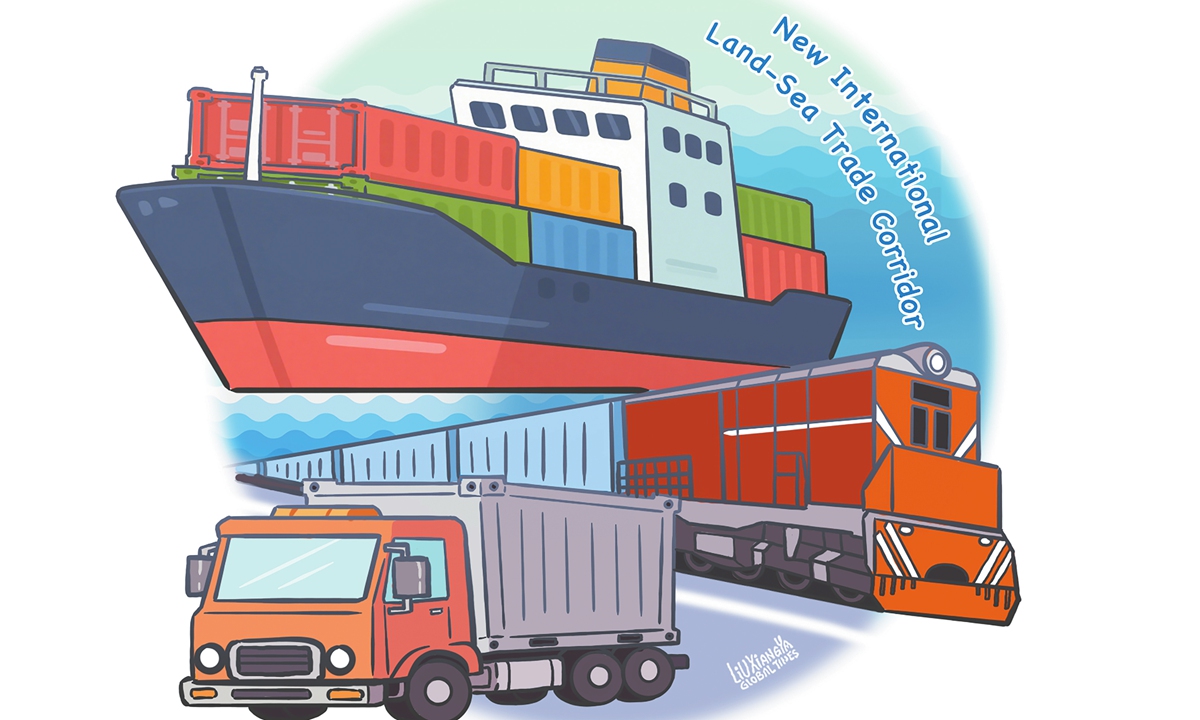
Illustration: Liu Xiangya/GT
In the first quarter of this year, China's trade through the New International Land-Sea Trade Corridor exceeded 200 billion yuan ($27.4 billion), reflecting year-on-year growth of more than 10 percent, CCTV News reported on Wednesday. This progress highlights the resilience of and potential for diversified expansion in China's foreign trade, especially in the face of increasing global unilateralism and protectionism.The corridor is a joint endeavor of China's western provinces and ASEAN member states. Centered around China's Chongqing Municipality as a pivotal hub, this initiative extends through various western provinces and cities in China, utilizing a comprehensive network of rail, sea and road transport. It stretches southward, connecting to the world through coastal and border ports in Southwest China's Yunnan Province and South China's Guangxi Zhuang Autonomous Region, thereby facilitating access to ASEAN member states, Belt and Road Initiative (BRI) partner countries and beyond. This innovative corridor significantly reduces transit times compared with traditional sea routes along China's eastern coast.
In 2019, the Chinese government unveiled a master plan for the New International Land-Sea Trade Corridor. Over the past five years, this corridor has established connections with 563 ports in 127 countries and regions around the globe, enabling the transportation of more than 1,250 types of goods. By optimizing the logistics network through multimodal transport, the corridor's logistics hub function is continuously strengthened. This development provides enterprises in the western region with a more convenient route to the sea, reducing logistics costs and improving transportation efficiency, facilitating trade liberalization. As a result, this corridor has greatly tapped into the foreign trade capabilities of China's central and western areas.
The corridor's development does more than just enhance logistical efficiency; it also paves the way for industries to move westward. It has promoted the development of the manufacturing industry in Western China, thereby diversifying and strengthening economic resilience.
This upgrade has improved the ability to support industries, providing comprehensive logistics solutions that benefit automotive firms in the region, the Xinhua News Agency reported in January. Furthermore, the rollout of the New International Land-Sea Trade Corridor is fostering growth in sectors such as mechanical equipment manufacturing in the western parts of China. Equipment manufacturing companies in the region have accelerated their digital and intelligent transformation as a means to promote high-quality development, Xinhua reported on Tuesday.
Taking Chongqing as an example, the city's manufacturing sector is experiencing rapid growth. From January to August 2024, car production in the city reached 1.54 million units, an increase of 11 percent year-on-year, making it the second-highest in the country by output. The production of new-energy vehicles surged to 525,000 units, representing impressive growth of 151.4 percent. During the same period, Chongqing became a global leader in laptop production, with 44.832 million units manufactured; its integrated circuit output soared to 4.47 billion pieces, a jump of 111.9 percent, and LCD panel production increased to 250 million pieces, up by 24.9 percent.
This suggests that the corridor's development, coupled with various factors, has paved the way for industrial clustering, driving regions along the route to accelerate industrial upgrading. This industrial leap forward, in turn, bolsters China's foreign trade by unlocking the western regions' trade potential, enhancing trade relations with ASEAN and other BRI partner countries, diversifying China's trade portfolio, and significantly boosting the inherent strength and resilience of its foreign trade sector.
While expanding exports to countries like those in Southeast Asia, China is also facilitating its imports from these regions through the corridor. This corridor has opened up significant market opportunities for regional economies, leading to mutually beneficial economic and trade cooperation. High-quality agricultural products from countries such as Vietnam, Cambodia, Thailand, Malaysia and Indonesia are continuously entering the Chinese market and making their way onto the dining tables of Chinese families. Meanwhile, China's exports of new-energy items, new materials and electromechanical products are being shipped overseas, supporting the economic development of ASEAN member states.
In the short term, US tariff policies might put pressure on China's economy and the nation's global trade. However, it's unlikely to alter China's fundamentally positive long-term trade outlook. China's international trade has showed remarkable resilience and potential, growing stronger over time. The development of the New International Land-Sea Trade Corridor highlights this positive trend, showcasing its ongoing diversification and enhanced capacity to handle external challenges.
The author is a reporter with the Global Times. bizopinion@globaltimes.com.cn
RELATED ARTICLES