BRI cooperation to help boost trade amid rising protectionism: ex-Malaysian official
Bulwarks of multilateralism
By Published: Apr 27, 2025 09:17 PM

Editor's Note:
The role of the Global South as a stabilizing force in today's increasingly complex and uncertain world has been increasingly highlighted, as unilateralism and protectionism are rampant. How will such a role underpin regional and global development? How will the Belt and Road Initiative (BRI) further boost cooperation among countries in Southeast Asia? In an interview with Global Times' Chu Daye (GT), Ong Tee Keat, president of Belt and Road Initiative Caucus for Asia Pacific and former deputy speaker of the lower house of the Malaysian Parliament, shared his views on these questions as well as China-Malaysia BRI cooperation.

GT: On April 17, China and Malaysia vowed in a joint statement to promote the implementation of the BRI Cooperation Plan signed in 2024 and further align their development strategies. Looking at 2025, what are the key growth highlights of China-Malaysia BRI cooperation?
Ong: Under the BRI, completion of the East Coast Rail Link (ECRL) by the end of 2027 is set to enhance the logistical connectivity between both the west and east coasts of Peninsular Malaysia, enhancing the development potential of the latter where the Kuantan Industrial Park is located. This is deemed conducive to wooing more Chinese investments on-board.
The new phase of high-quality BRI development will give the "Two Countries, Twin Parks" project a renewed boost with the influx of new economic drivers in digital and green transition from China. Collaboration on renewable tech with China's CATL and the location of Huawei's ASEAN hub in Malaysia bode well to boost Malaysia in realizing its agenda for sustainable development.

GT: Now that the BRI has entered its second decade, how do you view the role of the China-proposed initiative in driving global economic and trade growth? What's your response to certain claims such as "China overcapacity" and "debt-trap" hyped by some in the West?
Ong: Entering into the second decade, the BRI is heading to a new phase of high-quality development with priorities on sustainable digital and green transition, alongside "small yet beautiful" projects. The BRI is forecast to boost global trade by 6.2 percent, according to a World Bank report.
On the alleged "China overcapacity," the claim is merely part of the West's geopolitical semantics intended to curb market competition when exports of China's affordable tech products, like electric vehicles (EVs) and solar panels take the world by storm. It's a denial of the global division of labor theory and the norms of international trade through which overall production and consumption efficiency are to be maximized. Nations export products in which they have a comparative advantage and import those in which they have a comparative disadvantage.
The "Debt Trap Theory" label was disproved as "unfounded" in the global narratives circle, albeit still being recycled repeatedly by some spin doctors.
GT: You recently attended the 2025 Boao Forum for Asia Annual Conference, what chief message did you get, as the world faces turbulent protectionist headwinds? What roles do the Global South and emerging market economies play in this new environment?
Ong: I was given the privilege of attending a sub-forum, and was impressed by the diversity of topics deemed relevant and convergent toward building a shared future for Asia.
Amid rising protectionism, the Global South and emerging markets are increasingly poised to be alternative engines of global growth, accounting for over 50 percent of global GDP growth.
These developing nations, including ASEAN, BRICS, and African Union members, are presently the rare bulwarks of multilateralism left in driving regional integration to counter trade fragmentation. Leveraging on digital economy and diversification of supply chains, alongside closer South-South cooperation, the evolving dynamics are set to reshape the world order into a multipolar model.
GT: What are the prospects for China-ASEAN economic and trade cooperation in 2025? How the two sides should boost cooperation amid the current complex international situation?
Ong: China-ASEAN economic and trade cooperation looks set to scale greater heights in 2025 with the upcoming conclusion of CAFTA 3.0. Digital economy, green transition and cross-border e-commerce are the key initiatives for driving such cooperation.
The ASEAN-China Digital Economy Partnership Agreement marks a new milestone in digital integration, while the influx of Chinese investments in the manufacturing of EV batteries in ASEAN will set the green transition in motion in the China-ASEAN economic cooperation.
GT: As a former Malaysian Transport Minister, how do you view the prospects of and some solid progress made by the Trans-Asian Railway?
Ong: The Trans-Asian Railway is a transformative endeavor of infrastructural connectivity linking China with Peninsular ASEAN. Having fostered the Kunming- Vientiane - Bangkok connectivity in the north helps keep the project active, while the Kuala Lumpur-Singapore HSR in the south remains straight-jacketed by the finance gap. The project is a litmus test to the political will of the respective stakeholder nations in the region in the face of global geopolitical challenges.
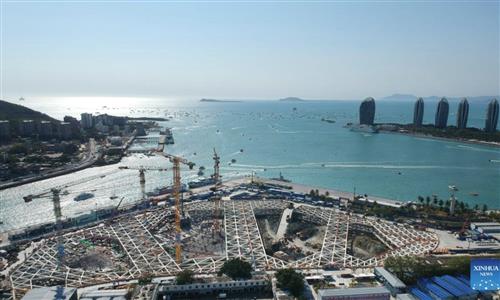
GT: As China's Hainan Province intensifies efforts to build itself into a free trade port, what opportunities and challenges do you see in 2025?
Ong: While building Hainan into a free trade port in 2025, its central locality within the sphere of RCEP is yet to be fully harnessed to integrate it into the free trade bloc.
The zero-tariff policies and eased cross-border data flows constitute an appealing pull to multinationals to have their headquarters in Hainan, alongside visa-free access to 59 nations that helps enhance its tourism potential.
In green finance, Hainan's carbon trading hub may cover 15 percent of China's carbon market by 2025. It should explore beyond China and tap into the huge potential of rainforests for carbon credit in Southeast Asia.
The role of the Global South as a stabilizing force in today's increasingly complex and uncertain world has been increasingly highlighted, as unilateralism and protectionism are rampant. How will such a role underpin regional and global development? How will the Belt and Road Initiative (BRI) further boost cooperation among countries in Southeast Asia? In an interview with Global Times' Chu Daye (GT), Ong Tee Keat, president of Belt and Road Initiative Caucus for Asia Pacific and former deputy speaker of the lower house of the Malaysian Parliament, shared his views on these questions as well as China-Malaysia BRI cooperation.
A machine is laying tracks on the East Coast Rail Link project in Malaysia. File photo: Courtesy of China Communications Construction Co
GT: On April 17, China and Malaysia vowed in a joint statement to promote the implementation of the BRI Cooperation Plan signed in 2024 and further align their development strategies. Looking at 2025, what are the key growth highlights of China-Malaysia BRI cooperation?
Ong: Under the BRI, completion of the East Coast Rail Link (ECRL) by the end of 2027 is set to enhance the logistical connectivity between both the west and east coasts of Peninsular Malaysia, enhancing the development potential of the latter where the Kuantan Industrial Park is located. This is deemed conducive to wooing more Chinese investments on-board.
The new phase of high-quality BRI development will give the "Two Countries, Twin Parks" project a renewed boost with the influx of new economic drivers in digital and green transition from China. Collaboration on renewable tech with China's CATL and the location of Huawei's ASEAN hub in Malaysia bode well to boost Malaysia in realizing its agenda for sustainable development.
Ong Tee Keat. Photo: Courtesy of OTK
GT: Now that the BRI has entered its second decade, how do you view the role of the China-proposed initiative in driving global economic and trade growth? What's your response to certain claims such as "China overcapacity" and "debt-trap" hyped by some in the West?
Ong: Entering into the second decade, the BRI is heading to a new phase of high-quality development with priorities on sustainable digital and green transition, alongside "small yet beautiful" projects. The BRI is forecast to boost global trade by 6.2 percent, according to a World Bank report.
On the alleged "China overcapacity," the claim is merely part of the West's geopolitical semantics intended to curb market competition when exports of China's affordable tech products, like electric vehicles (EVs) and solar panels take the world by storm. It's a denial of the global division of labor theory and the norms of international trade through which overall production and consumption efficiency are to be maximized. Nations export products in which they have a comparative advantage and import those in which they have a comparative disadvantage.
The "Debt Trap Theory" label was disproved as "unfounded" in the global narratives circle, albeit still being recycled repeatedly by some spin doctors.
GT: You recently attended the 2025 Boao Forum for Asia Annual Conference, what chief message did you get, as the world faces turbulent protectionist headwinds? What roles do the Global South and emerging market economies play in this new environment?
Ong: I was given the privilege of attending a sub-forum, and was impressed by the diversity of topics deemed relevant and convergent toward building a shared future for Asia.
Amid rising protectionism, the Global South and emerging markets are increasingly poised to be alternative engines of global growth, accounting for over 50 percent of global GDP growth.
These developing nations, including ASEAN, BRICS, and African Union members, are presently the rare bulwarks of multilateralism left in driving regional integration to counter trade fragmentation. Leveraging on digital economy and diversification of supply chains, alongside closer South-South cooperation, the evolving dynamics are set to reshape the world order into a multipolar model.
GT: What are the prospects for China-ASEAN economic and trade cooperation in 2025? How the two sides should boost cooperation amid the current complex international situation?
Ong: China-ASEAN economic and trade cooperation looks set to scale greater heights in 2025 with the upcoming conclusion of CAFTA 3.0. Digital economy, green transition and cross-border e-commerce are the key initiatives for driving such cooperation.
The ASEAN-China Digital Economy Partnership Agreement marks a new milestone in digital integration, while the influx of Chinese investments in the manufacturing of EV batteries in ASEAN will set the green transition in motion in the China-ASEAN economic cooperation.
GT: As a former Malaysian Transport Minister, how do you view the prospects of and some solid progress made by the Trans-Asian Railway?
Ong: The Trans-Asian Railway is a transformative endeavor of infrastructural connectivity linking China with Peninsular ASEAN. Having fostered the Kunming- Vientiane - Bangkok connectivity in the north helps keep the project active, while the Kuala Lumpur-Singapore HSR in the south remains straight-jacketed by the finance gap. The project is a litmus test to the political will of the respective stakeholder nations in the region in the face of global geopolitical challenges.
GT: As China's Hainan Province intensifies efforts to build itself into a free trade port, what opportunities and challenges do you see in 2025?
Ong: While building Hainan into a free trade port in 2025, its central locality within the sphere of RCEP is yet to be fully harnessed to integrate it into the free trade bloc.
The zero-tariff policies and eased cross-border data flows constitute an appealing pull to multinationals to have their headquarters in Hainan, alongside visa-free access to 59 nations that helps enhance its tourism potential.
In green finance, Hainan's carbon trading hub may cover 15 percent of China's carbon market by 2025. It should explore beyond China and tap into the huge potential of rainforests for carbon credit in Southeast Asia.
RELATED ARTICLES