Any single market volatility has limited impact on China’s foreign exchange reserves: PBC official on US treasury fluctuations
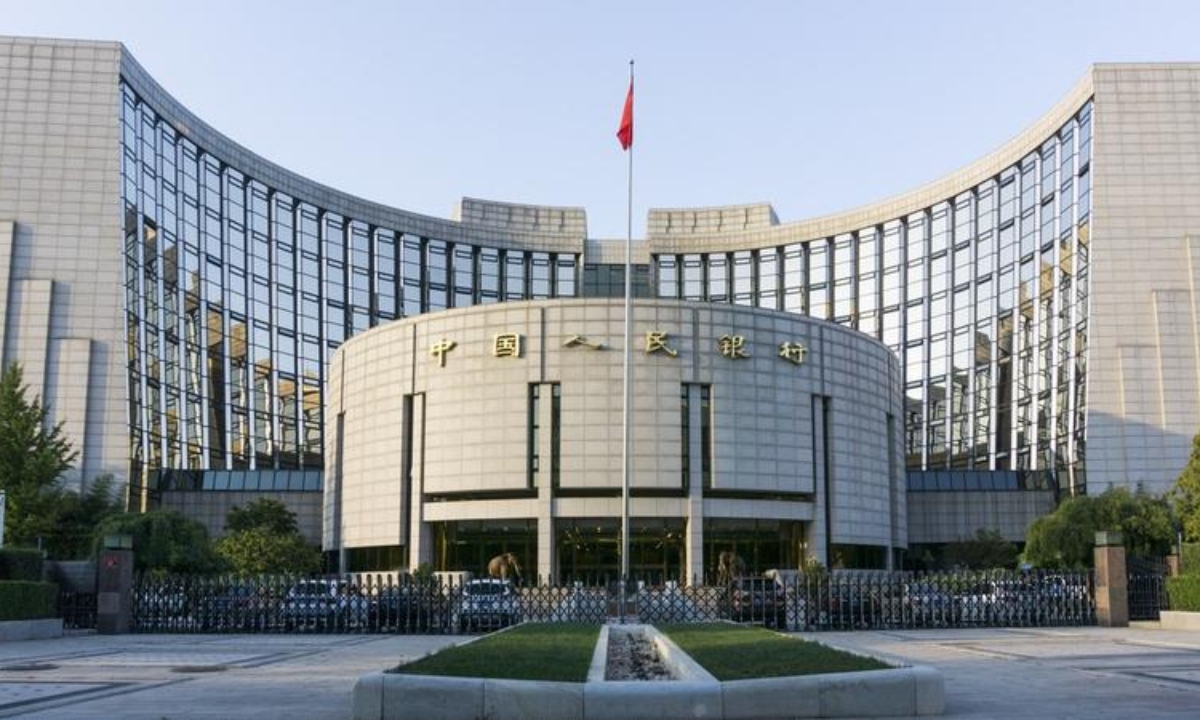
The headquarters of the People's Bank of China in Beijing Photo: IC
China's foreign exchange reserves adhere to the principles of safety, liquidity, and value preservation and appreciation, and have been managed according to market-oriented and professional principles in international financial markets, while fluctuations in any single market or asset have a limited overall impact on China's foreign exchange reserves, Zou Lan, deputy governor of the People's Bank of China (PBC), said on Monday.
Zou made the remarks at a press conference in response to a question about the impact of US treasury and US dollar exchange rate volatility on the Chinese market.
"Recently, the US announced significant tariff hikes on multiple economies, which seriously infringes on the legitimate rights and interests of other countries, undermines the rules-based multilateral governance system, disrupting the global economic order, and jeopardizing long-term global economic stability," Zou said.
The US' tariff measures have triggered severe volatility in global financial markets, with investors' risk aversion toward dollar-denominated assets rising sharply. This has led to a significant depreciation of the US Dollar Index, surge in US Treasury yields, and intensified fluctuations in US equities, while global asset portfolios undergo regional rebalancing, according to the official.
"However, China's economy had a strong start this year, continuing its recovery momentum. The country's financial system remains robust and financial markets have shown strong resilience and stable operations, with the yuan's exchange rate stabilizing around 7.3 against the US dollar," Zou said. He said China's solid economic fundamentals, balanced international payments, resilient foreign exchange markets will continue to provide robust support for maintaining basic stability in the yuan's exchange rate.
First, China has solid economic fundamentals. A recent meeting of the Political Bureau of the Communist Party of China Central Committee made important arrangements for recent economic work. China's economy remains on the upward trajectory, and the country is addressing the uncertainty of drastic changes in the external environment with the certainty of the country's high-quality development, Zou said.
Additionally, Chinese export enterprises are proactively diversifying markets and swiftly adapting to shifts in global demand. The opening-up of the financial markets and enhanced cross-border investment facilitation have attracted stable inflows of long-term foreign capital, according to the official.
China's foreign exchange market remains resilient, the official said. "Market participants have demonstrated greater maturity and rationality, with an increased use of foreign exchange derivatives for hedging and a rising share of yuan-denominated cross-border transactions. These developments have strengthened the market's capacity to absorb external shocks," he said, noting that China's foreign exchange reserves have remained stable above $3.2 trillion in recent months.
In the next phase, the PBC will continue to implement a moderately loose monetary policy to further support the real economy. Meanwhile, the PBC will adhere to a managed floating exchange rate regime based on market supply and demand, with reference to a basket of currencies, while upholding the decisive role of the market in exchange rate formation in a bid to strengthen foreign exchange market resilience, stabilize market expectations and maintain the yuan's exchange rate at a reasonable and balanced level, according to Zou.
Zou said the central bank will accelerate the implementation of proactive and effective macro policies, and make full use of a more proactive fiscal policy and a moderately loose monetary policy, with reserve requirement ratio and interest rates to be lowered at appropriate time depending on domestic and international economic situations and financial market performance.
Zou said that the central bank is also exploring ways to enrich its policy toolkit and will introduce incremental policies in a timely manner to support employment, businesses, the market and expectations aiming to effectively consolidate the fundamentals of the country's economic development and social stability.
RELATED ARTICLES