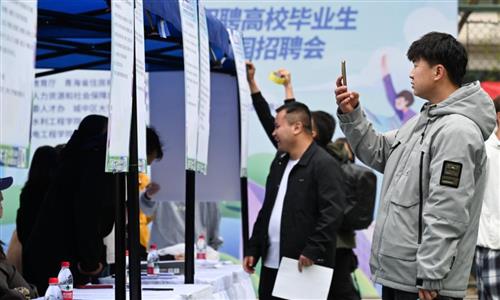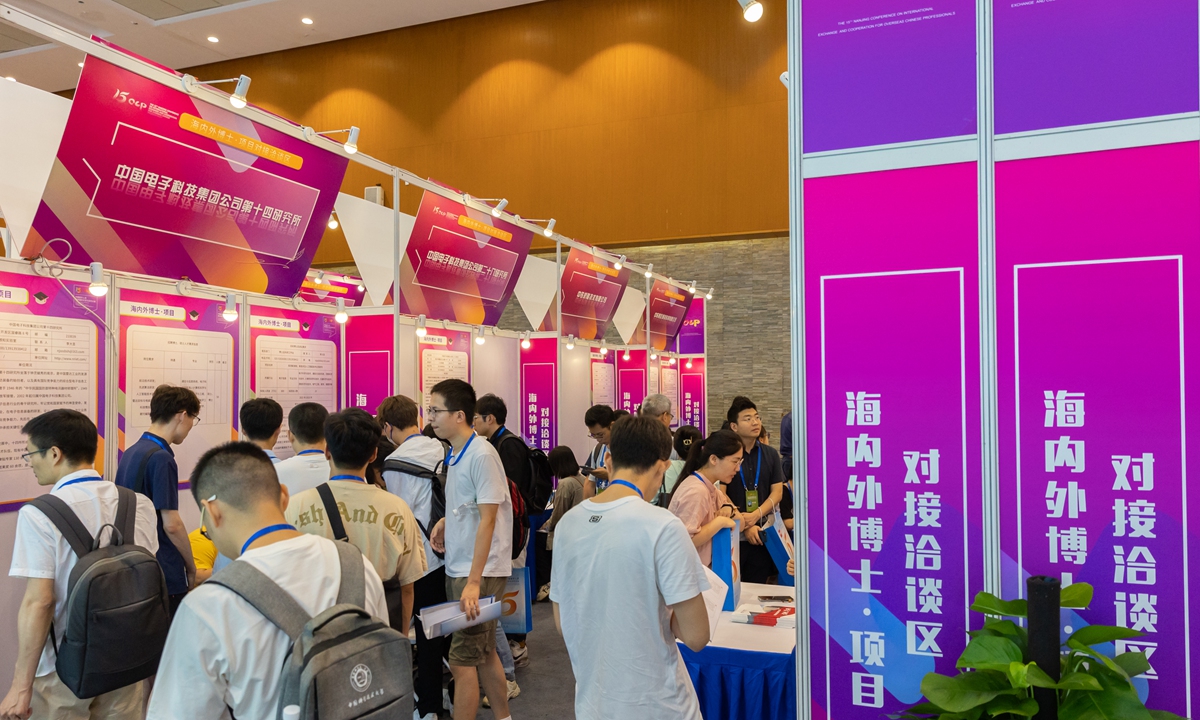
Overseas graduates hunt jobs in a fair held in Nanjing, East China's Jiangsu Province on June 28, 2023. Photo: VCG
A Chinese human resources official said on Monday that the country's job market remained generally stable in the first quarter of the year, while pledging to accelerate the rollout of additional policy measures to ensure employment stability throughout the year despite pressures from US tariffs.
China created 3.08 million new urban jobs in the first quarter, an increase of 50,000 from the same period last year and ahead of the typical pace, Yu Jiadong, vice minister of the Ministry of Human Resources and Social Security, said at a press conference hosted at the State Council Information Office on Monday.
Yu said that authorities had conducted thorough and objective assessments of this year's employment situation and maintained a well-stocked "policy toolbox" to respond to changes.
"Policy reserves have been prepared to encourage companies to expand hiring, support firms in retaining jobs, and promote employment and entrepreneurship for the unemployed, with new measures ready to be rolled out as needed," Yu noted.
At the same time, Yu warned that while China's economic recovery is gaining momentum, the foundation remains fragile and external shocks are intensifying.
Successive rounds of steep US tariff hikes have increased operating difficulties faced by some export-oriented enterprises, impacting certain jobs and adding pressure to the overall employment situation, according to Yu.
To ensure overall stability in China's labor market, the official vowed to expand job creation, strengthen supportive policies, safeguard employment in key sectors, boost skills training, and optimize employment services.
The ministry will step up the introduction of incremental policies, including increasing support for enterprises to expand hiring, enhancing employment subsidies for individuals, and adopting other targeted measures, Yu said.
"For companies heavily affected by tariffs, we will raise the proportion of unemployment insurance refunds aimed at stabilizing jobs," he emphasized.
He also stressed the need to fully implement existing measures, such as accelerating the disbursement of job stabilization refunds, guaranteeing loans, and distributing employment subsidies.
"We've already raised credit ceilings for job-stabilization loans - up to 50 million yuan ($6.9 million) for SMEs and 10 million yuan for individuals. Recently, together with the Ministry of Finance, we allocated 66.7 billion yuan in central employment subsidies to ensure the smooth implementation of relevant policies," Yu said.
Yu also emphasized the need to continuously tap into new employment opportunities by focusing on key areas such as new quality productive forces, major project implementation, and the provision of basic public services.
Meanwhile, authorities will actively explore new growth points for employment. Labor market data showed that in the first quarter, recruitment demand grew year-on-year in sectors such as household services, transportation and logistics. Demand for artificial intelligence roles, such as robotics algorithm engineers, surged by more than 30 percent, reflecting strong underlying potential in the job market, Yu added.
Global Times
RELATED ARTICLES