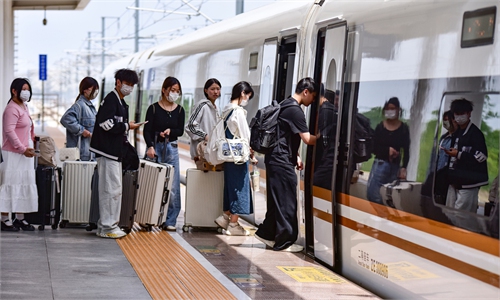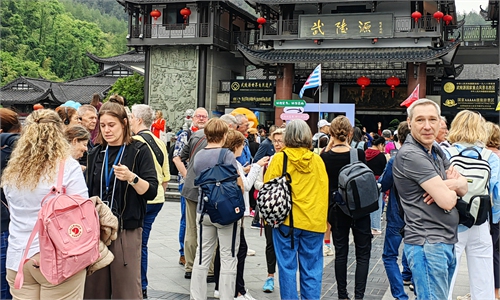
Tourists visit Jiabang terrace fields in Congjiang county, Southwest China’s Guizhou Province on April 26, 2025. Photo: VCG
When asked to design a five-day low-density domestic itinerary in China for the May Day holidays, DeepSeek, a Chinese artificial intelligence (AI) model, recommended a route to Xiahe and Luqu counties in Northwest China’s Gansu Province, areas that may be unknown to many travelers.
The recommendation was based on the counties’ beautiful scenery, while tourists are able to get close to nature, and most importantly, the number of visitors is low – at approximately 1,000 people per day at some attractions, according to DeepSeek.
The itinerary includes attractions such as the grasslands of Zhagana's and snow-capped mountains, birdwatching at Gahai Lake, horseback riding through Sangke Grassland and trekking along the Road of Joseph Rock, the Austrian-American explorer and botanist.
AI-planned countryside tourism also gained popularity, with the rise of places such as the Jiangba terrace fields in Southwest China’s Guizhou Province, as travelers search for less-crowded areas.
High-tech planning
Using AI to plan travel routes is currently trending on Chinese social media platforms, with users posting their AI-curated “hidden gems” for the upcoming May Day holidays, hoping to avoid the invariably overcrowded tourist attractions.
According to data Tongcheng Travel shared with the Global Times, travel popularity during the May Day holidays may reach its peak in nearly three years. On Meituan, an e-commerce platform, searches for “May Day holiday travel” has surged by 500 percent since mid-April, while searches for tourist attractions surged by 167 percent.
According to data from Tuniu.com, an online travel platform, the number of domestic travel reservations for the May Day holidays increased by more than 100 percent compared with the same period in 2024. Domestic long-distance travel has become mainstream, accounting for 46 percent of travel reservations on Tuniu.com.
Along with the surging holiday travels, the application of AI technology in tourism services is accelerating the industry’s high-quality development.
By analyzing vast datasets, AI can accurately recommend premium travel itineraries, avoiding potential misinformation online, while offering more transparent and convenient options, Song Ding, a research fellow at the China Development Institute, told the Global Times on Monday.
“Today’s travel demands have shifted from quantity to quality, with personalization and diversity becoming the norm. AI-powered itinerary planning and immersive experiences epitomize this trend, marking a stark contrast to the travel patterns of two decades ago,” said Song.
Meanwhile, AI technologies are being applied not only among tourists but also at scenic sites, aiming to better serve visitors.
In January, Chinese tech firm Baidu collaborated with multiple government ministries to launch an AI-powered rural travel recommendation assistant.
The intelligent agent leverages Baidu’s ERNIE large model in natural language processing and information retrieval to analyze 1,348 premium rural tourism routes released by the Ministry of Culture and Tourism over the past three years, providing personalized rural travel itineraries based on users’ preferences, according to media reports.
Besides outdoor "hard work" activities like hiking and mountain climbing recommended by AI to avoid huge crowds, immersive projects are trending – visitors now deeply engage in shows and games through role-playing and interactive tasks.
This trend not only meets travelers' growing desire for unique and personalized experiences but also enhances the appeal of cultural tourism by fostering emotional connections and encouraging hands-on participation, analysts said.
Wang Yuhao, a 30-year-old traveler, told the Global Times on Monday that he used AI to plan his trip from Shanghai to East China’s Shandong Province, aiming to avoid crowds and discover new tourist attractions. Wang had an impressive experience participating in the immersive detective game named "The Awakening Brewer" at the Tsingtao Beer Museum in Qingdao following AI-supported recommendations.
According to a report by Qingdao Evening News, the game “transports” participants back to 1913, when Tsingtao Brewery was selecting apprentice brewers to become the master brewer's protege. But at this critical moment, the overseer in charge of the selection is attacked. Who is the culprit? And who will ultimately claim the apprenticeship? Players take on dual roles as brewing apprentices and private detectives during the game.
“It offered a unique interactive experience,” Wang said. “The game was set against the historical backdrop of the Tsingtao Brewery. I wore 1920s costumes, assumed character roles, and completed puzzle-solving tasks to learn about beer brewing and the factory's history.”
Wang noted that this approach was far more engaging than traditional audio guides or static exhibits, making him feel that he was “time traveling.” The experience, he said, added depth and memorable highlights to his travels.
Immersive experience
“Immersive tourism has emerged as a new trend, particularly among younger generations, who prioritize participatory and personalized experiences over traditional sightseeing models,” said Song.
According to data from Meituan, people born after the 1990s increasingly favor thrilling, immersive, and interest-driven entertainment experiences. About 75 percent of consumers of immersive activities are Generation Z youth aged 20 to 35.
In addition to pursuing an immersive experience, Chinese tourists are also seeking “challenges” and “hard work” during their travels.
For example, at the Sanxingdui Museum's new interactive exhibition hall in Southwest China’s Sichuan Province, visitors can personally experience ancient jade craftsmanship – cutting, drilling, engraving, and polishing.
The museum’s VR project immerses guests in a life-sized, virtual recreation of the archaeological excavation site of sacrificial pits. Through enhanced digital technologies, even the most inaccessible cultural relics become virtually available for public engagement in an immersive manner.
In addition, participating in intangible cultural heritage handicrafts has also become a growing trend.
For example, a 33-year-old Beijing resident surnamed Cai told the Global Times that she brought home the “ugly” porcelain she made at Jingdezhen, a city in East China’s Jiangxi Province known as the “Porcelain Capital of the World.”
“The handicraft was more difficult than I imagined. But it was interesting to have a souvenir I made myself,” said Cai.
The rise of "adversity tourism," or hardship-based consumption, reflects a transformation in tourist behavior – from passive observers to active participants with greater engagement, Song said.
China has released various policies to boost tourism, including improvements on the supply side. In January, the country released a set of measures to foster new growth points in the culture and tourism sector and boost related consumption, including supporting the creation of immersive experience spaces in museums, scenic areas, and urban districts, launching innovative immersive cultural tourism products and scenarios.
RELATED ARTICLES