Illustration: Xia Qing/GT
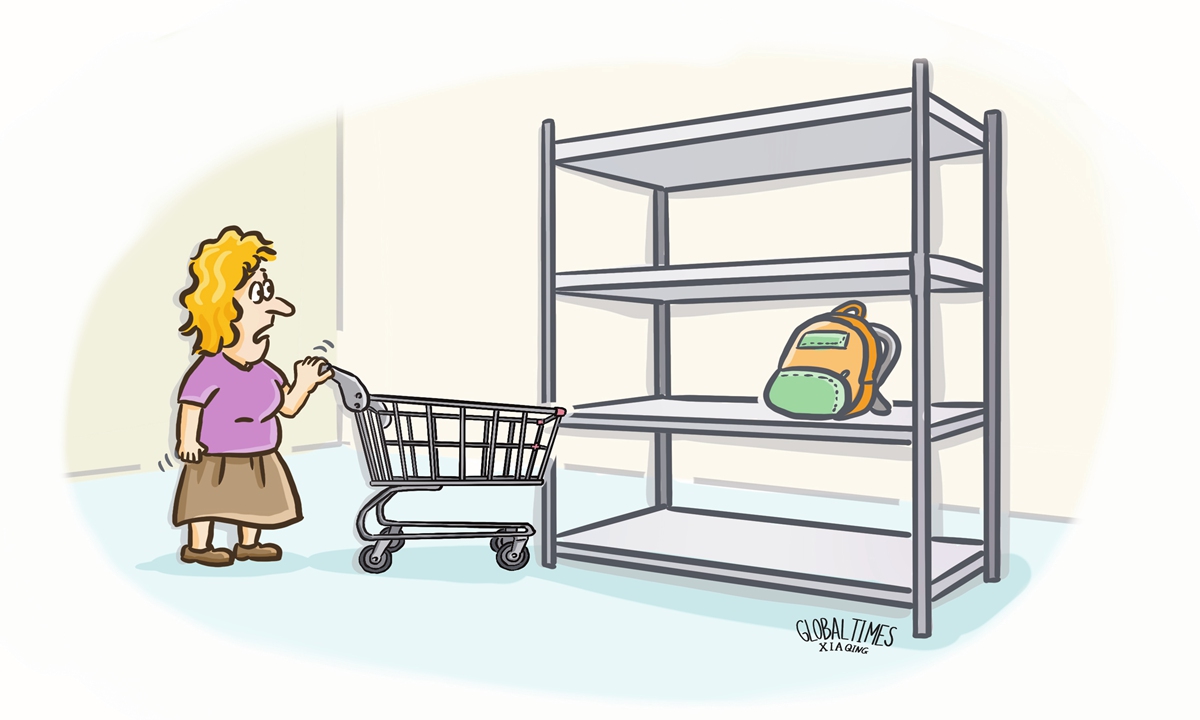
California Governor Gavin Newsom's latest criticism of the US protectionist tariffs have garnered significant attention. US media outlet POLITICO reported on Friday that Newsom warned that the US tariffs will lead to a slowdown of goods entering the country, raising concerns of empty store shelves during the back-to-school and Christmas shopping seasons. "These tariffs punish families and risk ending America's run as the world's greatest economy," he was quoted as saying.It is noteworthy that Newsom has repeatedly slammed the US government's tariff policy. While US politicians attempt to use tariffs to encourage the return of American manufacturing, it is ironic that California, the center for manufacturing output in the US with more than 36,000 manufacturing firms, has strongly opposed the tariffs.
Data from California highlight the detrimental impact that tariffs are inflicting on the US economy, coincident with Newsom's concerns. In the wake of the tariffs, cargo at the Port of Los Angeles was down 35 percent year-on-year last week, NPR reported on Wednesday. California predicts a 9 percent decline in international visits this year due to negative global sentiment about the US government's policies, according to Bloomberg. Newsom's concerns and these figures reflect the profound damage that tariffs have inflicted on various aspects of the US economy.
In the manufacturing industry, US tariffs have led to an increase in the cost of importing raw materials and components, resulting in higher production costs for US companies. To maintain profitability, companies are forced to raise prices, which further weakens the competitiveness of American manufactured goods in the international market. In this sense, the impacts of the US tariff policy are counterproductive to its stated goals.
Moreover, US tariffs have increased trade barriers within the global supply chain, making it difficult for US companies to obtain the necessary components and raw materials, affecting production schedules and even leading to shutdowns.
In terms of consumption, US tariffs will lead to an increase in prices, raising the cost of living for Americans. As the prices of imported goods rise, so do those of similar domestic products, forcing consumers to pay higher prices for goods. Many imported goods are unable to enter the US market due to increased tariffs, narrowing consumers' choices.
In a recent Citi Research note, US economists Andrew Hollenhorst and Veronica Clark warned that pausing reciprocal tariffs, excluding China, doesn't mean the US economy has avoided a slowdown in growth and a rise in inflation. They predict increasingly severe negative effects.
US households and firms sourcing goods from overseas could see a surge in imports in the second quarter, but there is expected to be slowdown in the third quarter. Uncertainty for businesses will remain high, which could mean an extended pause in hiring and investment, according to the report.
In a report headlined "A tidal wave of change is headed for the US economy," The New York Times said that the major effects on the US economy of shutting down trade with China will start to become apparent in the summer of 2025, when the US might slip into a recession, citing Torsten Slok, an economist at Apollo.
If the White House reverses course soon and significantly drops tariffs on China, much of the pain for the US economy and consumers can be avoided, the report noted, citing trade experts.
Although US government officials have chosen to downplay the negative impact of tariffs on the American economy, an increasing number of local officials and business leaders are raising alarms, and more economists are warning of recession risks.
Perhaps US officials should genuinely reckon with whether the American economy is truly prepared to withstand the subsequent shocks of tariffs before it is too late, rather than turning a blind eye and continuing down this dangerous and misguided path.
The author is a reporter with the Global Times. bizopinion@globaltimes.com.cn
RELATED ARTICLES