China willing to work with Canada to get bilateral ties back on right track, ambassador says
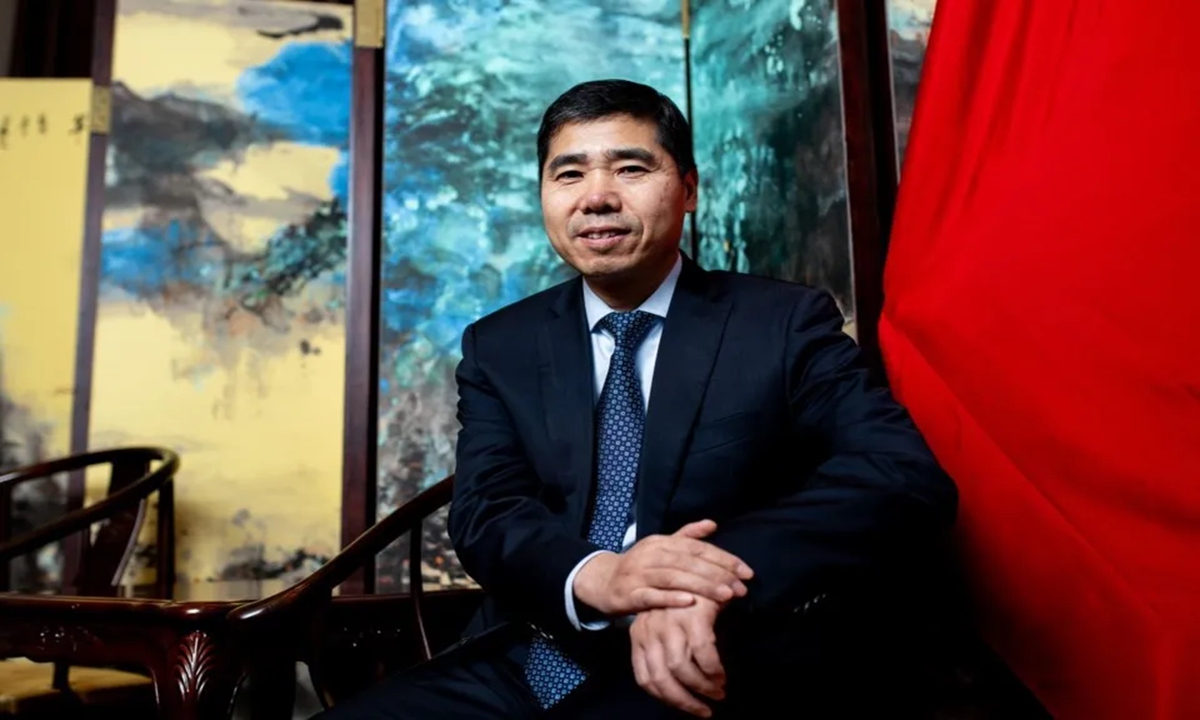
Chinese Ambassador to Canada Wang Di gives an exclusive interview to Canada’s largest news agency, The Canadian Press, at the Chinese Embassy on April 21, 2025. Photo: Chinese Embassy in Canada
China is willing to “look forward” and work with Canada to bring bilateral relations back on the right track, Chinese Ambassador to Canada Wang Di said in a recent interview with Canadian Television (CTV), expressing hope for prompt talks to address key issues.
Wang made the remarks on May 9 during an interview with CTV‘s flagship political affairs program Question Period. A summary of the interview was published Monday on the official WeChat account of the embassy.
When asked whether the two governments had discussed lifting tariffs, Wang noted that last year Canada unilaterally imposed tariffs on China. “We have maintained communication with the Canadian government, but despite China’s repeated objections, Canada proceeded with these unilateral measures,” he said.
After a thorough investigation, China had concluded that Canada’s tariffs were discriminatory in nature and China had therefore taken reciprocal countermeasures, Wang said.
In March, China announced additional tariffs on certain Canadian imports based on the findings of an anti-discrimination investigation starting from March 20, 2025. The measures include a 100 percent tariff on imports of canola oil, oil cakes and peas from Canada, and a 25 percent tariff on aquatic products and pork.
The decision comes after China's first anti-discrimination probe into foreign countries and regions, which found that Canada's restrictive measures on certain Chinese products have constituted discriminatory restrictions that disrupt normal trade order and harm the legitimate rights and interests of Chinese enterprises.
Last year, Canada announced tariff hikes on electric vehicles and steel and aluminum products imported from China, prompting the Chinese side to initiate an anti-discrimination probe in September.
“At this point, the ball is in Canada’s court. The Canadian government has expressed on multiple occasions a desire to resolve issues through dialogue,” Wang said.
“I expect that in the near future, the two sides can hold talks on relevant issues as soon as possible,” he added.
China and Canada have a solid foundation for practical cooperation, with highly complementary economies and strong mutual needs, Wang said, adding that “Due to well-known reasons, our bilateral ties have encountered setbacks. But the cause and effect, and the rights and wrongs, are very clear.”
China is willing to look forward and work with Canada to bring our relations back on the right path, Wang emphasized. “China is an opportunity, not a challenge, for Canada’s economic development and people’s well-being.”
In today’s uncertain world, cooperation between China and Canada not only serves the interests of both nations, but also contributes to global stability and positive momentum, according to Wang.
Both China and Canada have long supported free trade and multilateralism, and have implemented countermeasures in response to the US’ unilateral tariffs, Wang noted.
“We hope to strengthen communication and coordination with Canada and with all countries that oppose unilateralism and protectionism, to jointly resist bullying and unilateral practices and safeguard free trade and multilateralism,” Wang said. “This is of critical importance to the entire world.”
Global Times
RELATED ARTICLES