ARTS / CULTURE & LEISURE
Chinese archaeologists invited to Uzbekistan for joint mission
Efforts to advance Silk Road site preservation co-op
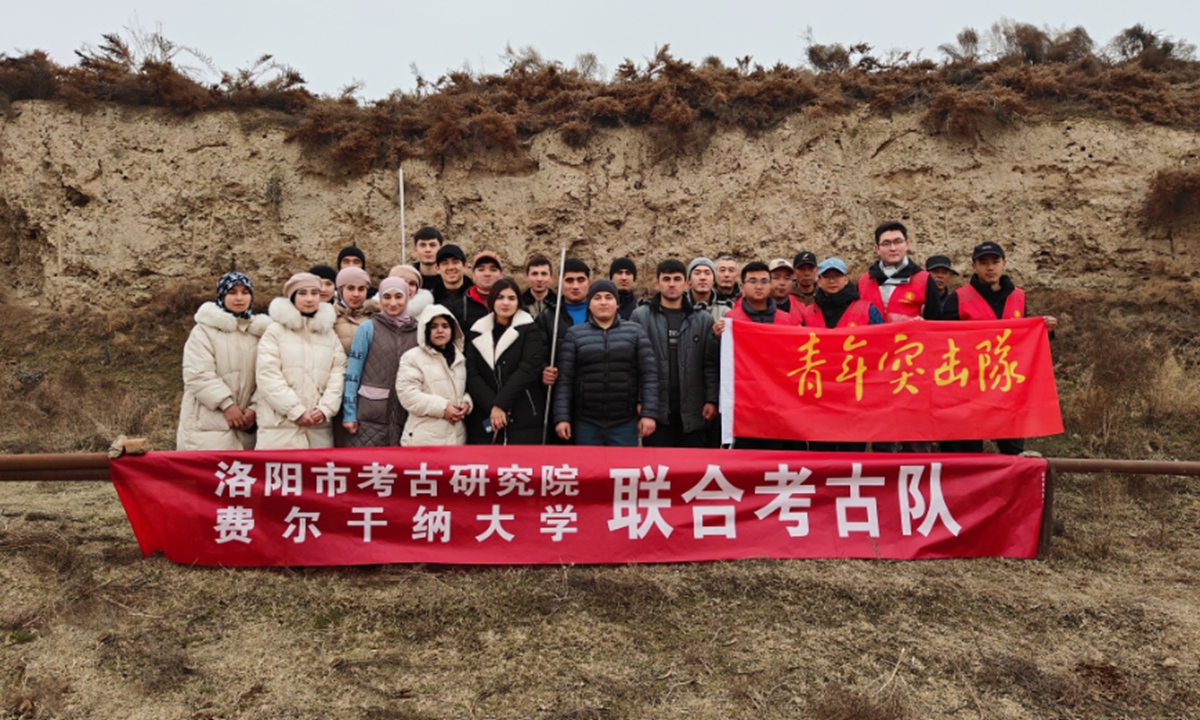
Photo: Courtesy of Liu Bin
A delegation from the Luoyang Institute of Archaeology will depart for Uzbekistan on Thursday to carry out a roughly 50-day joint teaching and archaeological mission at the invitation of Fergana State University. The initiative aims to further advance bilateral cooperation in archaeological technology exchanges, heritage site preservation and the training of young talent."The joint teaching and archaeological mission to Uzbekistan will not only provide archaeological evidence to uncover the historical context of ancient Fergana, but also inject momentum into the training of local archaeological professionals," Liu Bin, head of the Luoyang delegation, told the Global Times on Wednesday.
According to materials provided by the Luoyang Institute of Archaeology, Uzbekistan's Fergana region was a hub along the ancient Silk Road, with historical ties to China dating back over 2,000 years.
Located at the strategic junction of Uzbekistan, Tajikistan, and Kyrgyzstan, the Fergana Valley is historically recognized in ancient Chinese texts as the homeland of the Dayuan Kingdom. It was a key waypoint on the Silk Road traversed by prominent Chinese envoys and travelers such as Zhang Qian in the Western Han Dynasty (206BC-AD25), Ban Chao in the Eastern Han Dynasty (25-220), and the Tang Dynasty (618-907) monk Xuanzang. With a long and rich history, Fergana is home to numerous ancient cultural sites that have drawn archaeological teams from around the world.
"Historically, Chinese artifacts such as porcelain and bronze mirrors were brought into Fergana via the Silk Road, bearing witness to the enduring cultural exchanges between the two regions," Liu said.
In October 2023, the joint archaeology department of Uzbekistan and China was officially established at Fergana State University. Since then, the two sides have conducted joint investigations of the ancient city site of Kuva in Fergana in November 2023 and February 2024, making key discoveries related to the structure of the northern city wall, the moat, and remnants of ancient roads.
"In recent years, Uzbekistan has made remarkable progress in the protection and utilization of cultural heritage through international cooperation, technological innovation, and revitalization of cultural assets," Liu noted.
"The restoration of the ancient city of Khiva, the first Chinese-funded cultural heritage conservation project in Central Asia, stands as a model of China-Uzbekistan collaboration."
The restoration of the ancient city of Khiva followed the principle of "restoring the old as it was," using locally sourced traditional materials and techniques to repair the main structures and improve the surrounding environment. The project has been highly praised by UNESCO and recognized as a landmark achievement in cultural cooperation under the Belt and Road Initiative.
For Liu, Uzbekistan is still in the early stage of cultural heritage preservation and utilization. Compared to China's operational archaeological site parks, there remains a significant gap.
Liu and his team will offer lectures at Fergana State University on topics such as "An Overview of Chinese Archaeology" and "Conservation and Restoration of Excavated Cultural Relics." They will also conduct joint excavations at the Kuva ancient city site and the recently discovered Khanabad cemetery, focusing on clarifying the functional zoning and stratigraphy of the site while assisting the Uzbek side in organizing excavation data.
"Our joint archaeological and teaching work is not only a deep academic collaboration, but also a meaningful opportunity for friendly exchanges between the youth of both countries," Liu said.
"The majority of our archaeological team consists of young professionals, while almost all the Uzbek students involved are from the post-2000 generation, representing the future of the country's heritage and archaeology preservation efforts," he added.
Beyond field surveys and excavation research, the Chinese delegation is also demonstrating techniques such as plaster restoration and stone rubbing, and introducing the principles behind the use of the Luoyang spade.
"We hope to share Chinese archaeological methods through structured coursework, allowing the outcomes of this exchange to have a lasting impact," Liu noted.
Zhang Yin, a member of the Society for East Asian Archaeology (SEAA), told the Global Times on Wednesday that in recent years, China has significantly expanded its archaeological engagements abroad, with projects spanning Central Asia, the Middle East, and Africa.
"Over the past few decades, Chinese archaeological teams have gradually developed their own system through extensive fieldwork, interdisciplinary collaboration, and advances in site conservation," he said.
"These experiences, when shared in international collaboration, help address gaps in local teams' conservation practices and organizational capacities."
Zhang emphasized that the value of joint archaeological projects lies not only in the artifacts unearthed but also in fostering dialogue between different historical and civilizational perspectives.
"In projects along the Silk Road, growing evidence points to long-term interactions and exchanges between China and the material cultures and belief systems of Central and Western Asia," he noted.
"When we speak of Chinese archaeology 'going global,' it's not just about unearthing ancient sites," Zhang said.
"It's also about sharing methodologies for understanding the past, demonstrating respect for the history of others, and working together to shape a more inclusive global narrative of human civilization."
RELATED ARTICLES