New spokesperson of China’s Ministry of National Defense debuts; nation to establish three new military academies
By and Published: May 15, 2025 11:04 PM


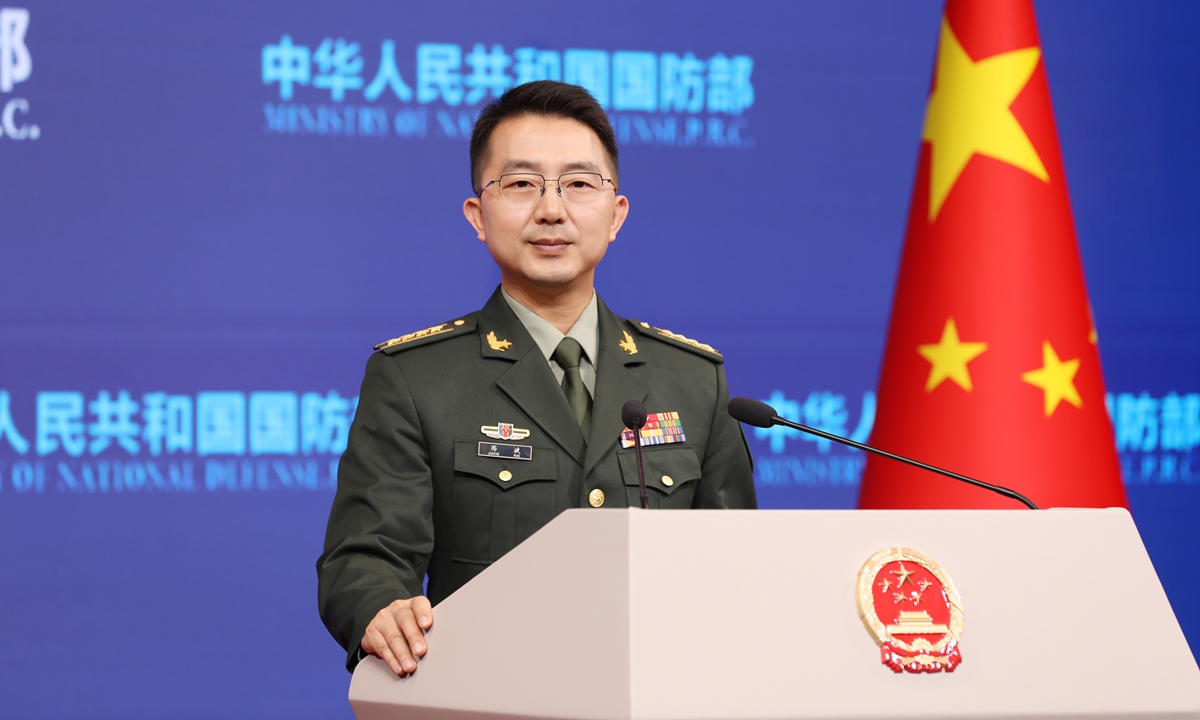
Jiang Bin Photo: China's Ministry of National Defense
Senior Colonel Jiang Bin made his debut as the newly appointed spokesperson for China's Ministry of National Defense on Thursday, releasing information on recent military-related issues. Jiang is the ninth person to serve in this role and notably the first spokesperson born in the 1980s.According to the ministry's official website, the ministry currently has two spokespeople - Zhang Xiaogang and Jiang Bin.
During the press release on Thursday, Jiang also announced that China will restructure its current military schools and establish three new military academies.
To implement the guiding principles of the Third Plenary Session of the 20th Communist Party of China Central Committee and supporting adjustments to the structure and deployment of military branches and cultivation of military talent, the Central Military Commission has approved the restructuring and establishment of three new military academies, Jiang said.
The three institutions are a People's Liberation Army (PLA) university for branches of the army, a PLA information support force engineering university and a PLA joint logistics support force engineering university.
The PLA university for branches of the army will be formed on the basis of the Army Academy of Armored Forces and the PLA Army Academy of Artillery and Air Defense with its main campus located in Hefei, East China's Anhui Province.
The PLA information support force engineering university will be established based on the College of Information and Communication of the National University of Defense Technology and the communication institute of the Army Engineering University of PLA, with its main campus located in Wuhan, Central China's Hubei Province.
The PLA joint logistic support force engineering university will be formed from the Army Logistics University and the main campus of the Army Military Transportation University. The school main campus will be located in Southwest China's Chongqing.
All three will be recognized as institutions of higher education and will begin admission process toward high school graduates across the country. Information on specific majors, enrollment quotas and admission processes will be announced in due course in coordination with the annual national recruitment plan, according to Jiang.
In line with the current trajectory of military development, the cultivation of military talent is increasingly structured around service branches as the core organizational units. Military academies are now generally aligned with these branches, and within each branch, there are further subdivisions into various specialized arms. Both branches and arms require dedicated institutions to support the targeted and professional training of personnel, Song Zhongping, a Chinese military affairs expert, told the Global Times.
The three newly established military academies represent a strategic effort to consolidate and optimize existing educational resources across different arms under each service branch. This move aims to enhance the systematic training of military personnel, promote greater integration and coordination among various arms, and ultimately strengthen the overall combat effectiveness of each service's force structure, Song added.
RELATED ARTICLES