
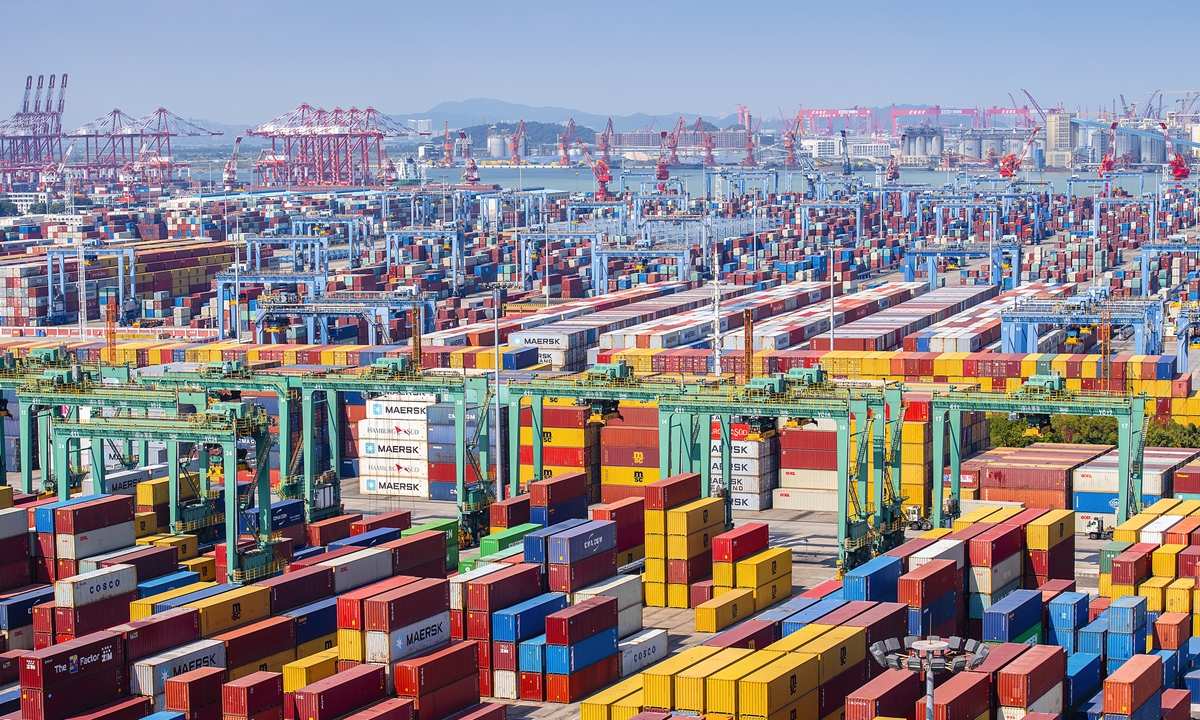
The Guangzhou Port in Guangzhou, South China's Guangdong Province, which opened a direct route to Peru's Chancay Port on April 29, 2025 Photo: VCG
The trade agreement reached between China and the US in Geneva, Switzerland has drawn global attention, which has received positive responses from various sectors.
The two sides recognize the importance of their bilateral economic and trade relationship to both countries and the global economy, and the significance of building a sustainable, long-term and mutually beneficial economic and trade relationship, according to the Joint Statement on China-US Economic and Trade Meeting released from the Geneva talks.
For a long time, economic and trade cooperation between China and the US has gone well. This relationship is characterized by their complementary nature and mutual benefit. Since China's accession to the World Trade Organization (WTO), it has fulfilled a commitment to market openness. In 2024, China-US bilateral trade reached $688.28 billion - eight times the amount in 2001 when China joined WTO.
Despite Washington's imposition of unilateral tariffs and other restrictions in recent years, bilateral trade in goods between China and the US continues to exhibit strong complementarity. In 2024, China's top five export categories such as electrical machinery accounted for 57.2 percent of China's exports to the US, while China's top five import categories from the US, such as mineral fuels, machinery and industrial components made up 52.8 percent of China's total imports from the US.
As important trading partners, China and the US have formed a complementary trade structure through frequent trade interactions. Even in the first quarter of 2025, despite the US imposing unjustified tariffs on Chinese goods, bilateral trade still grew, with total imports and exports reaching 111 trillion yuan ($153 billion), a 4-percent year-on-year rise.
Services trade between China and the US has yielded mutually beneficial outcomes. Since the implementation of the reform and opening-up policy, Chinese people's living standards have greatly improved, leading to a shift in consumption patterns. China's per capita GDP has surpassed $13,000, and services consumption is entering a rapid growth phase.
In 2024, consumer spending on services increased by 7.4 percent year-on-year, contributing 63 percent to the growth of consumer spending. As China's second-largest services trade partner, the US has filled gaps in China's services sector, meeting consumer demand while also generating significant profits for the US.
According to the US Department of Commerce, from 2001 to 2023, US services exports to China expanded from $5.63 billion to $46.71 billion, marking an 8.3-fold rise.
Trade patterns are largely driven by economic fundamentals. The US, as the world's largest consumer market, and China, the world's largest manufacturing nation, are economically bound by economic laws of supply and demand. Given the massive scale, depth and complexity of China-US economic interactions, differences are normal sometimes. However, disputes should be addressed through fair dialogues. Unilateral measures are unhelpful but escalate tensions.
From the perspective of history, China and the US have shared a solid foundation for cooperation in many areas. The two countries have achieved fruitful collaboration in establishing the global multilateral trade system and promoting global prosperity. And, the success of such cooperation has always relied on mutual trust and rational communication.
As a spokesperson of China's Ministry of Commerce noted recently, "if the US seeks to resolve issues through negotiation, it must face squarely the severe negative impacts of its unilateral tariffs on itself and on the world, face up to international economic and trade rules, fairness, justice, and the rational voices across sectors, demonstrate sincerity for talks, correct its erroneous practices, and meet China halfway to address mutual concerns through equal consultations."
China-US cooperation aligns with global expectations, too. For the global economy to grow faster, it must rest on markets that are more inclusive, open and transparent. As the world undergoes profound transformation unseen in a century, with rapid evolvement in AI, bio-tech and other technologies, it is essential to update and synchronize international rules to prevent and manage risks.
Trade wars produce no winners, and protectionism is never a solution to the US' domestic economic challenges. The two nations should adhere to the principles of mutual respect and peaceful coexistence, and work together as equals to tackle market risks and challenges.
Wang Qian is associate professor at the School of Global Governance, Shanghai University of International Business and Economics (SUIBE). Wu Zijie is a postgraduate student at SUIBE. bizopinion@globaltimes.com.cn
RELATED ARTICLES