China practices true multilateralism, with ‘extremely healthy’ co-op with emerging markets: economists at global finance forum
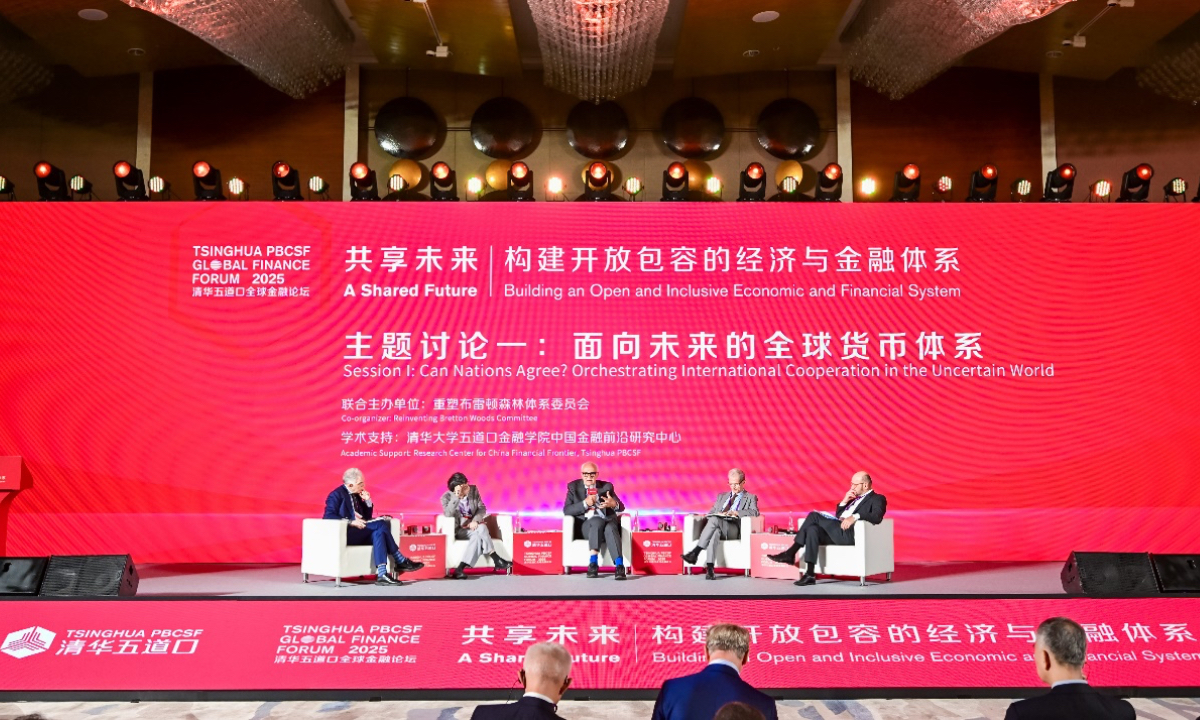
Mark Malloch-Brown (middle), former deputy secretary-general of the United Nations, delivers a speech at the 2025 Tsinghua PBCSF Global Finance Forum. Photo: Courtesy of Tsinghua PBCSF
Amid growing global uncertainties, China is actively practicing true multilateralism and upholding free trade, and its cooperation with emerging markets is “extremely healthy,” according to global officials and economists at a high-level finance forum on Saturday.
The 2025 Tsinghua PBCSF Global Finance Forum, organized by Tsinghua University’s PBC School of Finance, commenced on Saturday in Shenzhen, South China’s Guangdong Province.
Under the theme “A Shared Future: Building an Open and Inclusive Economic and Financial System,” the forum convened nearly 100 senior officials, prominent economists, and business leaders from both China and abroad to discuss pressing economic and trade issues.
Discussing China’s role in reinforcing the multilateral framework, Mark Malloch-Brown, former deputy secretary-general of the United Nations, told the Global Times on the sidelines of the high-level forum that both China and the global community benefit from a robust multilateral system.
“Everything I’m seeing during my visit to the country confirms that China is deeply committed to that,” the former UN official said.
Malloch-Brown further emphasized China’s ongoing efforts to promote social and economic development in Global South nations, underscoring the importance of deepening these partnerships for global economic stability. He noted that a “whole new generation” of Chinese innovation and trade partnerships is emerging.
“I believe China is a vital partner for many developing countries. All of this is unfolding within the broader framework of the Belt and Road Initiative and reflects a highly constructive and extremely healthy trade relationship — not just for China and its partner countries, but for the global economy as a whole,” Malloch-Brown noted.
At the forum’s opening, some economists expressed concerns about the challenges confronting globalization, emphasizing that the global economy faces structural issues such as slowing growth and risks of divergence, exacerbated by unilateralism and protectionism, which hinder the international economic cycle.
Amid globalization challenges, Michael Spence, the 2001 Nobel Laureate in Economics, emphasized in his keynote speech that Europe, China, and other major emerging market countries are more likely to support a rational and feasible multilateral system.
“[External shocks and geopolitical changes] should not undermine China’s continued push for multilateralism, as this is critical and benefits all countries,” Spence said.
Marek Belka, former prime minister of Poland, highlighted during the forum that the severe challenges posed by US tariff policies to global economies, arguing that trade protectionism is “a step backward in history” and will not help resolve the US underlying domestic issues.
Belka suggested that Europe diversify its markets and emphasized the potential for China-Europe cooperation. “China has now become a manufacturer and exporter of technology…European companies hope to further enter the Chinese market, and China is also interested in discussing this,” he said.
Belka noted the growing presence of Chinese electric vehicles (EVs) in Europe, stating that it's increasingly likely that Chinese auto brands could overtake US manufacturers’ position in the market.
For years, China has been a major contributor to global economic growth and a stabilizing anchor, said Jiao Jie, dean of the PBC School of Finance at the Tsinghua University, emphasizing that the country steadfastly upholds true multilateralism, advocating for economic globalization and trade liberalization in an uncertain world.
Jiao noted China’s high-quality economic development, which aims to address growth bottlenecks with new quality productive forces. “This approach uses certainty to counter the uncertainties of a rapidly changing external environment.”
During an interview with the Global Times on Saturday, Tian Xuan, associate dean and chair professor at Tsinghua PBCSF, highlighted China’ resolute strategic determination and great-power responsibility in addressing the challenges of globalization.
“Amid unwarranted external suppression, China firmly pushes back while upholding multilateralism and promoting free trade. Its unwavering commitment to expanding high-level opening-up will inject greater vitality into the global economy,” Tian said.
Tian noted that although China and the US have achieved tangible outcomes in trade talks, the future of the global economy is unlikely to return to its previous state of free trade.
However, China is reducing its reliance on single markets, and its highly forward-looking “dual circulation” strategy, which encompasses both domestic and international cycles, is expected to play a crucial role in addressing these challenges, Tian said.
For global investors, “China is clearly a very big investment market that you have to consider, so it’s always a key factor in any investment allocation,” Duncan Bonfield, chief executive of the International Forum of Sovereign Wealth Funds, told the Global Times at the forum.
RELATED ARTICLES