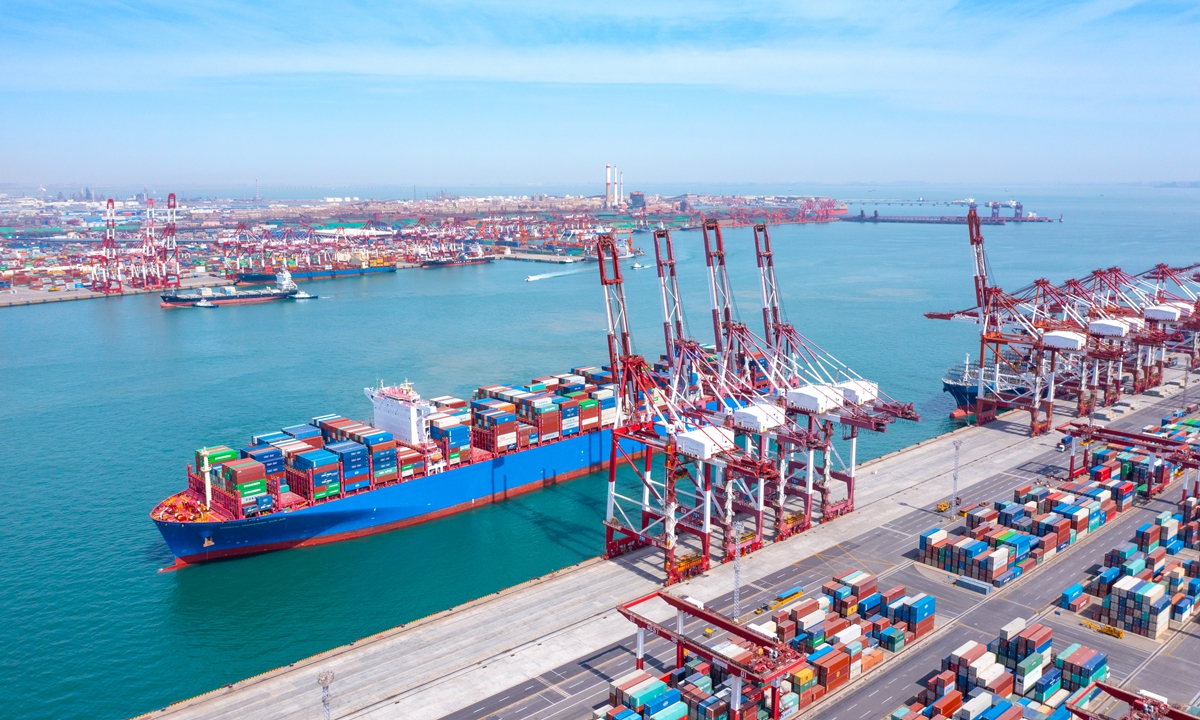
The view of a port in Qingdao, East China's Shandong Province. Photo: VCG
In recent years, the US government has ramped up efforts to suppress China in areas such as technology and trade, continuously narrowing the space for the development of China-US economic relations. This has sparked concerns among many about the possibility of a "new Cold War" or even the "decoupling" of the two economies. In my view, this "decoupling theory" is a hypothesis that fails to fully consider the course of world history. It only conducts causal reasoning based on visible realistic structures while ignoring the historical evolution of process structure.
A main reason behind the US' containment efforts is the fact that it simply doesn't want to see China climb up the global value chain, claiming that this will endanger its hegemonic pillars, including the US dollar. However, no matter how much the US "spare no expense" to maintain its global hegemony, both China and the US still need to develop their economic and trade relations, as indicated by the laws of world history.
In short, the so-called "decoupling theory" that has emerged previously is a false proposition. Why? The key answer lies in the "world market." The formation of the world market is a decisive moment in economic globalization, and it also opens up a history dominated by the "world." As a keyword in the history of human civilization, the "world market" carries multiple implications and also has a significant impact on the evolution of China-US relations.
When discussing the reasons why the Chinese and US economies will not "decouple," many people may first think of Smith's Theorem - that division of labor enhances efficiency, and the larger the market and the higher the degree of division of labor, the greater the efficiency. Although this is widely understood, it is still necessary to briefly outline the current state of division of labor based on the world market.
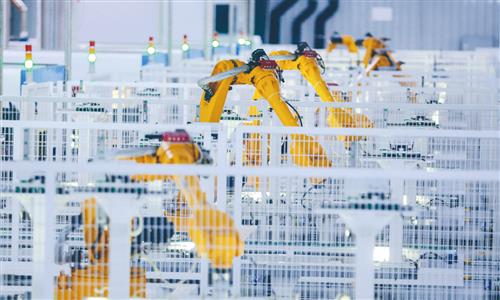
The current economic structure of the US is largely the result of the division of labor in the world market. At the end of World War II, the US GDP accounted for 56 percent of the world's total, and it could produce almost all kinds of industrial products. With the deepening of economic globalization, the world has witnessed the rapid development of emerging market countries with China being the representative. With its world-class size, super-large market and deep participation in the process of economic globalization, China has long been "the world's factory" and is moving toward a "smart manufacturing power" on this basis.
The US, deeply burdened by its "deindustrialization," increasingly views China as a "threat," and blames economic globalization and the global industrial and supply chain structure shaped by "Smith's Theorem" for its own issues such as the "Rust Belt" issue. But in fact, the US is by no means a loser in economic globalization, but a real winner. In 1980, the US GDP made up 25 percent of the global output, and it remained roughly at this level in 2020. In 1980, the US GDP was 3.02 times that of Germany and 2.53 times that of Japan. In 2020, it was 6.5 times that of Germany and 6.8 times that of Japan. Given the collective rise of Global South countries, the US maintaining this level underscores its status as one of the biggest beneficiaries of this phase of economic globalization. One of the ways the US economy maintains a significant lead is to use the "dollar tide" to reap the world's wealth. Why, then, does a wealthy US still face problems like the "Rust Belt"? On the surface, it appears to be a wealth distribution issue, but the deeper cause lies in its political system, which has turned the US into a "nation of the people, by the people, for the people" only for 1 percent of Americans.
The US government is attempting to revive domestic manufacturing through protectionist measures, but it has clearly used the wrong policy tools. Neither the division of labor in the world market under the Smith's Theorem nor the broader process of economic globalization can be reversed by protectionist tactics like tariffs.
World history shows that while Western political systems and nation-states were created and sustained by the world market, their national interests have not always been aligned. Instead, they are often conflicting or even antagonistic. This is the root cause of the frequent wars between Western countries and between the great powers and non-Western countries since the 17th century, and also the root cause of the outbreak of the two world wars.
History reflects reality. This is why when the US government provoked tariff frictions around the world, Canada, Japan, Australia and major European countries generally expressed criticism and opposition, and why the vast majority of countries chose to maintain close economic relations with China. For countries built on the world market, China, with its massive market and commitment to high-level opening-up, represents the well-being of the people and development dividends.
China now has the world's most complete industrial production system. The collective rise of emerging market countries represented by China as well as the broader Global South is dismantling the West's monopoly on advanced productivity, and pushing the world power structure, which has been maintained for hundreds of years, toward a more just and reasonable direction. This is also why the US and other Western countries are gripped by "anxiety" - they are anxious about losing their long-standing monopoly rights and the monopoly dividends that transcend the economy itself.
The shift in the "poles" of the global value chain will eventually bring about a multipolar transformation of the world market and world politics. In this sense, the "pole" change in the structure of the world market has become the underlying logic behind the once-in-a-century transformation now underway.
World history shaped by the world market shows that countries become interdependent through market-based division of labor. At the same time, countries established on the basis of world market, especially Western nation-states, have conflicting or even antagonistic economic interests. Based on these laws, we can find that Chinese and US economies cannot be "decoupled" for two reasons. First, it is because of the intertwined or interdependent situation formed by market division of labor; second, it is impossible for the US to build a unified economic alliance to contain China because the economic interests of those countries themselves are conflicting or even antagonistic. The "ideological alliance" at the level of political thought cannot override the hard realities of the world market.
The author is a distinguished professor of political science and dean of the School of International Studies at Renmin University of China. bizopinion@globaltimes.com.cn
RELATED ARTICLES