May the Zidanku Silk Manuscripts light the way home for more national treasures: Global Times editorial
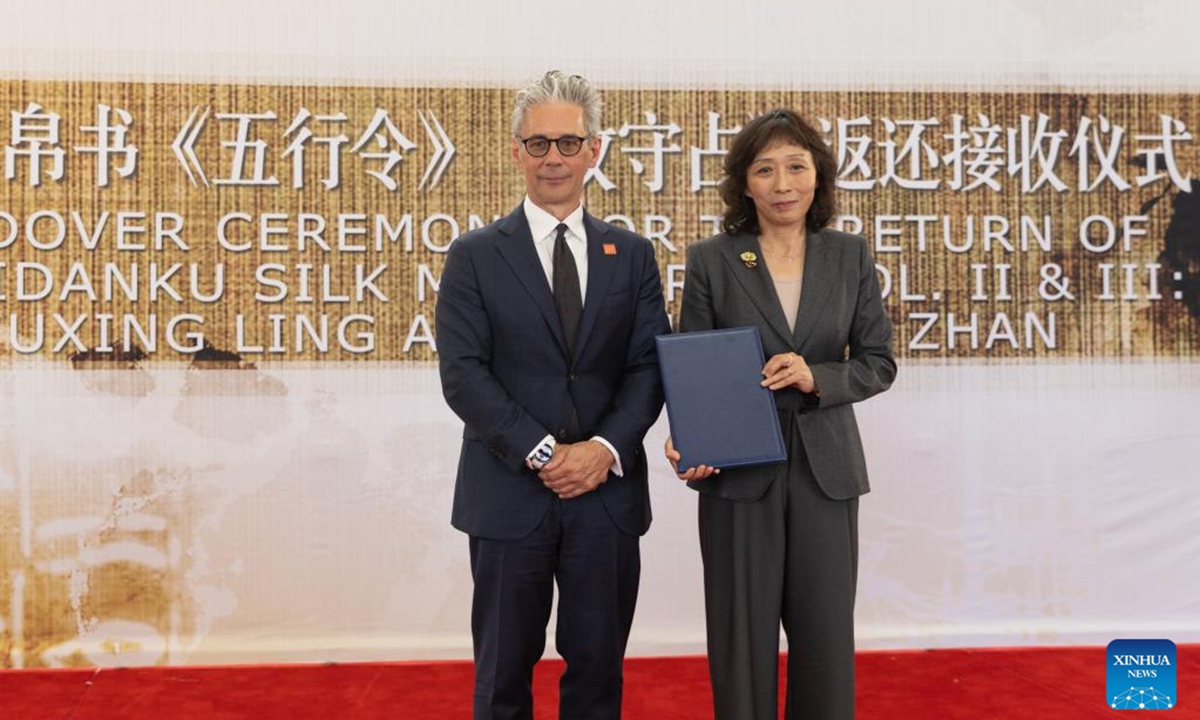
Zhu Ye (R), deputy director-general of Office for the Recovery and Restitution of Lost Cultural Property, National Cultural Heritage Administration of China, receives a certificate of transfer from Chase F. Robinson, director of the Smithsonian's National Museum of Asian Art, during a handover ceremony of the ancient Zidanku Silk Manuscripts from the Warring States period at the Chinese Embassy in the United States in Washington, D.C., on May 16, 2025. Photo: Xinhua
In the early hours of May 18, the Zidanku Silk Manuscript volumes II and III: Wuxing Ling and Gongshou Zhan returned to Beijing from Washington. These precious artifacts, once held by the Smithsonian's National Museum of Asian Art, have ended their 79-year journey abroad. Since the beginning of this year, joint efforts between China and the US have led to the repatriation of more than 40 Chinese cultural relics and artworks from the US. Additionally, China's National Cultural Heritage Administration (NCHA) said that it will continue to promote the return of volume I of the silk manuscripts Sishi Ling as soon as possible. The successful repatriation of the silk manuscripts and other Chinese cultural relics is a positive example of China-US cultural exchanges and offers a model of cooperation for more inclusive global cultural governance.
Cultural relics are not only living history but also keys to unlocking collective historical memory. The Zidanku Silk Manuscripts were unearthed in 1942 from the Zidanku site in Changsha, Central China's Hunan Province. They are currently the only known silk manuscripts from the Warring States period (475-221BC) and represent the earliest silk text discovered to date - as well as the earliest known earliest known example of a classical Chinese book in the true sense - making them of immense academic value.
These two precious silk manuscripts were illegally taken to the US in 1946 and, after passing through several hands, ended up in the collection of the Smithsonian's National Museum of Asian Art. Their return to China today not only recognizes China's sovereign rights over its cultural heritage but also demonstrates respect for the value of Chinese civilization. Cultural relics are the lifeblood of a nation and vessels of its historical memory; the Zidanku Silk Manuscripts belong not only to China but also embody a priceless fragment of the world's cultural diversity.
The path for the Zidanku Silk Manuscripts' return home has been illuminated by the torchbearers of our shared civilization. At the end of 2023, the NCHA assembled a solid and complete chain of evidence documenting the illicit outflow of the Zidanku Silk Manuscripts, and then engaged in a year of intensive dialogue and negotiation with the Smithsonian's National Museum of Asian Art. Those efforts ultimately achieved the repatriation of Wuxing Ling and Gongshou Zhan to China. This milestone attests to China's unremitting commitment to safeguarding its cultural heritage and exemplifies the fruits of China-US cooperation.
Among the key figures in this success are Professor Donald John Harper of the University of Chicago, who traversed two countries to trace the origin of the manuscripts; Professor Lothar von Falkenhausen of the University of California, who spoke out with integrity for their return; and Li Ling, professor of Department of Chinese Language and Literature, Peking University, who has devoted much of his life to the study of the manuscripts. They, like so many others, are the true heroes.
Meanwhile, the repatriation of the Zidanku Silk Manuscript volume I: Sishi Ling, remains in progress. With the continued joint efforts of China and the US, we look forward to its return in the near future.
Throughout history, due to the influence of colonial powers, cultural relics have been requisitioned, looted, illegally exported, and trafficked, trampling on the cultural rights and national sentiments of the countries and peoples to whom these relics originally belonged. This represents a notable wound in the history of human civilization. The promotion and facilitation of the return of such cultural relics to their original countries have long been challenging issues. However, with the deepening reflection and understanding of colonial heritage and unjust international relations in recent years, promoting and facilitating the return of lost cultural relics to their countries of origin has gradually become an international consensus.
The countries that hold cultural relics and their countries of origin should collaborate on the protection of these relics and engage in dialogue about their return, with the aim of promoting the concept of building a community with a shared future for mankind and safeguarding the achievements of human civilization. UNESCO has estimated that 1.6 million Chinese objects have been looted and scattered around the world. In 2014 and 2024, China voiced its stance regarding the issue of recovering lost cultural relics in Dunhuang and Qingdao, respectively, strongly supporting international fairness and justice, and contributing the Chinese solution to the protection and return of cultural relics lost throughout history.
Since the signing of an intergovernmental memorandum of understanding on preventing the illegal entry of Chinese cultural relics into the US on January 14, 2009, the two countries have successfully cooperated in the repatriation of 20 batches, totaling 594 lost artifacts, to China. These achievements not only represent an important affirmation of the cooperation between China and the US in the protection of cultural relics but also provide experience and confidence for future efforts to recover and return more lost cultural relics. At the same time, the successful return of the Zidanku Silk Manuscript volumes II and III offers a positive insight for the relationship between the two major powers: Despite the many differences between China and the US, as long as dialogue and cooperation are strengthened on the basis of mutual respect, peaceful coexistence, and win-win cooperation, it is possible to work together to achieve many beneficial outcomes for both countries and the world.
Currently, a large number of cultural relics from China remain scattered around the world. These relics carry the historical memories of the Chinese nation, and their path to return is long and challenging. Each successful return is a restoration of historical wounds and a defense of the dignity of civilization. Civilization endures through respect and flourishes through dialogue. Hopefully the return of the Zidanku Silk Manuscript volumes II and III will illuminate the path for more national treasures to come home. When these two volumes are exhibited under the lights of the National Museum of China in July, they will tell not only the vivid history of the ancient Huaxia ancestors but also the wisdom of coexistence in modern human civilization.
RELATED ARTICLES