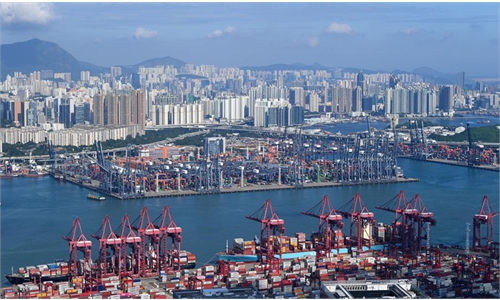
Hong Kong stock market momentum File Poto: VCG
At a time when the global economic outlook faces multiple uncertainties, the deepening integration between Hong Kong's capital markets and the Chinese mainland's high-tech companies has been increasingly of significant strategic importance. This evolving relationship strengthens Hong Kong's position as a leading international financial center while establishing a vital financing avenue for the mainland's technology sector, particularly as the US intensifies its technological containment strategy against China's high-tech advancements.Hong Kong's IPO market has prospered this year. The Hong Kong Stock Exchange on Tuesday will see the listing of a leading mainland new-energy company [CATL], marking the largest IPO so far this year. This event will raise the total amount raised through local IPOs to more than HK$60 billion ($7.69 billion) so far this year, more than six times the year-earlier figure, and temporarily position Hong Kong as the largest market for IPOs worldwide, Hong Kong Financial Secretary Paul Chan Mo-po said on Sunday.
This impressive figure highlights Hong Kong's achievements in fostering innovation and technology research and development, facilitating the transformation of scientific and technological achievements, supporting the growth of technology enterprises, and attracting key enterprises to the region. It also reflects the robust growth of mainland industries, which has led many enterprises to seek financing in Hong Kong. Beyond the mere number, the figure of HK$60 billion symbolizes the sustained optimism of international capital regarding Hong Kong's stock market transformation and the promising prospects of China's technological development.
In recent years, due to the US containment policies against Chinese mainland high-tech enterprises, mainland technology companies have faced lots of challenges in financing and development. Since the US Holding Foreign Companies Accountable Act was signed into law at the end of 2020, some have politicized capital market regulation and used the law to crack down on US-listed Chinese companies, forcing many to seek financing opportunities in other international markets.
The Hong Kong Stock Exchange, through its reform of the listing system, has opened its doors to these tech companies, such as those that have yet to make a profit. This reform aligns precisely with the urgent needs of mainland technology enterprises. Success stories like Alibaba's secondary listing and WuXi Biologics' fundraising provide clear evidence that the Hong Kong market is becoming a pivotal strategic support for the development of the mainland's tech sector in the face of US technological containment.
As an international financial hub, Hong Kong's stock market offers mainland tech companies a strategic springboard. IPOs in Hong Kong enable these firms to rapidly amass capital for research and development, capacity expansion, and technological breakthroughs, alleviating financial strains exacerbated by external pressures. Moreover, the city's internationalized environment and diverse investor base enhance mainland companies' global visibility, expand their overseas markets, and strengthen international exchanges and cooperation. By leveraging Hong Kong's platform, many Chinese tech enterprises have successfully globalized their operations, fortifying their resilience against US containment measures and solidifying their positions in global value chains.
With more and more mainland tech companies going public in Hong Kong's stock market, Hong Kong's financial ecosystem has been reinvigorated. This year, Hong Kong's stock market has witnessed the robust performance of technology stocks. As of the end of March, the total capitalization of Hong Kong's securities market reached HK$40 trillion, up 32 percent from a year earlier.
In the first quarter of 2025, the Hang Seng Index rose 16.78 percent, while the Hang Seng Tech Index surged by 23.24 percent. These trends not only amplify Hong Kong's technological footprint but also elevate its influence in global financial discourse, reaffirming its status as a resilient and promising financial hub.
Last but not least, as Washington's tariffs continue to disrupt global markets, prompting investors to seek out stable and high-potential destinations, Hong Kong's stock market transformation has emerged as an important choice for global investors. As this transformation increasingly captures the attention of international investors, it also serves as a powerful indicator of China's unstoppable technological ascent and its growing influence in the global economy.
RELATED ARTICLES