Putin, Trump hold phone talks amid ongoing Ukraine crisis
Transatlantic rift, row within EU further exposed due to ‘conflicting interests’

Latest news
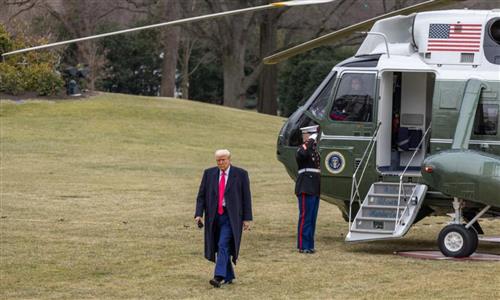
Russian President Vladimir Putin held a phone conversation with US President Donald Trump, the third between the two leaders this year, on Monday amid efforts to reach a ceasefire deal on Ukraine crisis, Al Jazeera reported.
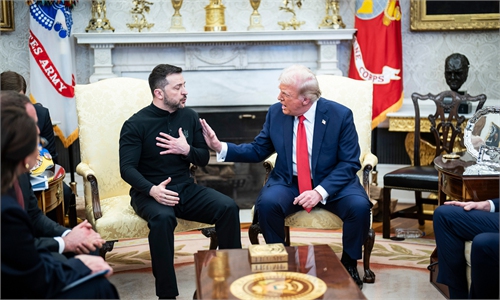
After speaking to Putin, Trump is due to call Ukrainian President Volodymyr Zelensky and NATO leaders.
Putin was speaking from Russia's Black Sea resort of Sochi while Trump was in Washington. Shortly before the call, US Vice President JD Vance told reporters that Washington recognized there was an impasse in ending the war - and that if Moscow was not willing to engage then eventually the United States would have to say it was not its war, per Reuters.
Before the Monday phone conversation, Trump said on Truth Social that "Hopefully it will be a productive day, a ceasefire will take place, and this very violent war, a war that should have never happened, will end," Trump said, Associated Press reported Sunday local time.
Some experts said that the US is eager to broker a ceasefire to fulfill the current administration's campaign pledges, but contradicting interests among different parties complicate the negotiations.
Putin said on Sunday that "long-lasting peace and protection of rights of the Russian-speaking population in Ukraine must be the core result of Russia's special military operation, according to a Tass report. Putin stressed that Russia has ample forces to complete the special military operation and reach the designated objectives.
Ukrainian President Volodymyr Zelensky in Rome said Sunday that "Pressure on Russia must continue until it is ready to stop the war," after a meeting with US Vice President JD Vance in Rome. Zelensky "reaffirmed Ukraine's readiness for real diplomacy and stressed the importance of a full and unconditional ceasefire as soon as possible," the Washington Post reported Sunday.
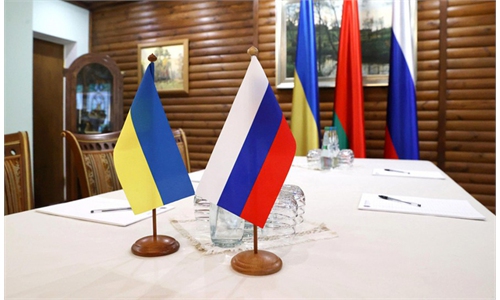
Russia and Ukraine, the two parties directly in conflict, had their first direct talk in three years on Friday, where both sides agreed to trade 1,000 prisoners of war each soon in what would be the biggest such exchange yet.
In response to a question related to the direct talk, Chinese Foreign Ministry spokesperson Mao Ning said on Monday that China's position on the Ukraine crisis is consistent and clear. "We hope that relevant parties will continue to work towards a fair, lasting and binding peace agreement that can be accepted by parties concerned through dialogue and negotiation, and ultimately realize the political settlement of the crisis," Mao said.
Based on latest developments, Sun Xiuwen, an associate professor at the Institute for Central Asian Studies at Lanzhou University, believes the top agenda of the Putin-Trump phone talk is set to focus on ceasefire conditions - the US is likely to test Russia bottom line on eastern Ukraine territories.
The two sides may also reiterate willingness to maintain contact and improve relations, including on energy cooperation and Middle East issues, according to Sun.
Reuters, citing sources, reported on May 8 that the US and Russia are exploring ways to restore Russian gas flows to Europe.
The Monday talk is the third Putin-Trump phone call this year. The last conversation took place on March 18. It focused on the Ukrainian and Middle East settlements, as well as bilateral relations. At that time, Putin supported Trump's idea of a ceasefire in Ukraine, but only with some reservations. On February 12, Putin and Trump discussed over the phone the Ukrainian issue and the accumulated problems in the relations between the two countries, Tass reported.
A White House press release on a Saturday phone call between US Secretary of State Marco Rubio and Russian Foreign Minister Sergey Lavrov claimed the comprehensive peace plan proposed by the US outlines the best way forward. Rubio emphasized President Trump's call for an immediate ceasefire and an end to the violence.
The US is eager to broker and settle the conflict to fulfill the current administration's campaign pledges and demonstrate some diplomatic win, but contradicting interests of different parties complicate the negotiations, Sun said.
Contradicting interests
Trump has made clear that he will discuss terms for ending the Russia-Ukraine conflict with Putin, but Kiev and Moscow remain far apart on what would constitute a fair deal, said the Washington Post on Sunday.
The leaders of UK, France, Germany and Italy again pressed the need for sanctions against Russia in a call with Trump, the British prime minister's office said. "The leaders discussed the situation in Ukraine, and the catastrophic cost of the war to both sides," said a spokesman for British Prime Minister Keir Starmer in a statement on the call late Sunday, AFP reported.
CNN reported that Monday's planned call will therefore be the most serious examination of Trump's credibility and sincerity in the Ukraine negotiations, as well as his willingness to impose even the slightest pressure on Russia.
Sanctions won't solve the problem, Sun noted, adding that while views on tougher measures vary across the US and EU, Russia has adapted by deepening ties with the Global South.
Zhang Hong a research fellow at the Chinese Academy of Social Sciences, told the Global Times that the US is not interested in adding sanctions to pressure Russia as its Western allies will, meaning US brokering methods are rather limited in the brokering. The US is concerned that sanctions will hinder the process of normalization of the relationship between US and Russia.
Tensions have also appeared within the Europe as French President Emmanuel Macron on Friday accused Italian Prime Minister Giorgia Meloni of spreading "false information" about her not taking part in a small group of European leaders meeting with Zelensky and having a joint call with Donald Trump, Financial Times reported Sunday.
The Italian Prime Minister told Italian journalists she was not included in the meeting because of her refusal to send troops to Ukraine as part of a proposed "coalition of the willing" to provide security after any peace deal.
Despite Europe's attempts to lead peace efforts, lack of unity and weakened US support for NATO seems to further complicate the situation, Zhang added.
RELATED ARTICLES