The US can’t win the high-tech race by tripping up others: Global Times editorial
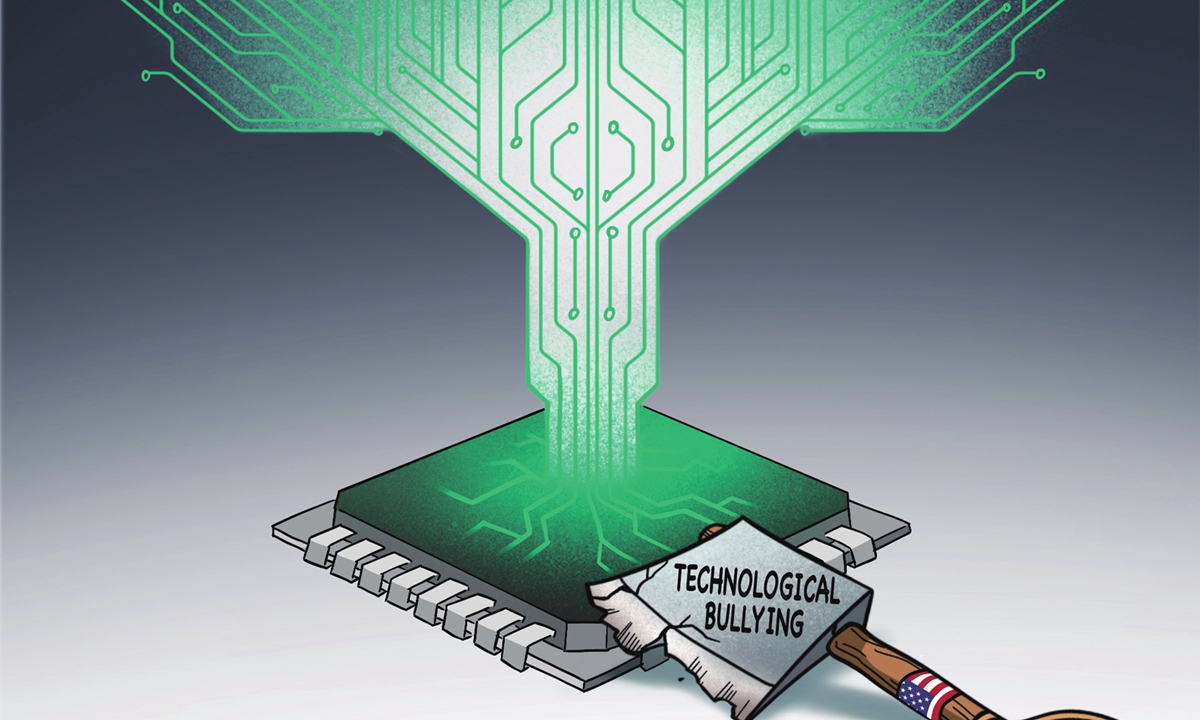
Illustration: Liu Rui/GT
The US Department of Commerce recently issued guidance stating that the use of Huawei Ascend artificial intelligence chips "anywhere in the world" violates US export controls. It later softened the wording to "alert industry to the risks of using PRC advanced computing ICs, including specific Huawei Ascend chips." Regardless of how it is phrased, in essence, this is a blatant attempt to trip up China's high-tech development, relying on baseless accusations and long-arm jurisdiction - a familiar playbook. In response, China's Ministry of Commerce issued two statements on Monday and Wednesday, denouncing the US move as "overreaching" and "a typical unilateral bullying behavior," expressing China's firm resolve to defend its legitimate rights and interests.
The essence of the US policy is an attempt to impose its domestic power will on the global market, aiming for a comprehensive blockade against China's high-performance computing chips. The goal is to stifle China's technological advancement, cut it off from global supply chains, and force international companies to continue relying on US-made chips. Most outrageously, Washington's "long arm" now even seeks to interfere with Chinese companies using Chinese-made chips within China - a blatant disregard for the development rights of over 1.4 billion people. Technological progress is essential for every country to enhance its competitiveness and improve the lives of its people; it cannot be taken away by others. The world is not the US' private vegetable garden for its kitchen. All countries - regardless of size or strength - and all peoples deserve equal rights and respect in their pursuit of a better life.
Can one stay perpetually ahead by tripping others up? The answer is certainly no. Just as the US attempts to "trip up" China, two pieces of good news have emerged from China's high-tech industry: Huawei officially launched its new HarmonyOS-powered computer, and Xiaomi announced it has begun mass production of 3-nanometer chips. Industry insiders believe that the breakthroughs announced by these two Chinese companies are in key areas where the US has long held an advantage and imposed tight restrictions on China. Chinese technology companies are striving to transcend the era of paying high "digital taxes" to Western companies with a spirit of self-reliance and a surge of innovative vitality. From the breakthroughs in "two bombs, one satellite" (China's first atomic bomb, intercontinental ballistic missile and satellite) to leading the world in 5G networks, from deep-sea exploration to the successful launch of Shenzhou-20, the history of China's technological progress repeatedly shows that external blockades only stimulate internal motivation and ignite the fighting spirit of China's technological development.
It is entirely understandable that the explosive growth of a developing country's technological potential would create psychological shockwaves among traditional powerful countries that have maintained their dominant position since the Industrial Revolution. However, to claim that China's technological development is aimed at "replacing the US" is baseless speculation and self-inflicted anxiety. Unfortunately, this reflects the entrenched mind-set of many Washington politicians who still view China through the narrow lens of strategic competition and even a so-called "tech cold war." In reality, China's technological progress is clearly aimed at serving its domestic economic modernization and the improvement of people's lives. China's technological development, including Huawei's Ascend chips and Xiaomi's chip R&D, objectively offers the world more choices and accelerates the pace of global technological progress.
Facts speak louder than words. Chinese technology companies are focused on doing their own things well, which can lead to a development route that is not only suitable for themselves but also benefits more countries. China's development has never been about "toppling" anyone but rather inviting everyone to work together to enlarge the cake. Electric buses on the streets of African cities, photovoltaic power stations in the depths of Middle Eastern deserts, and satellite signals in remote villages of Southeast Asia… In every corner of the world, we can see the vibrant energy that the concept of a community with a shared future for mankind, advocated by China, brings to the global technology ecosystem. While providing differentiated products with more competitive prices, China is also promoting a new development concept and pathway to the world: that beyond the win-lose, zero-sum game, there is also win-win cooperation and mutual growth. It is this path of globalization, where we work hand in hand to create additional value for the world, that has lifted the opportunity for China's technological development.
Hence, trying to "trip up" Chinese technology is doomed to fail - because behind Chinese companies stands a highly specialized and collaborative ecosystem. Within the global semiconductor supply chain, Dutch lithography machines, Japanese semiconductor material suppliers, and American chip manufacturers are all deeply connected to the Chinese market. Washington's attempt to "trip up" China in this highly valued field among nations will not only encounter strong resistance from Chinese companies but will also inevitably face opposition from businesses in various countries that rely on the Chinese market and supply chain - including many US firms. In the long run, this protectionist "trip" will do nothing to enhance the competitiveness of American firms.
The 21st century is an era of multipolarity and economic globalization. In the tide of global development, the mind-set of "winners and losers" is already short-sighted and outdated; inclusiveness and shared benefits are the true path to win-win development. Hopefully the US side will immediately cease this erroneous practice that violates international law and fundamental principles of international relations, and stop using discriminatory restrictive measures to suppress Chinese technology companies. In the high-tech arena, success cannot be achieved by "tripping up" others. Fair competition, open cooperation and mutual benefit are the right way to move forward.
RELATED ARTICLES