IN-DEPTH / IN-DEPTH
Guardians of Memory: From battle call to global anthem, torchbearers of ‘March of the Volunteers’ witness global echo of Chinese national spirit
Editor's Note:
This year marks the 80th anniversary of the victory of the Chinese People's War of Resistance against Japanese Aggression (1931-1945) and the World Anti-Fascist War. Winning the war is a great victory of the national spirit with patriotism at its core, a great victory achieved with the Communist Party of China (CPC) fighting as the central pillar, a great victory fought by the whole nation through solidarity and bravery, and a great victory for the Chinese people, anti-fascist allies and people around the world who fought shoulder-to-shoulder.
To commemorate this historic milestone and its lasting impact, the Global Times has launched a themed series revisiting the great significance of the victory through three lenses: The "Guardians of Memory," the "Witnesses of Struggle," and the "Practitioners of Peace." It underscores the importance of "learning from history to build together a brighter future."
This second installment of our "Guardians of Memory" series traces the extraordinary journey of China's national anthem through the voices of its creators' descendants and modern-day torchbearers. Their accounts reveal how the song, "March of the Volunteers," has evolved from a wartime battle cry to a global bridge of cultural understanding.
Ninety years ago, on May 24, the film Sons and Daughters in a Time of Storm premiered in Shanghai. As its denouement, the "March of the Volunteers" - lyrics by Tian Han, music by Nie Er - sounded for the first time. Its stirring melody instantly ignited the patriotic fervor of countless Chinese compatriots, fueling their resolve in the war against Japanese aggression.
Born amid China's darkest hour, this anthem outgrew its silver screen origins to become a living chronicle of modern China. It echoed through the trenches of the Chinese People's War of Resistance against Japanese Aggression, witnessed the founding and rise of the People's Republic of China, and, as the national anthem, marked every key transformation of the country.
Over the past 90 years, the "March of the Volunteers" has continuously inspired the Chinese people, uniting individual strength into an indomitable national will. Its melody, whether at the Olympics or remote border outposts, fills Chinese people with solemn pride and emotion.
What makes this 84-character, 46-second melody endure? Through the relentless efforts of its countless interpreters, the anthem's influence has transcended borders. The "March of the Volunteers" is not merely a unique international symbol of China; it has resonated globally, emerging as a shared melody in humanity's pursuit of freedom, justice, and peace.
'Brave the enemy's gunfire, march on!'
For over three decades, Tian Wei has immersed herself in studying the life of his uncle, Tian Han, the lyricist behind China's national anthem "March of the Volunteers." Among countless historical documents, one passage remains seared in her memory: "Truth be told, our Chinese nation has reached its most perilous moment. To be masters or slaves - this very instant decides it all! We must summon our last ounce of courage to break through this line of death and fight for our survival!" These urgent words appeared in Tian Han's commentary "After Breaking through the Death Line," published in Shanghai's Morning Post on April 4, 1933.
In an interview with the Global Times, Tian Wei emotionally recounted the anthem's genesis.
On September 18, 1931, Japanese troops blew up a section of rail under their control near Shenyang, and accused Chinese troops of sabotage as a pretext for an attack. Later that night, they bombarded barracks near Shenyang, marking the start of the September 18, 1931 Incident. As Japanese aggression spread, Chinese public fervor for anti-Japanese resistance surged. Tian Han and Nie, who joined the Communist Party of China (CPC) in 1932 and 1933, respectively, devoted themselves wholeheartedly to anti-Japanese literary and artistic campaigns led by the CPC.
In 1934, Tian Han was invited by the Diantong Film Company to write a film focusing on anti-Japanese aggression. He created Sons and Daughters in a Time of Storm, a story about intellectuals who, after experiencing confusion and despair following Japan's occupation of northeast China, bravely joined the frontlines to fight the Japanese invaders in the 1930s.
After completing the lyrics for the "March of the Volunteers" in mid-late January 1935, Tian Han was arrested by the Kuomintang government on charges of "promoting communism." While imprisoned, Tian Han scribbled the anthem's core lyrics on cigarette paper to smuggle them out of jail. Upon hearing this, Nie volunteered to compose the music. Fleeing Kuomintang persecution, Nie traveled to Japan and mailed the score from Tokyo.
With the music integrated, the film's premiere featured an iconic scene: As the screen faded to black, audiences erupted in cheers: "Arise, we who refuse to be slaves." The anthem quickly became a rallying cry against Japanese aggression, resonating across China.
"You had a great uncle!" Throughout her childhood, Tian Wei heard her father, Tian Hong, speak of Tian Han with pride. "My father shared a deep bond with Tian Han. When their father died young, their family in Changsha, Central China's Hunan Province, could only afford one child's education. In a rock-paper-scissors game, Tian Hong forfeited, letting his older brother pursue his studies," Tian Wei said.

After Tian Han rose to fame, he never forgot his brother's family. During the war, he sheltered Tian Hong's family across South China's Guangxi Zhuang Autonomous Region and Southwest China's Sichuan Province, naming his nieces "Shaoyang," "Guilin," and "Xiangyu" - place names memorializing their wartime migrations amid Japan's aggression.
Though the 73-year-old Tian Wei never experienced the war against Japanese aggression firsthand, she often heard her family tell stories of soldiers and civilians singing the anthem her uncle had composed while fleeing conflict. They heard the same song resounding across China, and saw Chinese soldiers charging into battle emboldened by the lyric "Brave the enemy's gunfire, march on!
"Knowing this song was created by my uncle, I truly believe what my father said: We had a great uncle, a remarkable man," Tian Wei told the Global Times.
Timeless hymn of progress
In 1949, with the founding of the People's Republic of China, the "March of the Volunteers" was chosen as the provisional national anthem. "My uncle was overjoyed when he learned of this. He immediately wrote to his younger brother, saying, 'I have done the greatest filial deed for our family and our mother', "Tian Wei recalled.
On March 14, 2004, the Second Session of the 10th National People's Congress passed a Constitutional amendment, formally designating "March of the Volunteers" as the national anthem of the People's Republic of China.
"Today, the anthem has transcended family honor and its role in revolutionary times," Tian Wei said. "Its influence grows deeper, with more people dedicated to interpreting its spiritual essence - it's become part of the Chinese nation's genetic code."
For Yu Hai, former conductor of the People's Liberation Army Band, these words ring profoundly true. "This anthem isn't just music - it's the soundtrack of Chinese resilience," Yu told the Global Times.

Having conducted the anthem at epochal moments from the Beijing 2008 Olympics to the 70th anniversary of WWII's end, he knows its power firsthand.
But Yu's most enduring contribution began in 2008 as a member of the National Committee of the Chinese People's Political Consultative Conference (CPPCC). For a decade, he relentlessly proposed legislation to protect the anthem's dignity - a campaign that culminated in the national anthem law's adoption on September 1, 2017.
Even after retiring in 2017, Yu hasn't paused his mission, his "Beloved Anthem" lecture series has reached 390 venues nationwide, including unforgettable sessions in prisons.
"Even here, the anthem connects people to their country," Yu said, sharing inmates' handwritten letters with the Global Times. One from a prison in Beijing read: "Though we're absent from China's vibrant development, our love remains. Gazing at the anthem's score posted beside our national flag, I hear its melody whisper: 'I love you, China'."
"From its earliest days, the anthem united Chinese people against foreign aggression - the lyric 'With our very flesh and blood, let us build our new Great Wall' was both vow and action," Yu said. "Today, while the Great Wall's military role has faded, the anthem stands as its spiritual equivalent - an emblem of national unity, inspiring generations to strive in the new era."
As 2025 marks the anthem's 90th anniversary, Yu plans more lectures and performances to spread its story. Xu Lijuan, director of Yuxi City's Nie Er Memorial Hall in Southwest China's Yunan Province, is also busy: In May, the hall collaborated with Shanghai's National Anthem Gallery and Changsha's Tian Han Cultural Park for cross-regional commemorations.
Xu told the Global Times that visits to the memorial hall have increased significantly this year. Yuxi residents are actively participating in local music and cultural events, enthusiastically sharing the story of "Nie Er and the National Anthem" nationwide and globally. They are committed to preserving and promoting the national anthem's spirit and showcasing its image, ensuring Nie Er's spirit shines brightly in the new era.
"The people of Yuxi cherish Nie and the national anthem as precious treasures and regard sharing their story as a sacred mission," Xu said with determination.
War song transcends national boundaries
In Shanghai's National Anthem Gallery, a handwritten memoir by Tian Han reveals an anecdote: "When educator Tao Xingzhi returned from Europe, he heard our song echoing at Egypt's pyramids and found it remarkable, mentioning it several times in speeches. Architect Liang Sicheng mistook an American child whistling the tune for a compatriot..." Such stories, Tian Han wrote, proved "the hearts of anti-imperialist people worldwide beat as one."
History confirms this vision. According to the Xinhua News Agency, during WWII, the "March of the Volunteers" - usually translated as "Chee Lai!" (Arise!) - became a global resistance anthem.
Soviet, French, and Czech recordings circulated widely, while the most iconic overseas version was the English adaptation by African-American singer Paul Robeson. After the 1941 Pacific War broke out, the anthem spread across Southeast Asia as a battle cry for the international anti-fascist coalition, aired by radio stations in Europe and the US. In 1944, it became the opening theme for Delhi Radio's broadcasts to China.
Tian Wei steadfastly embraces her uncle's belief in global anti-imperialist solidarity. In 1988, she moved to Japan with three trunks of Tian Han's archives, marrying a Chinese-Japanese man.
"My father was initially reluctant," she said. "But he later agreed, urging me to lay flowers at Nie's memorial every year."
Tian Wei kept that vow. Every July 17, Tian joins Fujisawa City's memorial for Nie. When the mayor learned Tian Han's niece lived in Japan, he invited her to speak and perform the anthem.
Witnessing Japanese citizens voluntarily erect statues, sweep graves, and offer flowers for Chinese musicians, Tian Wei dedicated herself to being a bridge between the two nations. "Through holding concerts and lectures about the 'March of the Volunteers,' I want more Japanese people to understand China, and reflect on history squarely," Tian Wei said.
Dong Jiaqi, a Chinese musician who has studied and worked in Japan for seven years, first met Tian Wei, at a 2021 memorial event for Nie Er at the composer's monument in Fujisawa. As a student at Showa University of Music, Dong stood before the monument holding a Chinese national flag, listening to Tian recount the story behind the"March of the Volunteers." In that moment, the weight of the anthem's lyrics—"building a new Great Wall with our flesh and blood"—suddenly resonated.
"When Ms. Tian raised her arm to conduct the chorus, I realized something profound," Dong told the Global Times. "We were in our 20s, the same age as Nie when he composed this. That's when I grasped the 'youthful fervor' that drove Tian Han and Nie."
As a practitioner of China-Japanese cultural exchange and president of his university's Chinese student association, Dong has since channeled the anthem's spirit into concrete bridge-building efforts. He has organized numerous musical events promoting cultural dialogue, believing that "even if people don't know the history, they'll be moved by the melody's power."
Marking the 80th anniversary of the end of World War II, Dong, now a university lecturer, feels a special responsibility. "We must use art to spread peace," he says, "while ensuring the younger generation remembers history's weight."
Tian Wei told the Global Times that her ultimate dream is to build a Tian Han memorial hall in Tokyo, where her uncle once studied and live, in the near future, and further make the "March of the Volunteers" a cross-border anti-fascist battle song played in a new international setting.
This year marks the 80th anniversary of the victory of the Chinese People's War of Resistance against Japanese Aggression (1931-1945) and the World Anti-Fascist War. Winning the war is a great victory of the national spirit with patriotism at its core, a great victory achieved with the Communist Party of China (CPC) fighting as the central pillar, a great victory fought by the whole nation through solidarity and bravery, and a great victory for the Chinese people, anti-fascist allies and people around the world who fought shoulder-to-shoulder.
To commemorate this historic milestone and its lasting impact, the Global Times has launched a themed series revisiting the great significance of the victory through three lenses: The "Guardians of Memory," the "Witnesses of Struggle," and the "Practitioners of Peace." It underscores the importance of "learning from history to build together a brighter future."
This second installment of our "Guardians of Memory" series traces the extraordinary journey of China's national anthem through the voices of its creators' descendants and modern-day torchbearers. Their accounts reveal how the song, "March of the Volunteers," has evolved from a wartime battle cry to a global bridge of cultural understanding.
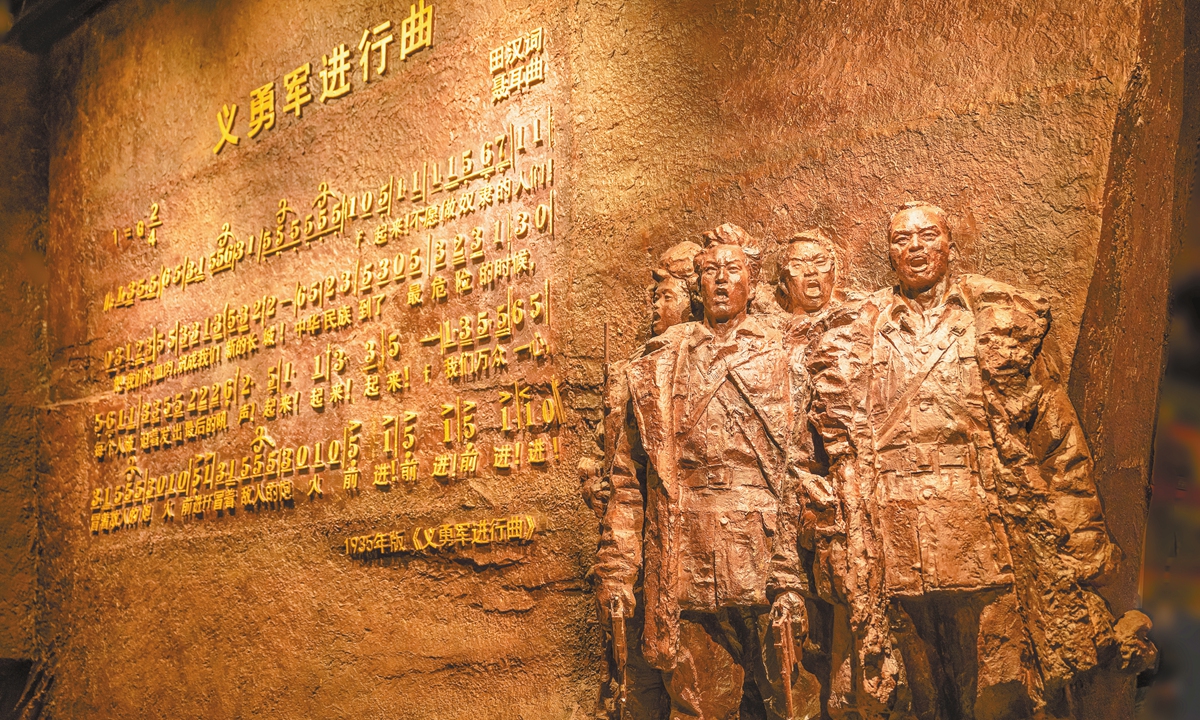
A relief related to the "March of the Volunteers" inside the 9.18 Historical Museum in Shenyang, Northeast China's Liaoning Province Photo: VCG
Ninety years ago, on May 24, the film Sons and Daughters in a Time of Storm premiered in Shanghai. As its denouement, the "March of the Volunteers" - lyrics by Tian Han, music by Nie Er - sounded for the first time. Its stirring melody instantly ignited the patriotic fervor of countless Chinese compatriots, fueling their resolve in the war against Japanese aggression.
Born amid China's darkest hour, this anthem outgrew its silver screen origins to become a living chronicle of modern China. It echoed through the trenches of the Chinese People's War of Resistance against Japanese Aggression, witnessed the founding and rise of the People's Republic of China, and, as the national anthem, marked every key transformation of the country.
Over the past 90 years, the "March of the Volunteers" has continuously inspired the Chinese people, uniting individual strength into an indomitable national will. Its melody, whether at the Olympics or remote border outposts, fills Chinese people with solemn pride and emotion.
What makes this 84-character, 46-second melody endure? Through the relentless efforts of its countless interpreters, the anthem's influence has transcended borders. The "March of the Volunteers" is not merely a unique international symbol of China; it has resonated globally, emerging as a shared melody in humanity's pursuit of freedom, justice, and peace.
'Brave the enemy's gunfire, march on!'
For over three decades, Tian Wei has immersed herself in studying the life of his uncle, Tian Han, the lyricist behind China's national anthem "March of the Volunteers." Among countless historical documents, one passage remains seared in her memory: "Truth be told, our Chinese nation has reached its most perilous moment. To be masters or slaves - this very instant decides it all! We must summon our last ounce of courage to break through this line of death and fight for our survival!" These urgent words appeared in Tian Han's commentary "After Breaking through the Death Line," published in Shanghai's Morning Post on April 4, 1933.
In an interview with the Global Times, Tian Wei emotionally recounted the anthem's genesis.
On September 18, 1931, Japanese troops blew up a section of rail under their control near Shenyang, and accused Chinese troops of sabotage as a pretext for an attack. Later that night, they bombarded barracks near Shenyang, marking the start of the September 18, 1931 Incident. As Japanese aggression spread, Chinese public fervor for anti-Japanese resistance surged. Tian Han and Nie, who joined the Communist Party of China (CPC) in 1932 and 1933, respectively, devoted themselves wholeheartedly to anti-Japanese literary and artistic campaigns led by the CPC.
In 1934, Tian Han was invited by the Diantong Film Company to write a film focusing on anti-Japanese aggression. He created Sons and Daughters in a Time of Storm, a story about intellectuals who, after experiencing confusion and despair following Japan's occupation of northeast China, bravely joined the frontlines to fight the Japanese invaders in the 1930s.
After completing the lyrics for the "March of the Volunteers" in mid-late January 1935, Tian Han was arrested by the Kuomintang government on charges of "promoting communism." While imprisoned, Tian Han scribbled the anthem's core lyrics on cigarette paper to smuggle them out of jail. Upon hearing this, Nie volunteered to compose the music. Fleeing Kuomintang persecution, Nie traveled to Japan and mailed the score from Tokyo.
With the music integrated, the film's premiere featured an iconic scene: As the screen faded to black, audiences erupted in cheers: "Arise, we who refuse to be slaves." The anthem quickly became a rallying cry against Japanese aggression, resonating across China.
"You had a great uncle!" Throughout her childhood, Tian Wei heard her father, Tian Hong, speak of Tian Han with pride. "My father shared a deep bond with Tian Han. When their father died young, their family in Changsha, Central China's Hunan Province, could only afford one child's education. In a rock-paper-scissors game, Tian Hong forfeited, letting his older brother pursue his studies," Tian Wei said.
A statue of Nie Er, the composer of "March of the Volunteers" Photo: VCG
After Tian Han rose to fame, he never forgot his brother's family. During the war, he sheltered Tian Hong's family across South China's Guangxi Zhuang Autonomous Region and Southwest China's Sichuan Province, naming his nieces "Shaoyang," "Guilin," and "Xiangyu" - place names memorializing their wartime migrations amid Japan's aggression.
Though the 73-year-old Tian Wei never experienced the war against Japanese aggression firsthand, she often heard her family tell stories of soldiers and civilians singing the anthem her uncle had composed while fleeing conflict. They heard the same song resounding across China, and saw Chinese soldiers charging into battle emboldened by the lyric "Brave the enemy's gunfire, march on!
"Knowing this song was created by my uncle, I truly believe what my father said: We had a great uncle, a remarkable man," Tian Wei told the Global Times.
Timeless hymn of progress
In 1949, with the founding of the People's Republic of China, the "March of the Volunteers" was chosen as the provisional national anthem. "My uncle was overjoyed when he learned of this. He immediately wrote to his younger brother, saying, 'I have done the greatest filial deed for our family and our mother', "Tian Wei recalled.
On March 14, 2004, the Second Session of the 10th National People's Congress passed a Constitutional amendment, formally designating "March of the Volunteers" as the national anthem of the People's Republic of China.
"Today, the anthem has transcended family honor and its role in revolutionary times," Tian Wei said. "Its influence grows deeper, with more people dedicated to interpreting its spiritual essence - it's become part of the Chinese nation's genetic code."
For Yu Hai, former conductor of the People's Liberation Army Band, these words ring profoundly true. "This anthem isn't just music - it's the soundtrack of Chinese resilience," Yu told the Global Times.
People sing during an event commemorating the 90th anniversary of the birth of "March of the Volunteers" in Yuxi, Southwest China's Yunan Province on May 8, 2025. Photo: Courtesy of Xu Lijuan
Having conducted the anthem at epochal moments from the Beijing 2008 Olympics to the 70th anniversary of WWII's end, he knows its power firsthand.
But Yu's most enduring contribution began in 2008 as a member of the National Committee of the Chinese People's Political Consultative Conference (CPPCC). For a decade, he relentlessly proposed legislation to protect the anthem's dignity - a campaign that culminated in the national anthem law's adoption on September 1, 2017.
Even after retiring in 2017, Yu hasn't paused his mission, his "Beloved Anthem" lecture series has reached 390 venues nationwide, including unforgettable sessions in prisons.
"Even here, the anthem connects people to their country," Yu said, sharing inmates' handwritten letters with the Global Times. One from a prison in Beijing read: "Though we're absent from China's vibrant development, our love remains. Gazing at the anthem's score posted beside our national flag, I hear its melody whisper: 'I love you, China'."
"From its earliest days, the anthem united Chinese people against foreign aggression - the lyric 'With our very flesh and blood, let us build our new Great Wall' was both vow and action," Yu said. "Today, while the Great Wall's military role has faded, the anthem stands as its spiritual equivalent - an emblem of national unity, inspiring generations to strive in the new era."
As 2025 marks the anthem's 90th anniversary, Yu plans more lectures and performances to spread its story. Xu Lijuan, director of Yuxi City's Nie Er Memorial Hall in Southwest China's Yunan Province, is also busy: In May, the hall collaborated with Shanghai's National Anthem Gallery and Changsha's Tian Han Cultural Park for cross-regional commemorations.
Xu told the Global Times that visits to the memorial hall have increased significantly this year. Yuxi residents are actively participating in local music and cultural events, enthusiastically sharing the story of "Nie Er and the National Anthem" nationwide and globally. They are committed to preserving and promoting the national anthem's spirit and showcasing its image, ensuring Nie Er's spirit shines brightly in the new era.
"The people of Yuxi cherish Nie and the national anthem as precious treasures and regard sharing their story as a sacred mission," Xu said with determination.
War song transcends national boundaries
In Shanghai's National Anthem Gallery, a handwritten memoir by Tian Han reveals an anecdote: "When educator Tao Xingzhi returned from Europe, he heard our song echoing at Egypt's pyramids and found it remarkable, mentioning it several times in speeches. Architect Liang Sicheng mistook an American child whistling the tune for a compatriot..." Such stories, Tian Han wrote, proved "the hearts of anti-imperialist people worldwide beat as one."
History confirms this vision. According to the Xinhua News Agency, during WWII, the "March of the Volunteers" - usually translated as "Chee Lai!" (Arise!) - became a global resistance anthem.
Soviet, French, and Czech recordings circulated widely, while the most iconic overseas version was the English adaptation by African-American singer Paul Robeson. After the 1941 Pacific War broke out, the anthem spread across Southeast Asia as a battle cry for the international anti-fascist coalition, aired by radio stations in Europe and the US. In 1944, it became the opening theme for Delhi Radio's broadcasts to China.
Tian Wei steadfastly embraces her uncle's belief in global anti-imperialist solidarity. In 1988, she moved to Japan with three trunks of Tian Han's archives, marrying a Chinese-Japanese man.
"My father was initially reluctant," she said. "But he later agreed, urging me to lay flowers at Nie's memorial every year."
Tian Wei kept that vow. Every July 17, Tian joins Fujisawa City's memorial for Nie. When the mayor learned Tian Han's niece lived in Japan, he invited her to speak and perform the anthem.
Witnessing Japanese citizens voluntarily erect statues, sweep graves, and offer flowers for Chinese musicians, Tian Wei dedicated herself to being a bridge between the two nations. "Through holding concerts and lectures about the 'March of the Volunteers,' I want more Japanese people to understand China, and reflect on history squarely," Tian Wei said.
Dong Jiaqi, a Chinese musician who has studied and worked in Japan for seven years, first met Tian Wei, at a 2021 memorial event for Nie Er at the composer's monument in Fujisawa. As a student at Showa University of Music, Dong stood before the monument holding a Chinese national flag, listening to Tian recount the story behind the"March of the Volunteers." In that moment, the weight of the anthem's lyrics—"building a new Great Wall with our flesh and blood"—suddenly resonated.
"When Ms. Tian raised her arm to conduct the chorus, I realized something profound," Dong told the Global Times. "We were in our 20s, the same age as Nie when he composed this. That's when I grasped the 'youthful fervor' that drove Tian Han and Nie."
As a practitioner of China-Japanese cultural exchange and president of his university's Chinese student association, Dong has since channeled the anthem's spirit into concrete bridge-building efforts. He has organized numerous musical events promoting cultural dialogue, believing that "even if people don't know the history, they'll be moved by the melody's power."
Marking the 80th anniversary of the end of World War II, Dong, now a university lecturer, feels a special responsibility. "We must use art to spread peace," he says, "while ensuring the younger generation remembers history's weight."
Tian Wei told the Global Times that her ultimate dream is to build a Tian Han memorial hall in Tokyo, where her uncle once studied and live, in the near future, and further make the "March of the Volunteers" a cross-border anti-fascist battle song played in a new international setting.
RELATED ARTICLES