IN-DEPTH / IN-DEPTH
How much leverage does India hold in navigating US tariff pressure?
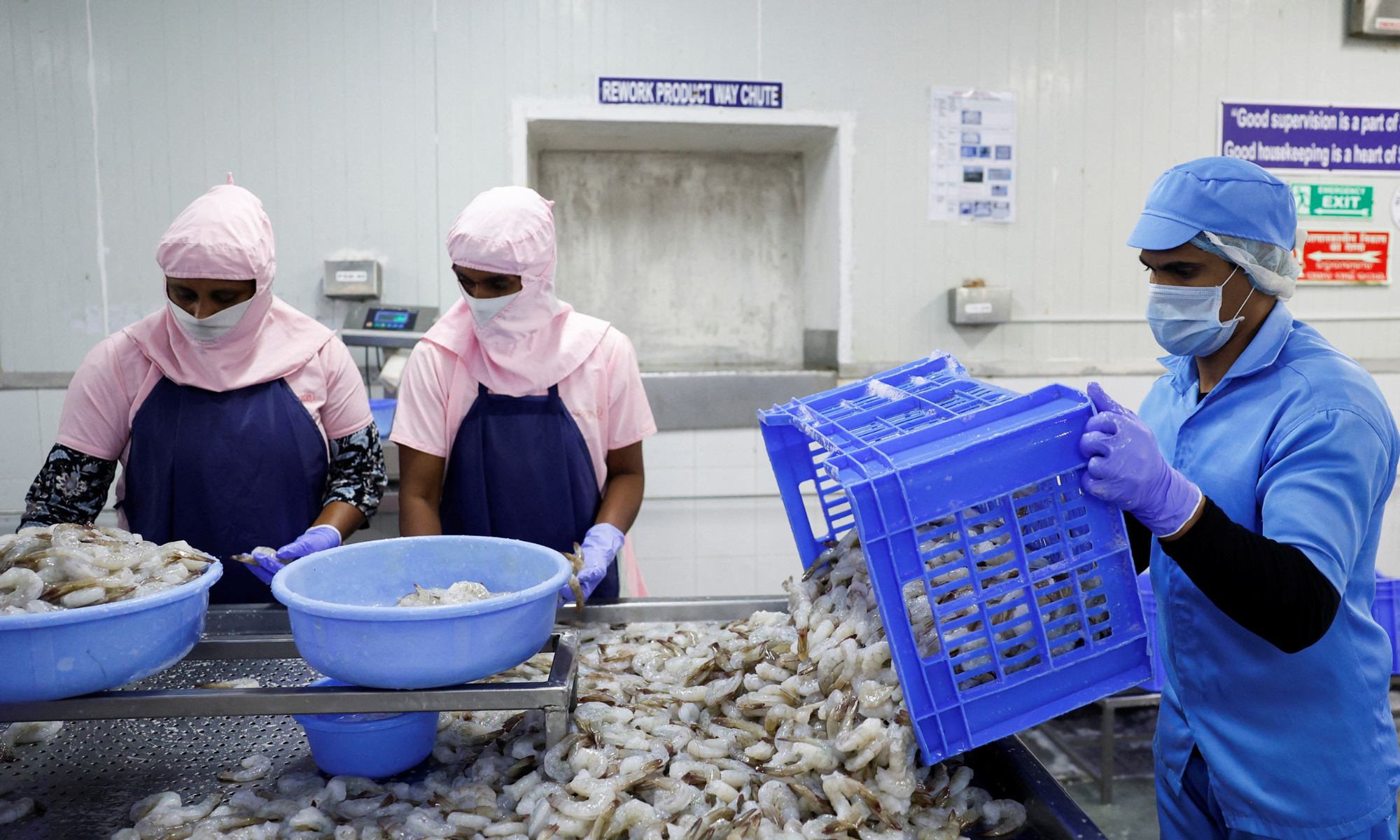
Workers process shrimps at a factory in suburban Visakhapatnam, India, on April 10, 2025. Photo: IC
Editor’s Note:
The four-day visit of India’s Commerce Minister Piyush Goyal to the US concluded on May 20. Goyal reported “good discussions” with US officials on a trade deal, Bloomberg reported the same day. India was one of the first countries to engage in trade negotiations with the US, and both governments indicated in April that significant progress had been made in talks. However, US President Donald Trump’s recent claim that India has offered a trade deal with “basically zero tariffs” was refuted by Indian External Affairs Minister Subrahmanyam Jaishankar.
What is the impact of US tariffs on the Indian economy? In the face of Washington’s tariff pressures, how much leverage does New Delhi have? Is the US imposition of so-called “reciprocal tariffs” an opportunity or a challenge for India? These questions are critical factors influencing India’s stance on US tariffs.
‘Expected to decrease by $5.76 billion’
Has India offered the US zero tariffs? According to a report by Al Jazeera on May 16, the US is India’s largest trading partner, with bilateral trade totaling some $129 billion in 2024. India ran a $45.7 billion surplus with the US that year. Trump has long complained about India’s high tariffs, claiming they harm US businesses, and has proposed a 26 percent “reciprocal tariff” on Indian goods.
Although this tariff has been suspended until July 9, products exported from India to the US are still subject to a 10 percent baseline tariff, and Indian steel and aluminum products face an additional 25 percent tariff, according to The Economic Times.
According to a Hindustan Times article published on April 3, the US is the top destination for India’s exports, accounting for 18 percent of the total cargo shipped. Electric machinery and equipment goods are the top exports from India, followed by pearls, gems, and jewelry, as well as pharmaceutical products. Many analysts believe these sectors will be most affected by US “reciprocal tariffs,” the article noted. “Notably, Indian pharmaceuticals have been exempted from the so-called ‘reciprocal tariffs,’” it added.
“India’s exports to the US are set to drop by $5.76 billion in 2025 due to increased US tariffs,” read a Times of Indian article published on April 7. It said that, according to a report by the Global Trade Research Initiative, Indian exports from key sectors such as marine items, gold, electronics, and electrical products are expected to bear the brunt of the tariff hike.
The article mentioned that India’s electronics and smartphone exports to the US, which reached $14.4 billion in 2024 (accounting for 35.8 percent of its global shipments in this category), are expected to see a significant decline. The new tariff hike could reduce these exports by 12 percent, or $1.78 billion, placing pressure on India’s position as the fourth-largest supplier of electronics and smartphones to the US.
Some other industries in India are also likely to suffer great losses. As mentioned in the Times of Indian article, in terms of seafood exports, the US imported $2-billion worth of frozen fish and shrimp from India in 2024, which previously entered the market duty-free. With the new 26 percent tariff, seafood exports are expected to fall by 20.2 percent, or $404.3 million. Similarity, India’s exports of gold jewelry and cut and polished diamonds to the US are projected to decline by 15.3 percent, or roughly $ 1.82 billion. Its vehicle and auto parts exports, valued at $ 2.8 billion in 2024, are expected to fall by 12.1 percent, or $ 339.4 million, under the new tariff policies.
However, Peeyush Mittal, a portfolio manager at US investment firm Matthews Asia, told CNBC that he didn’t not see a substantial impact on India’s steel, pharmaceuticals, and auto parts sectors. Exporting steel from the US to India is a “money losing proposition,” given the high transportation costs, CNBC quoted Mittal as saying on May 8.
If the US imposes “reciprocal tariffs” on India without considering multinational chain reactions, India’s exports to the US could drop by $30-33 billion at 26 percent tariffs, which comes to 0.8-0.9 percent of its GDP, said an analysis by India-based Emkay Global Financial Services. Also, India’s Finance Secretary Ajay Seth said that he expects the direct impact of US tariffs on Indian GDP growth to be around 0.2 to 0.5 percentage points, The Economic Times reported on April 23.
Consumer-oriented economy
Trump has long been dissatisfied with India's tariffs. The US President called India a “Tariff King,” reported The Wall Street Journal. According to a report by Al Jazeera in May, a study from the Indian Council for Research on International Economic Relations shows that India's average tariff rate is 17 percent, while the US average tariff rate is 3.3 percent.
Since February this year, India has taken several measures to show goodwill toward the US. The Hindustan Times reported that measures include the repeal of a 6 percent digital advertising tax and a reduction of tariffs on US bourbon whiskey from 150 percent to 100 percent, among others.
According to Bloomberg, in early May, as part of ongoing trade negotiations, India also proposed zero tariffs on US auto parts within a certain quota on a reciprocal basis.
However, India's stance appears to have shifted. On May 12, a notification sent by New Delhi to the World Trade Organization indicated that India proposed imposing additional import tariffs on certain US-manufactured goods in response to US tariffs on steel and aluminum imports from India, Reuters reported.
Qian Feng, director of the research department at the National Strategy Institute at Tsinghua University, told the Global Times that politically, if the Modi administration continuously compromises, it may be perceived as weak by some citizens. From an international perspective, influenced by China-US trade talks, India may believe that a firm stance better protects its economic interests. Facing US pressure, India has also engaged in regional cooperation with the EU, the UK, and the ASEAN, sending signals of economic and diplomatic autonomy, which could help expand its role in future regional economic cooperation.
CNBC quoted experts who noted that, unlike other export-dependent Asian emerging economies, India’s consumer-oriented economy gives it a significant advantage in trade talks with the US.
World Bank data shows that in 2023, goods and services exports accounted for about a fifth of India’s economy, while exports accounted for 65 percent of Thailand’s GDP and 87 percent of Vietnam’s GDP.
Lin Minwang, a deputy director at the Center for South Asian Studies at Fudan University, told the Global Times that India holds some unique advantages in countering US tariff policies, such as in pharmaceuticals, where the US relies, to some extent, on India.
According to the BBC, Arvind Panagariya, an economist at Columbia University, detailed India’s long-standing tariff barrier policies in his book India's Trade Policy: The 1990s and Beyond. Between the two world wars, India’s textile and steel industries received high levels of protection. During WWII, prolonged material shortages led to stricter import controls enforced through a complex licensing system. While economies like South Korea and Singapore shifted to export-oriented models in the 1960s and grew at remarkable rates of 8-10 percent annually, India doubled down on import substitution. By the mid-1960s, India had completely banned consumer goods imports. This reduced pressure on domestic producers to improve product quality and limited access to significant investment and advanced technology, causing Indian products to lose competitiveness globally and exports to stagnate. The resulting foreign exchange shortage tightened import controls further, creating a vicious cycle that suppressed growth. From 1951 to 1981, India’s per capita income grew at a sluggish rate of 1.5 percent annually.
The turning point came in 1991. The BBC reported that, faced with a balance-of-payments crisis, India lifted many import controls and devalued the rupee. In 2001, India abolished its consumer goods import licensing system, yielding remarkable results: From 2002 to 2012, India’s goods and services exports surged more than five-fold, from $75 billion to over $400 billion.
However, India’s resistance to trade liberalization persisted. Panagariya noted that India’s trade liberalization reversed twice, in the 1996-1997 fiscal year and in 2018, when India heavily used anti-dumping measures to block imports from other countries.
According to a report by India’s Deccan Herald, the US tariff hike policy may trigger a new wave of protectionism in India. The report notes that while public attention is primarily focused on the impact of US “reciprocal tariffs” on the Indian economy, there is a growing domestic call to strengthen protectionist measures. Increasingly, people are urging the government to continue implementing production-linked incentive (PLI) subsidy schemes.
“Could these impositions act as a catalyst for a manufacturing boom, as some experts seem to predict?” asked an article published by the Hindustan Times.
According to the Hindustan Times article, countries like Malaysia and Indonesia are possibly better positioned than India. “We may regain some lost ground in garments now that Bangladesh faces higher tariffs, but the reality is we've treated garments as a sunset sector and failed to invest. Without building capacity, how can we truly benefit from these tariff shifts?" Biswajit Dhar, Professor and Head of the Centre for WTO Studies at the Indian Institute of Foreign Trade, told the Hindustan Times.
Outlook for ‘three-stage trade deal’ uncertain
According to a Bloomberg report on May 20, India hopes to reach a trade deal with the US in three tranches. Indian officials revealed that the country aims to secure an interim agreement with the US before July. The second phase of the trade deal is expected to be timed between September and November, and may cover 19 key areas in which the two countries reached consensus in April. The third phase of the trade deal might only be completed in 2026 and would require approval from the US Congress, read the Bloomberg article.
Negotiations between the US and India are still ongoing. According to Bloomberg, it remains unclear whether the US has agreed with India’s proposed plan.
Qian told the Global Times that for the Indian government, negotiating a specific trade deal with the US requires careful balancing between protecting domestic industries, maintaining “strategic autonomy,” and avoiding excessive harm to its political agenda. At the same time, since the US is India’s largest export market, and India has limited leverage for countermeasures, it is also reluctant to provoke the current US administration. Instead, it tends to strengthen and expand economic and trade cooperation with the US to advance its domestic economic agenda.
According to estimates by Yale University’s Budget Lab, the Trump administration’s policies would raise the average US tariff rate to 17.8 percent, the highest since 1934.
An article published on the East Asia Forum website states that the US tariff hike policy will increase uncertainty, potentially triggering global recession and disruptions to the international trade order. Small open economies will be considerably affected, while major Asian powers and BRICS countries may, after making necessary adjustments, find new opportunities. They could potentially establish new trade frameworks and build regionalized trade systems and localized production networks, thereby shaping the future of global commerce, read the article.
“In this evolving landscape, many countries may find regional and multilateral cooperation the most pragmatic strategy to manage growing global uncertainty,” said the article.
RELATED ARTICLES