This trilateral summit indicates a new trend in Global South development: Global Times editorial
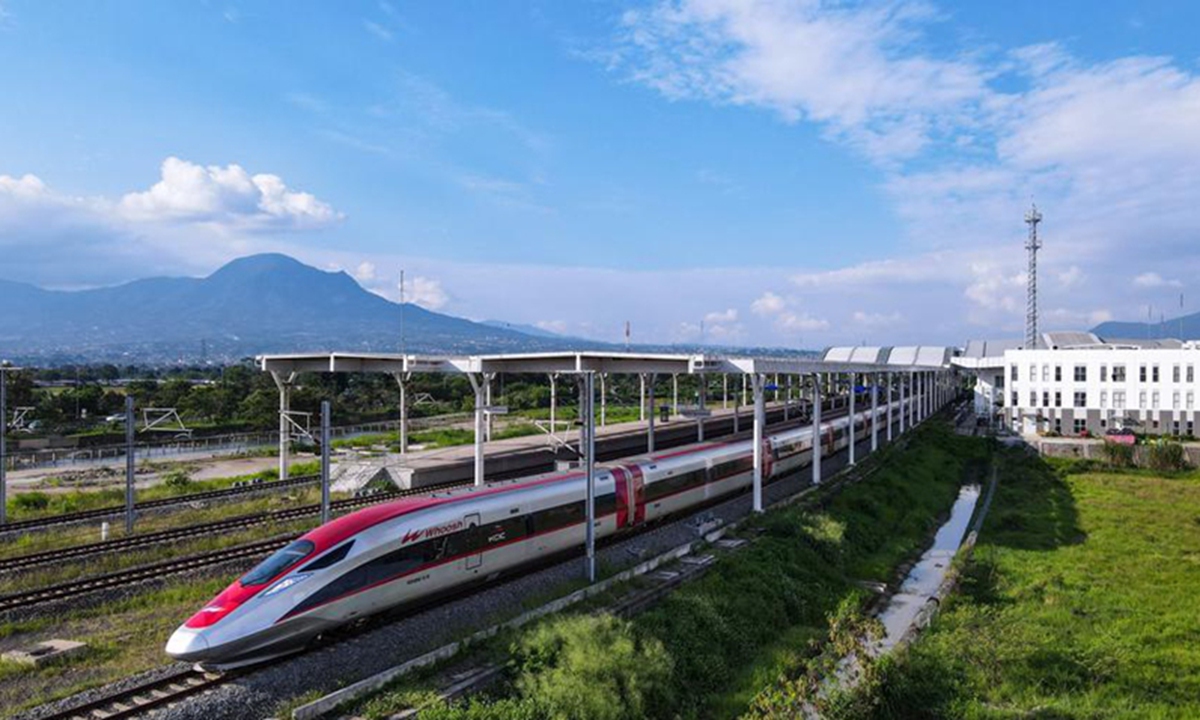
An aerial drone photo taken on May 20, 2025 shows a high-speed electrical multiple unit (EMU) train leaving Tegalluar Station of Jakarta-Bandung High-Speed Railway (HSR) in Bandung, Indonesia. Photo: Xinhua
At the invitation of Malaysian Prime Minister Anwar Ibrahim, whose country currently holds the rotating chair of ASEAN, Chinese Premier Li Qiang is attending the ASEAN-China-Gulf Cooperation Council (GCC) Summit in Kuala Lumpur, Malaysia, from Monday to Wednesday. Observers have noted that this is the first time this trilateral summit is being held. Like China, both ASEAN and the GCC member states are emerging economies in Asia and key members of the Global South. They are also important partners in Belt and Road cooperation. This trilateral summit, geographically spanning East Asia, Southeast Asia, and West Asia, signals a new trend in the development of the Global South and represents an advanced desire for regional integration.
ASEAN, China, and the GCC are three major economic entities with significant influence in Asia. China is the world's second-largest economy, while ASEAN has risen to become the fifth-largest global economy, following the US, China, the EU, and Japan. The GCC countries hold the world's largest reserves of oil and natural gas, boast a per capita GDP three times the global average, and collectively manage sovereign wealth funds that account for one-third of the total assets of the world's top 100 sovereign wealth funds. Together, the economies participating in this summit represent nearly a quarter of global GDP and a vast market of over 2.1 billion people. Judging by economic scale alone, the establishment of a tripartite cooperation mechanism among ASEAN, China, and the GCC is certain to unlock greater potential and inject added stability into the global economy.
The ASEAN-China-GCC Summit is a natural outcome rooted in profound historical and contemporary ties. The ancient Silk Road once connected the three regions through early trade and civilizational exchanges. Malaysia, Indonesia, and other ASEAN countries, along with the GCC members, are all Islamic countries that have maintained close economic and cultural ties for a long time. Over the past few decades, China has contributed positive momentum to regional cohesion through its amicable, secure and prosperous neighborhood policy, as well as the Belt and Road Initiative (BRI). Today, China is the GCC's largest trading partner while China and ASEAN are each other's largest trading partner. On May 20, negotiations for version 3.0 of the China-ASEAN Free Trade Area were officially concluded. Talks for a China-GCC free trade agreement, launched in 2004, have already seen 11 rounds. Decades of deepened cooperation have laid a solid foundation of mutual trust for this summit.
Today, the three parties have already established bilateral or multilateral cooperation mechanisms at various levels, and there is also a practical need to further deepen cooperation. With China possessing strong industrial manufacturing and technological innovation capabilities, ASEAN having abundant natural resources and a youthful demographic structure, and the GCC countries accelerating the diversification of their economic structures and foreign investments, there is a vast space for cooperation due to their strong economic complementarity. This trilateral summit is expected to advance strategic alignment and deeper connectivity between China's BRI, Master Plan on ASEAN Connectivity 2025, and the GCC's Vision 2030 - fostering a new pattern of building connections with other countries over land and sea while creating synergy between eastern and western regions. In this sense, the summit reflects not only the momentum of regional integration but also the increasingly diverse and in-depth cooperation among Asian countries.
In today's world, the shadow of unilateralism and protectionism looms large, and global supply and production chains frequently face the risk of "decoupling." Asian countries, as manufacturing and trade powerhouses, are particularly affected. China, ASEAN, and GCC countries increasingly recognize the importance of expanding diversified economic and trade cooperation and reducing reliance on a single market, which serves as an inherent driving force for further cooperation among the three parties. The holding of the trilateral summit has also sent a strong signal in support of free trade and open cooperation, adding certainty to stabilizing global supply and production chains and ensuring the healthy operation of regional and world economies.
This summit has built a strategic platform for Asian integration and will serve as a testing ground for cross-regional cooperation, providing an action plan for broader global economic collaboration. The three parties share a wide consensus on maintaining regional security and stability, advocating for the peaceful resolution of regional disputes and opposing hegemonism. From the perspective of South-South cooperation, the complementary, non-exclusive, and development-prioritized characteristics of the ASEAN-China-GCC cooperation model also have broad reference significance.
Amid the clamor of "de-risking" in the global economy and in an era where unilateral hegemony is showing signs of fatigue, the ASEAN-China-GCC Summit timely offers the world an Eastern wisdom and realistic choice of "non-zero-sum game." The summit sends a clear message to the world: The Global South is no longer a passive recipient of the international order, but an active builder and reformer. This emerging order is not founded on military deterrence, but on shared development; not sustained by bloc politics, but nurtured by mutual benefit and cooperation.
RELATED ARTICLES