SCI-TECH / AIR & SPACE
China's FAST and South Africa's MeerKAT team up to refresh the limits of Galactic observation
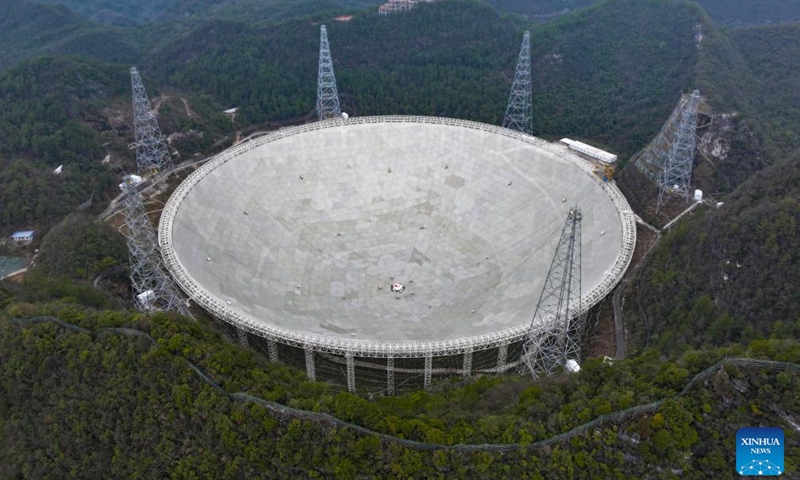
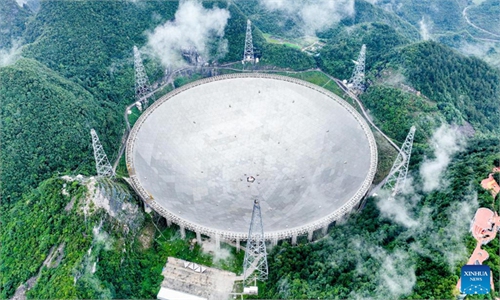
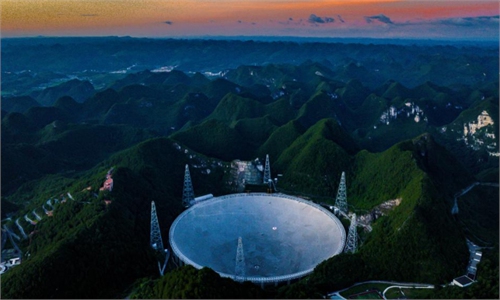
An aerial drone photo taken on Feb. 18, 2025 shows China's Five-hundred-meter Aperture Spherical Radio Telescope (FAST) under maintenance in southwest China's Guizhou Province. In recent years, Guizhou has leveraged its scientific research resources such as FAST to develop educational travel for science, a favorable choice across China for inquisitive minds seeking to embark on a journey of knowledge and exploration in science. (Photo: Xinhua)
Recently, an international team of astronomers from China's top Tsinghua University, along with collaborators from Italy, Australia, Germany, and other countries, conducted high-precision observations of Galactic globular clusters using China's Five-hundred-meter Aperture Spherical Radio Telescope (FAST) and South Africa's MeerKAT radio telescope array. Their work has produced the most comprehensive measurements to date of magnetic field gradients and upper limits of ionized gas in globular clusters, yielding a clearer map of the Milky Way's magnetic field and providing new insights into both cluster evolution and Galactic magnetism, as reported by CCTV on Sunday.
Globular clusters are among the oldest celestial objects in the Milky Way Galaxy, typically composed of millions of stars, including pulsating neutron stars. These highly magnetized pulsars emit precisely timed electromagnetic pulses that traverse vast interstellar distances to reach Earth, carrying valuable information about interstellar matter and magnetic fields.
With its 500-meter dish, FAST excels at detecting the faintest cosmic ripples—pulsar signals from millions of light-years away—while MeerKAT's 64-antenna array specializes in tracking signals across wider regions of the sky, capable of detecting even the slightest polarization changes caused by gas ionization. This marks the first in-depth collaboration between these two world-leading radio telescopes in globular cluster research, pushing observational limits to new frontiers.
The team obtained polarization rotation measurements from 43 pulsars across eight globular clusters, revealing that seven of these clusters showed no detectable ionized gas—unexpectedly "clean" environments. This finding contradicts theoretical models predicting abundant intracluster gas, suggesting the existence of efficient gas-clearing mechanisms within globular clusters, potentially driven by intense radiation winds from white dwarfs and young stars. Dr. Zhang Lei, the lead researcher for the data analysis, was quoted by CCTV as saying that "We expected globular clusters to be gas-rich, but found they've reached a dust-free state—this forces us to reconsider cluster evolution theories."
CCTV noted that FAST and MeerKAT will continue collaborating to monitor pulsar glitches, study interstellar turbulence, and even search for potential extraterrestrial signals.
Global Times
RELATED ARTICLES