OPINION / GLOBAL MINDS
Knowledge diplomacy essential for deepening China-LAC ties
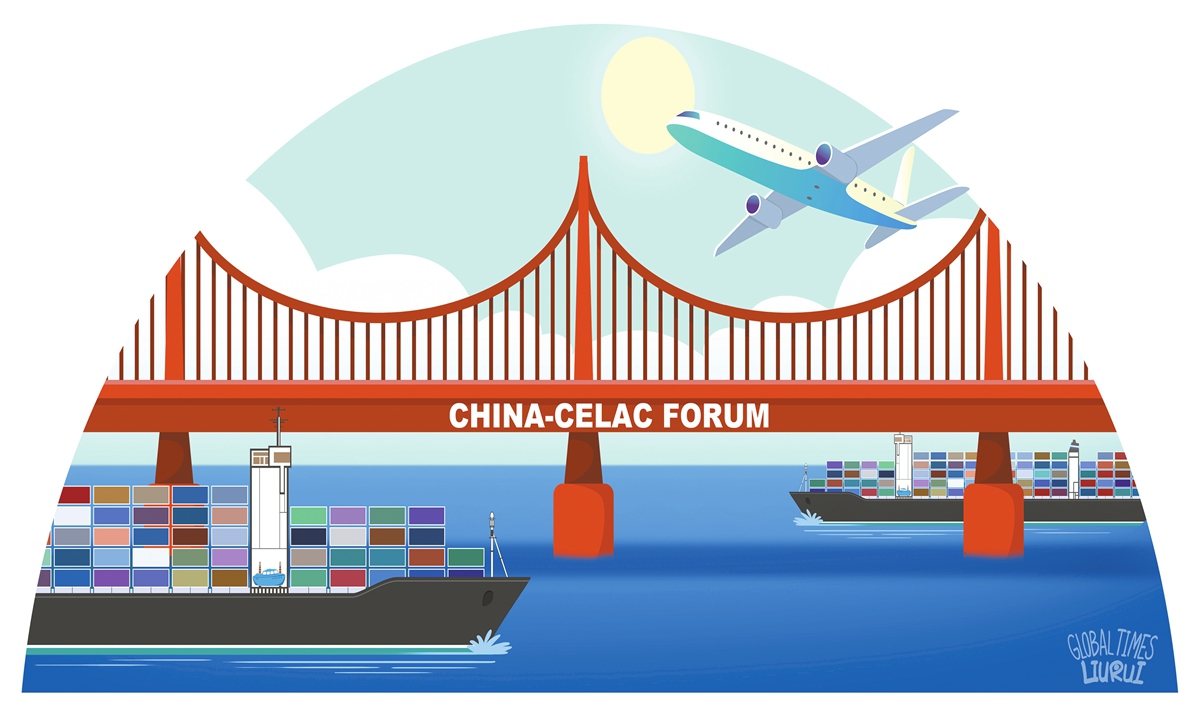
Illustration: Liu Rui/GT
The Fourth Ministerial Meeting of the China-CELAC Forum, held earlier this month, strengthened the commercial and diplomatic ties between China and the countries of Latin America and the Caribbean. It also highlighted the importance the Chinese government places on promoting knowledge about China in the Latin America and Caribbean region. Visa exemptions for five countries in the region (Argentina, Brazil, Chile, Peru and Uruguay), effective June 1, also serve as a clear sign of encouragement for people-to-people exchanges.From Latin America's perspective, if the region wishes to play a more active and creative role in its relations with China, it is essential to gain a deeper understanding of Chinese society. This understanding goes far beyond economic indicators or trade agreement analysis. It requires, above all, a structured comprehension of the political and institutional logic that guides the Chinese system, along with the domestic and foreign policies of the Chinese government and the historical and cultural values that shape Chinese social organization.
In the West, Chinese governance is often reduced to binary stereotypes: authoritarianism versus democracy, state control versus market freedom, communism versus capitalism. This shallow view, which insists on fitting a highly complex and ancient civilization into rigid conceptual frameworks, impoverishes the debate and undermines the quality of dialogue. Latin America and the Caribbean must reject this oversimplification.
For reasons rooted in Chinese history and political culture shaped over centuries, China's governance has its own logic, which includes, among other features, long-term planning with clear goals and metrics; a Party-based meritocracy that combines talent and virtue in official selection and promotion; coordinated institutional mobilization with vertical and horizontal oversight mechanisms; and, increasingly, broader public participation in evaluating and defining government initiatives. None of these variables is fully comprehended through traditional Western political analysis tools.
A common difficulty in many Latin American and Caribbean countries is understanding the rhythm and dynamics of Chinese society, which at times accelerates and at other times pauses. China has done its part. There is a series of structured actions in its foreign policy guided by the principle of knowledge diplomacy, rooted in a deep study of the partner before negotiation and cooperation. The creation of Latin American studies centers in China and cooperation with Latin American universities has enabled the development of high-level academic diplomacy aimed at fostering partnerships that benefit everyone involved.
What the China-CELAC Forum makes clear is that there is significant potential for South-South cooperation, but it requires greater informational symmetry. While the Chinese invest in studying Latin America, Latin American countries have not dedicated enough institutional effort to understanding contemporary China. Without robust training programs, investment in Sinology, and regional coordination for academic and institutional exchange, the region risks being a passive interlocutor.
This diplomatic effort to create Latin American studies and Chinese studies programs must be carried out by universities and think tanks in order to build technical and scientific bridges of dialogue. It also requires, above all, a re-education of perception: to stop seeing China through the filters of Washington's perspective, and to start seeing it as it truly is. Effective dialogue is not built merely on ideological affinities or commercial interests. It demands knowledge, institutional empathy and cultural sensitivity.
Knowing China is a prerequisite for relating to it in a mature and strategic way. The Fourth Ministerial Meeting of the China-CELAC Forum was a reminder that the 21st century will be largely defined by the quality of Asia-Latin America relations. This knowledge diplomacy will allow the peoples of China and Latin America and the Caribbean to build a community of shared future more effectively, avoiding diplomatic missteps and adapting their approaches to each people's distinctiveness.
The author is professor of international law at the Federal Fluminense University, Brazil. opinion@globaltimes.com.cn
RELATED ARTICLES