China's financing cooperation with developing nations follows international practice: FM
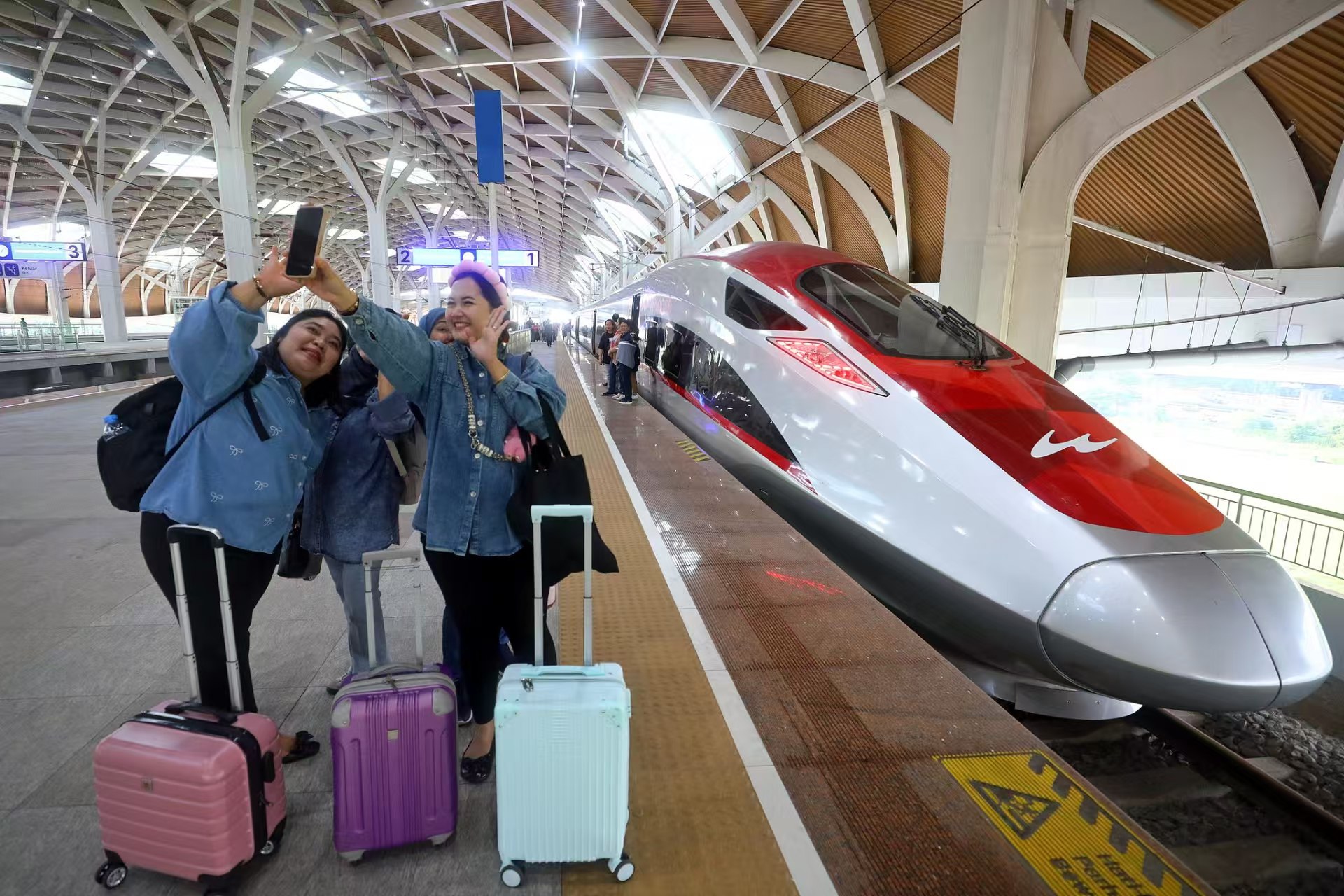
Passengers take photos with a high-speed train at Halim Station in Jakarta, Indonesia, on May 24, 2025. The Jakarta-Bandung High-Speed Railway, a flagship Belt and Road cooperation project jointly built by China and Indonesia, has been in full operation for 19 months. All stations along the line have been in service for nearly five months, with over 9 million passenger trips recorded to date. Photo: VCG
China's cooperation on investment and financing with developing countries follows international practice, market principles, and the principle of debt sustainability, a spokesperson for China's Foreign Ministry (FM) said on Tuesday, in responding to a report by the Australian think-tank Lowy Institute that claimed developing nations face enormous financial strain as debt payments to China reached record highs this year.At a regular press briefing, a reporter noted the report also raised that China could seek to use developing nations' debts as a "geopolitical leverage," and asked whether the FM wishes to comment on how China's shift from a major lender to a major debt collector might impact its relationship with developing nations.
In response, Mao Ning, the FM spokesperson, said that she does not know the basis of the report, but pointed out that a handful of countries are spreading the narrative that China is responsible for these countries' debt, while ignoring the fact that multilateral financial institutions and commercial creditors from developed countries are the main creditors of developing countries and the primary source of debt repayment pressure. "Lies cannot cover truth and people can tell right from wrong," Mao said.
The report, which was released on Monday, also asserted that developing countries are grappling with a surge in debt repayments and interest costs to China, as loans issued under the Belt and Road Initiative in the 2010s come due.
Chinese experts dismissed the report as biased and politically motivated, stressing that China's overseas financing follows the principles of equality and win-win cooperation with the aim of supporting these countries in building self-sustaining development capacity rather than creating dependency.
Yang Baorong, director of African Studies of the Institute of West-Asian and African Studies at the Chinese Academy of Social Sciences, told the Global Times on Tuesday that "China's financing focuses on infrastructure and capacity-building to enable self-reliance, not create dependency."
The Australian think-tank's report also claimed that "an increasingly isolationist US and a distracted Europe are withdrawing or significantly reducing their aid support."
Yang noted that China's lending differs from traditional Western aid models. "Our approach emphasizes long-term development, not short-term profit. It's about enabling self-reliance, not just filling short-term fiscal gaps."
He added that dollar-denominated debt poses a greater risk for developing countries, including many African nations, due to factors such as volatility in currency exchange rates.
Song Wei, a professor at the School of International Relations and Diplomacy at Beijing Foreign Studies University, told the Global Times on Tuesday that China seeks practical, development-oriented solutions, if certain projects face difficulty, instead of pressuring relevant countries as claimed by the report.
RELATED ARTICLES