China’s vast market offers numerous opportunities for German SMEs: senior official
Nation could help firms reduce costs, enhance overall competitiveness: expert
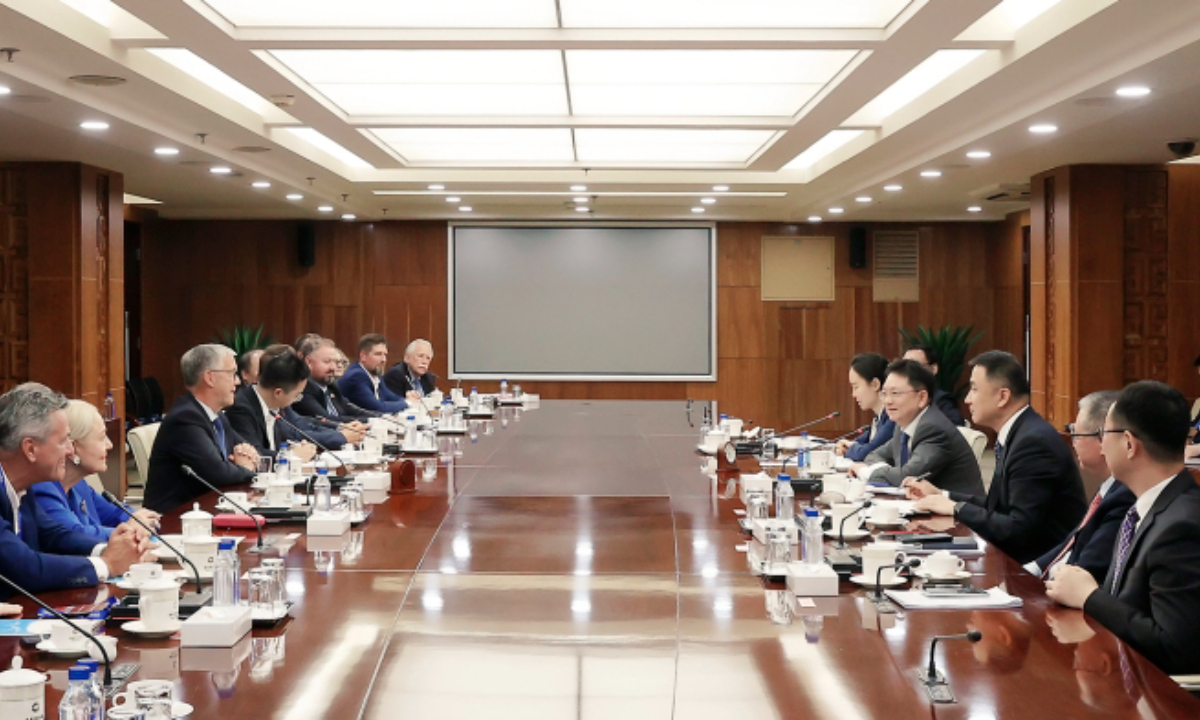
Ling Ji, vice minister of commerce and deputy China international trade representative meets a group of German small and medium-sized enterprises in Beijing on May 27, 2025. Photo: Screenshot from China's Ministry of Commerce
China's vast market, with its complete and highly effective industrial chain system, and vibrant tech innovation ecosystem, provides numerous opportunities for German small and medium-sized enterprises (SMEs) to grow their businesses, said Ling Ji, vice minister of commerce and deputy China international trade representative, according to the Ministry of Commerce (MOFCOM) on Wednesday.
Ling made the remarks during a meeting with a group of German SMEs in Beijing on Tuesday. "It is hoped that China and Germany will jointly maintain free trade and the stability of global industrial and supply chains, and continue mutually beneficial cooperation," Ling said, according to a MOFCOM statement.
Walter Döring, leader of the German SME delegation and chairman of the Senate of Economy Europe, said that the Chinese market is extremely attractive for German SMEs, vowing to actively help more German SMEs, especially "hidden champions," to enter the Chinese market, according to the statement.
Many German businesses have remained committed to the Chinese market. More than half of German enterprises surveyed plan to increase investment in China within the next two years, the Xinhua News Agency reported, citing a report issued during a three-day forum for Sino-German industrial cooperation and development that ended on Tuesday in Beijing.
The report also revealed that German and European "hidden champions," which refer to highly successful yet lesser-known SMEs that are global leaders in terms of market share in their respective niches, still have more than double the current growth potential in the Chinese market, according to Xinhua.
Jian Junbo, director of the Center for China-Europe Relations at Fudan University's Institute of International Studies, said that while these hidden champions possess strong comparative advantages in their respective niches, China offers a highly comprehensive and integrated supply chain that could be of great value for them.
"If these companies can effectively align themselves with the relevant upstream and downstream players in China, they will be able to significantly reduce costs and enhance their overall competitiveness," Jian told the Global Times on Wednesday.
German companies have long been among the most active sources of investment in the Chinese market. According to the MOFCOM, Germany's actual investment in China grew by 12.3 percent in the first four months of the year.
Since last year, many German enterprises have successively increased their investment in China. Among the examples, Volkswagen Group established its largest research and development center outside Germany in Hefei, East China's Anhui Province. BMW Group injected an additional 20 billion yuan ($2.78 billion) for the scale-up and technological innovation of its Shenyang plant in Northeast China's Liaoning Province. Bayer Group announced a 600-million-yuan investment to build a new supply center in East China's Jiangsu Province.
China's firm commitment to high-standard opening-up and the continuous improvement of its business environment are highly attractive to both multinational industry giants and SMEs, Jian noted, noting that amid rising protectionism globally, many European companies need new investment and market opportunities.
Amid an increasingly complex international environment, China and the EU have recently witnessed frequent exchanges between high-level officials and business leaders, with bilateral cooperation continuing to gain strong momentum.
Highlighting growing China-EU efforts to boost cooperation, Chinese Commerce Minister Wang Wentao will meet EU Commissioner for Trade and Economic Security Maros Sefcovic on the sidelines of a WTO ministerial meeting in Paris in early June, a source familiar with the matter told the Global Times on Monday.
China and the EU enjoy strong economic complementarity, each possessing unique strengths, mutual demand, and enormous potential and space for mutual benefit, creating a strong impetus to advance mutually beneficial and win-win cooperation, Jian said.
This year marks the 50th anniversary of the establishment of diplomatic relations between China and the EU. At a recent celebration event, the head of the Chinese Mission to the EU Cai Run said that "in today's world marked by great changes and turbulence, China-EU relations hold even greater strategic and global significance," adding that the stability of China-EU relations can inject more certainty and positive energy into an increasingly volatile world.
RELATED ARTICLES