China slams EU restrictions on Chinese medical device makers
Only through cooperation are issues better resolved: expert
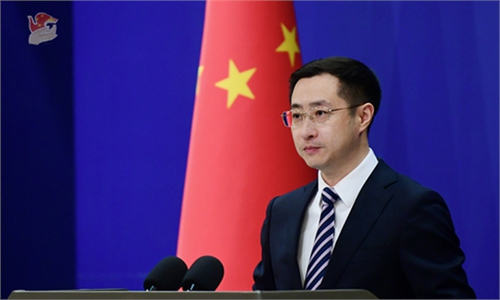
Chinese Foreign Ministry Spokesperson Lin Jian Photo: VCG
Two Chinese government departments and the main Chinese business group in the EU on Tuesday expressed firm opposition to the EU's reported approval of restrictive measures to exclude Chinese companies from selling medical devices in the EU, while urging the bloc to provide Chinese companies with a fair, transparent and non-discriminatory business environment.
At a regular press briefing of the Chinese Foreign Ministry on Tuesday, a reporter noted that the EU has voted to use something called the International Procurement Instrument (IPI), a piece of legislation, to exclude Chinese companies from selling medical devices in the EU, and asked the ministry's response.
In response, Lin Jian, a spokesperson for the ministry, said that the EU claims to be one of the most open markets in the world, but in reality has been inching towards protectionism, frequently resorting to unilateral trade tools, and competing unfairly in the name of fair competition. This is typical double standard.
"We hope the EU will observe its commitment to an open market and WTO rules, provide Chinese companies with a fair, transparent and non-discriminatory business environment, and work for sound and steady China-EU trade ties," Lin said, "China will firmly safeguard the legitimate and lawful rights and interests of Chinese companies."
Also asked to comment on the EU's reported move to bar Chinese medical device manufacturers from participating in EU public procurement tenders worth more than 5 million euros ($5.7 million) over the next five years, a spokesperson for the Chinese Ministry of Commerce (MOFCOM) said in on Tuesday that the relevant decision and discriminatory measure of the EU not only harm the interests of Chinese companies, but also use unilateral tools to undermine fair competition and build new trade barriers.
"China firmly opposes this protectionist practice," the MOFCOM spokesperson said in a statement, urging the EU to correct its wrong practices. "China will closely follow the EU's follow-up actions and will take measures to firmly safeguard the legitimate rights and interests of Chinese companies," the spokesperson stated.
Earlier on Tuesday, the China Chamber of Commerce to the EU (CCCEU) also expressed profound disappointment over the EU's decision and serious concerns about the EU's move to limit Chinese enterprises' participation in the EU procurement market, particularly in the healthcare sector, according to a statement sent to the Global Times.
The IPI is a unilateral instrument introduced by the EU, and its targeted application against Chinese enterprises sends a troubling signal - not only adding new complexity to China-EU economic and trade relations, but also contradicting the EU's stated principles of openness, fairness and non-discrimination in market access, the CCCEU statement said.
EU countries on Monday voted on the measures, which was the first action taken by the EU based on the IPI, a 2022 law that is meant to promote reciprocity in access to public procurement markets, Bloomberg reported.
However, instead of promoting reciprocity, the EU's move targeting Chinese enterprises clearly violates the non-discrimination principle, Zhou Mi, a senior research fellow at the Chinese Academy of International Trade and Economic Cooperation, told the Global Times on Tuesday.
China has been actively promoting cooperation in government procurement, including participation in WTO Government Procurement Agreement negotiations, where China and the EU are key stakeholders, Zhou said, adding that only through cooperation can both sides better resolve issues while respecting fundamental market principles.
The MOFCOM spokesperson also said on Tuesday that as the global economic order is suffering from the severe impact of unilateralism and protectionism, China and the EU, as responsible major economies, should abide by the rules of the WTO, adhere to the principles of fairness, transparency and non-discrimination, respond to challenges with mutual openness, properly handle differences through cooperation and dialogue, and jointly maintain the healthy development of China-EU economic and trade relations.
RELATED ARTICLES